Fundamentals of Current Electricity
From the CAPE physics kirchoff's law potential difference electromagnetism curriculum
TL;DR
Current electricity involves the flow of charge, driven by potential difference, through materials that offer varying resistance. Ohm's Law describes the relationship between voltage, current, and resistance, while Kirchhoff's Laws help analyze more complex circuits. Understanding these foundational concepts is crucial for solving most circuit problems.
1. The Mental Model
Think of electricity like water flowing through pipes. The potential difference (voltage) is like the water pressure pushing the water, the current is the amount of water flowing past a point per second, and resistance is anything that narrows the pipe or slows the flow.
2. The Core Material
Current electricity is all about how electric charge moves. When charges (usually electrons) flow in a specific direction, that's an electric current.
Electric Current (I)

Photo by Martinus on Pexels
Current is defined as the rate of flow of charge.
$I = \frac{\Delta Q}{\Delta t}$
Where:
* $I$ is current, measured in Amperes (A).
* $\Delta Q$ is the change in charge, measured in Coulombs (C).
* $\Delta t$ is the change in time, measured in seconds (s).
One Ampere means one Coulomb of charge passes a point in one second.
Potential Difference (V)

Photo by vergara_ on Pexels
Potential difference, often called voltage, is the work done per unit charge to move that charge between two points in a circuit. It's the "push" that makes current flow.
$V = \frac{W}{Q}$
Where:
* $V$ is potential difference, measured in Volts (V).
* $W$ is the work done (energy transferred), measured in Joules (J).
* $Q$ is the charge, measured in Coulombs (C).
One Volt means one Joule of energy is used to move one Coulomb of charge.
Resistance (R)
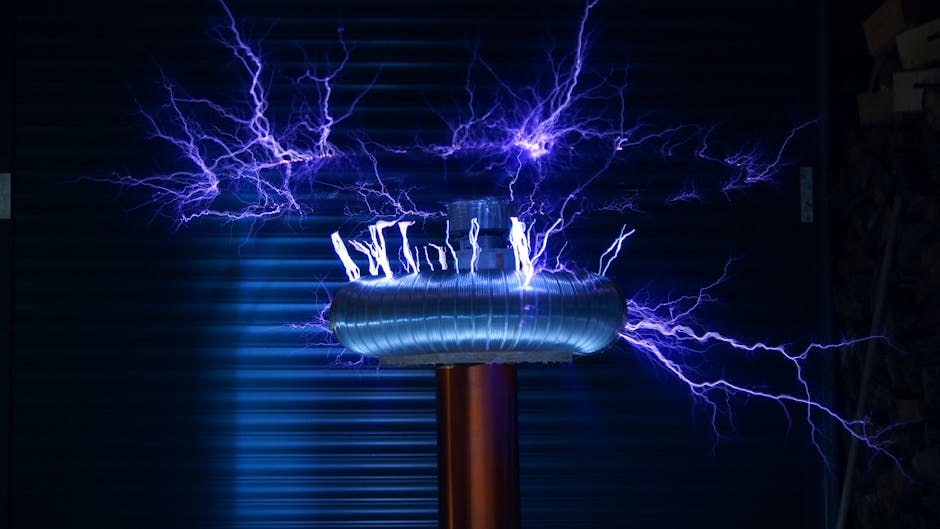
Photo by Killian Eon on Pexels
Resistance is a material's opposition to the flow of electric current. It's like friction for electrons.
$R = \rho \frac{L}{A}$
Where:
* $R$ is resistance, measured in Ohms ($\Omega$).
* $\rho$ (rho) is the resistivity of the material (a constant), measured in Ohm-metres ($\Omega \cdot m$).
* $L$ is the length of the conductor, measured in metres (m).
* $A$ is the cross-sectional area of the conductor, measured in square metres ($m^2$).
Longer and thinner wires have higher resistance. Different materials have different resistivities.
Ohm's Law
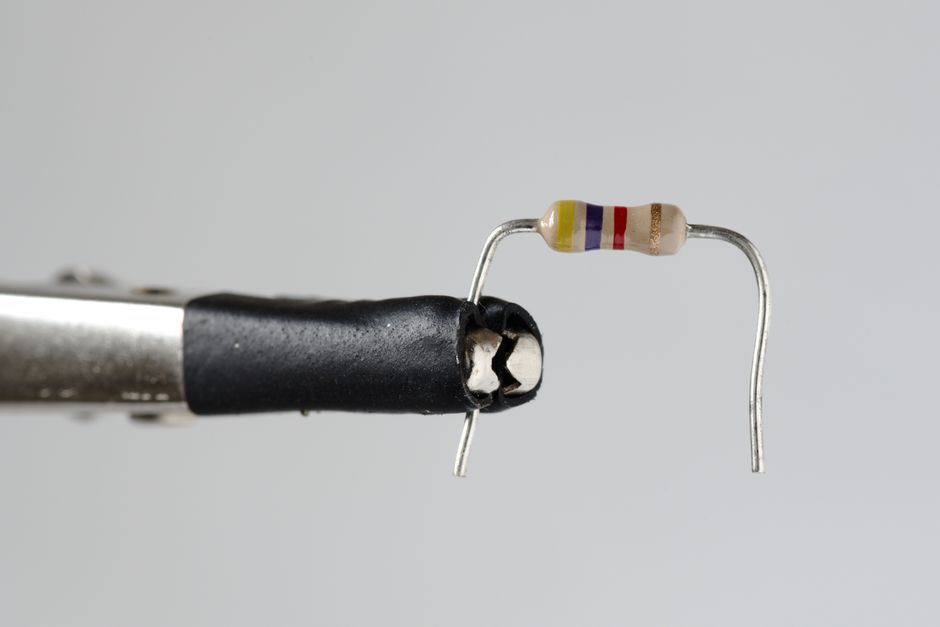
Photo by Zacharias Korsalka on Pexels
This fundamental law connects voltage, current, and resistance:
$V = IR$
You can rearrange this to find any of the three:
* $I = \frac{V}{R}$
* $R = \frac{V}{I}$
Electrical Power (P)
Power is the rate at which electrical energy is converted into other forms of energy (like heat or light).
$P = VI$
Using Ohm's Law, you can also express power as:
* $P = I^2 R$
* $P = \frac{V^2}{R}$
Power is measured in Watts (W).
Kirchhoff's Laws
These two laws are crucial for analyzing more complex circuits.
Kirchhoff's Current Law (KCL) / Junction Rule
The sum of currents entering a junction must equal the sum of currents leaving that junction. This is based on the conservation of charge – charge can't accumulate or disappear at a point.
Kirchhoff's Voltage Law (KVL) / Loop Rule
The sum of potential differences (voltages) around any closed loop in a circuit must be zero. This is based on the conservation of energy – any energy supplied by a source in a loop must be dissipated by the components in that same loop.
Here's a visual way to think about how these concepts relate:
graph TD
    A["Potential Difference (V)"] --> B["Drives Current (I)"]
    B --> C["Flows through Resistor (R)"]
    C --> D["Causes Voltage Drop (V = IR)"]
    D --> E["Dissipates Power (P = IV)"]
    A --"Energy Conservation (KVL)"--> D
    B --"Charge Conservation (KCL)"--> F["Junction (Current split/merge)"]
    F --"Current In = Current Out"--> B
3. Worked Example
Let's say you have a simple circuit with a 12V battery and three resistors: $R_1 = 2 \Omega$, $R_2 = 4 \Omega$, and $R_3 = 6 \Omega$. $R_1$ and $R_2$ are in series, and this combination is in parallel with $R_3$. Find the total current drawn from the battery.
Step 1: Calculate the equivalent resistance of $R_1$ and $R_2$ (series).
$R_{12} = R_1 + R_2 = 2 \Omega + 4 \Omega = 6 \Omega$
Step 2: Calculate the equivalent resistance of $R_{12}$ and $R_3$ (parallel).
$\frac{1}{R_{total}} = \frac{1}{R_{12}} + \frac{1}{R_3} = \frac{1}{6 \Omega} + \frac{1}{6 \Omega} = \frac{2}{6 \Omega} = \frac{1}{3 \Omega}$
$R_{total} = 3 \Omega$
Step 3: Use Ohm's Law to find the total current.
$I_{total} = \frac{V_{battery}}{R_{total}} = \frac{12 V}{3 \Omega} = 4 A$
So, the total current drawn from the battery is 4 Amperes.
4. Key Takeaways
- Current is the flow rate of charge, measured in Amperes.
- Potential difference (voltage) is the energy per unit charge, driving the current, measured in Volts.
- Resistance is the opposition to current flow, measured in Ohms.
- Ohm's Law ($V=IR$) defines the relationship between voltage, current, and resistance in a circuit.
- Electrical power ($P=VI$) is the rate at which energy is converted.
- Kirchhoff's Current Law states that total current entering a junction equals total current leaving it.
- Kirchhoff's Voltage Law states that the sum of voltages around any closed loop is zero.
Common Mistakes to Avoid:
- Confusing voltage with current; voltage pushes, current flows.
- Forgetting to convert units (e.g., mA to A) before calculations.
- Incorrectly combining resistors in series (add) versus parallel (reciprocal sum).
- Applying Ohm's Law to the wrong parts of a complex circuit; ensure V and I are for the specific R you're considering.
5. Now Try It
You have a circuit with a 9V battery. A $3 \Omega$ resistor and a $6 \Omega$ resistor are connected in series across the battery.
1. Calculate the total resistance of the circuit.
2. Calculate the total current flowing from the battery.
3. Calculate the potential difference (voltage drop) across each resistor.
4. Verify that the sum of the voltage drops across the resistors equals the battery voltage (Kirchhoff's Voltage Law).
You'll know you've succeeded if your total resistance is $9 \Omega$, your total current is $1 A$, and the voltage drops across the resistors add up to $9 V$.
Frequently asked about Fundamentals of Current Electricity
Study this next
Get the full CAPE physics kirchoff's law potential difference electromagnetism curriculum
Clone the complete plan to your dashboard for unlimited AI-generated notes, practice quizzes, and a personalised revision schedule.
Save this course free