Fundamental Cell Biology for Biotechnology
From the Science curriculum
TL;DR
Cells are the basic units of life, acting like tiny factories with specialized compartments for different jobs. Understanding their structures and how they work is crucial for biotechnology, as it allows us to manipulate them for various applications. Key cellular processes like DNA replication, protein synthesis, and energy production are foundational to biotechnological advances.
1. The Mental Model
Think of a cell as a self-contained, miniature city. Each "building" or "department" within the city has a specific role, working together to keep the city running, growing, and responding to its environment. Biotechnology often involves redesigning or repurposing these cellular cities.
2. The Core Material
Biotechnology heavily relies on understanding and manipulating cells. We're generally interested in two main types of cells: prokaryotic and eukaryotic.
Prokaryotic vs. Eukaryotic Cells

Photo by turek on Pexels
The biggest distinction is the presence of a nucleus and membrane-bound organelles.
-
Prokaryotic Cells (e.g., bacteria, archaea): These are simpler, smaller cells. They don't have a true nucleus, so their genetic material (DNA) floats freely in the cytoplasm. They also lack complex membrane-bound organelles. Think of them as studio apartments – everything's in one main room.
- Key features: Cell wall, cell membrane, cytoplasm, ribosomes, nucleoid (region with DNA), plasmids (small circular DNA).
- Biotech relevance: Widely used for producing proteins (like insulin), biofuels, and in gene editing (CRISPR originated from bacteria).
-
Eukaryotic Cells (e.g., animal, plant, fungi, protists): These are larger, more complex cells. They have a true nucleus that houses their DNA, and many specialized compartments called organelles, each enclosed by its own membrane. Think of them as houses with multiple rooms.
- Key features: Cell membrane, cytoplasm, nucleus, mitochondria, endoplasmic reticulum (ER), Golgi apparatus, lysosomes, peroxisomes. Plant cells also have cell walls, chloroplasts, and large central vacuoles.
- Biotech relevance: Used in tissue engineering, vaccine production, therapeutic protein production, and understanding disease mechanisms.
Key Cellular Organelles and Their Functions (Eukaryotic Focus)
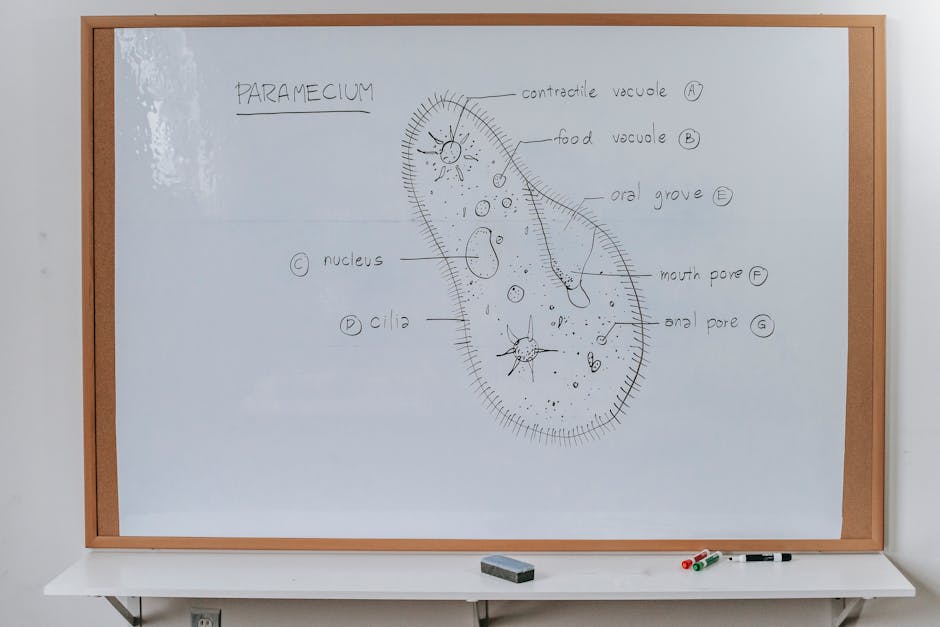
Photo by Katerina Holmes on Pexels
- Nucleus: The "control center." Contains the cell's genetic material (DNA) organized into chromosomes. It regulates gene expression and cell division.
- Mitochondria: The "powerhouses." Generate most of the cell's supply of adenosine triphosphate (ATP), used as a source of chemical energy. This process is called cellular respiration.
- Endoplasmic Reticulum (ER): A network of membranes involved in protein and lipid synthesis.
- Rough ER (RER): Studded with ribosomes; involved in synthesizing proteins destined for secretion or insertion into membranes.
- Smooth ER (SER): Involved in lipid synthesis, detoxification, and calcium storage.
- Ribosomes: The "protein factories." Found freely in the cytoplasm or attached to the RER. They translate messenger RNA (mRNA) into proteins.
- Golgi Apparatus: The "post office." Modifies, sorts, and packages proteins and lipids made in the ER for secretion or delivery to other organelles.
- Lysosomes: The "recycling centers" (animal cells). Contain digestive enzymes to break down waste materials and cellular debris.
- Cell Membrane: The "gatekeeper." A selective barrier that controls what goes in and out of the cell. Made primarily of a lipid bilayer with embedded proteins.
Here's a simplified view of how proteins are made and processed in a eukaryotic cell:
graph TD
    A["Nucleus (DNA)"] --> B["Transcription (mRNA)"];
    B --> C["Ribosome (on RER)"];
    C --> D["Protein Synthesis"];
    D --> E["Protein Enters RER"];
    E --> F["Protein Folding/Modification"];
    F --> G["Transport Vesicle to Golgi"];
    G --> H["Golgi Apparatus"];
    H --> I["Further Modification/Sorting"];
    I --> J["Transport Vesicle"];
    J --> K{"Destination (e.g., Secretion,\nLysosome, Cell Membrane)"};
Central Dogma of Molecular Biology

Photo by Nicola Narracci on Pexels
This fundamental concept explains how genetic information flows:
DNA → RNA → Protein
- Replication: DNA makes copies of itself (crucial for cell division).
- Transcription: DNA's genetic code is copied into messenger RNA (mRNA).
- Translation: mRNA is read by ribosomes to synthesize proteins.
Understanding and manipulating these steps (e.g., through gene editing, protein expression systems) is at the heart of biotechnology.
3. Worked Example
Let's consider how we might use a prokaryotic cell (like E. coli bacteria) to produce human insulin for diabetic patients.
- Identify the gene: We first need the human gene that codes for insulin. This DNA sequence contains the instructions to make the insulin protein.
- Insert into a plasmid: We isolate a small, circular piece of DNA called a plasmid from E. coli. Using enzymes, we cut open the plasmid and insert the human insulin gene into it. This modified plasmid is now called a recombinant plasmid.
- Transform bacteria: We introduce this recombinant plasmid into E. coli cells. The bacteria take up the plasmid.
- Bacterial growth and protein expression: We grow these transformed E. coli in large bioreactors. Since bacteria are efficient at transcription and translation, they start reading the human insulin gene on the plasmid and produce human insulin protein.
- Harvest and purify: The bacteria are then harvested, lysed (broken open), and the human insulin protein is purified from the bacterial components. This pure insulin can then be used as medication.
This process leverages the bacteria's cellular machinery (ribosomes, enzymes, energy production) to create a valuable human protein.
4. Key Takeaways
- Cells are the fundamental units of life, broadly categorized into simpler prokaryotic and more complex eukaryotic types.
- Prokaryotes lack a nucleus and membrane-bound organelles, while eukaryotes possess them.
- Each organelle in a eukaryotic cell has a specialized role, from energy production (mitochondria) to protein synthesis (ribosomes, ER) and packaging (Golgi).
- The Central Dogma (DNA → RNA → Protein) describes the flow of genetic information, a core principle manipulated in biotechnology.
- Biotechnology frequently utilizes cellular mechanisms, like bacterial protein synthesis, to produce useful compounds such as medicines.
- Understanding cellular structure helps predict how cells will respond to modifications and engineering.
Common Mistakes to Avoid:
- Confusing the functions of the ER and Golgi apparatus; remember ER makes and Golgi modifies/packages.
- Forgetting that ribosomes are present in both prokaryotic and eukaryotic cells, though they differ slightly.
- Assuming all proteins made in the cell immediately leave; many have functions inside the cell.
- Underestimating the importance of the cell membrane's role in controlling cellular environment and signaling.
5. Now Try It
Imagine you want to engineer a plant to produce a specific antibiotic. Based on what you've learned, write a short paragraph (3-5 sentences) describing which plant cell organelles would be most relevant to this task and why. What challenges might you face considering the plant cell's unique structures?
Success looks like: You've identified at least 2-3 key organelles (beyond just the nucleus) and briefly explained their role in producing and potentially storing or secreting the antibiotic, along with one challenge specific to plant cells.
Frequently asked about Fundamental Cell Biology for Biotechnology
More from Science
Get the full Science curriculum
Clone the complete plan to your dashboard for unlimited AI-generated notes, practice quizzes, and a personalised revision schedule.
Save this course free