DNA: Structure and Genetic Information
From the Science curriculum
TL;DR
DNA is a double helix molecule made of repeating units called nucleotides, each containing a sugar, a phosphate, and a nitrogenous base. The sequence of these bases (A, T, C, G) forms the genetic code, carrying all the instructions for building and operating an organism. This genetic information is copied during replication and used to make proteins through transcription and translation.
1. The Mental Model
Think of DNA as a vast instruction manual for a living organism, stored in a tiny, twisted ladder. Each rung of the ladder is a specific instruction, and the order of these instructions dictates how the organism is built and what it does.
2. The Core Material
DNA, or deoxyribonucleic acid, is the blueprint of life. It's a complex molecule that carries all the genetic instructions used in the growth, development, functioning, and reproduction of all known living organisms and many viruses.
DNA's Building Blocks: Nucleotides

Photo by Nicola Narracci on Pexels
DNA is a polymer, meaning it's made of many repeating units called monomers. In DNA's case, these monomers are nucleotides. Each nucleotide has three parts:
1. Deoxyribose sugar: A five-carbon sugar.
2. Phosphate group: A molecule containing phosphorus and oxygen.
3. Nitrogenous base: There are four types:
* Adenine (A)
* Thymine (T)
* Guanine (G)
* Cytosine (C)
The Double Helix Structure
Photo by Nicola Narracci on Pexels
Nucleotides link together to form a single strand of DNA, with the sugar and phosphate groups forming the sugar-phosphate backbone. Two of these strands then twist around each other to form the famous double helix shape, like a twisted ladder.
The "rungs" of this ladder are formed by the nitrogenous bases pairing up in a very specific way:
* Adenine (A) always pairs with Thymine (T) via two hydrogen bonds.
* Guanine (G) always pairs with Cytosine (C) via three hydrogen bonds.
This is known as Chargaff's Rule or complementary base pairing. The strands run in opposite directions, which we call antiparallel.
graph TD
    A["Nucleotide 1"] --> B["Sugar-Phosphate Backbone"]
    C["Nucleotide 2"] --> B
    B --> D["Single DNA Strand"]
    E["Complementary Single DNA Strand"] --> F["Hydrogen Bonds (A-T, C-G)"]
    D --> F
    F --> G["Double Helix Structure"]
    H["Genetic Information"] --> G
    I["Bases (A, T, C, G) Sequence"] --> H
Genetic Information Storage
Photo by Nicola Narracci on Pexels
The actual genetic information isn't in the sugar or phosphate; it's encoded in the sequence of the nitrogenous bases along one of the DNA strands. This sequence acts like a code, where every three bases (a codon) typically specifies a particular amino acid, which are the building blocks of proteins. The entire sequence of bases for a complete organism is its genome.
DNA's Role in Heredity
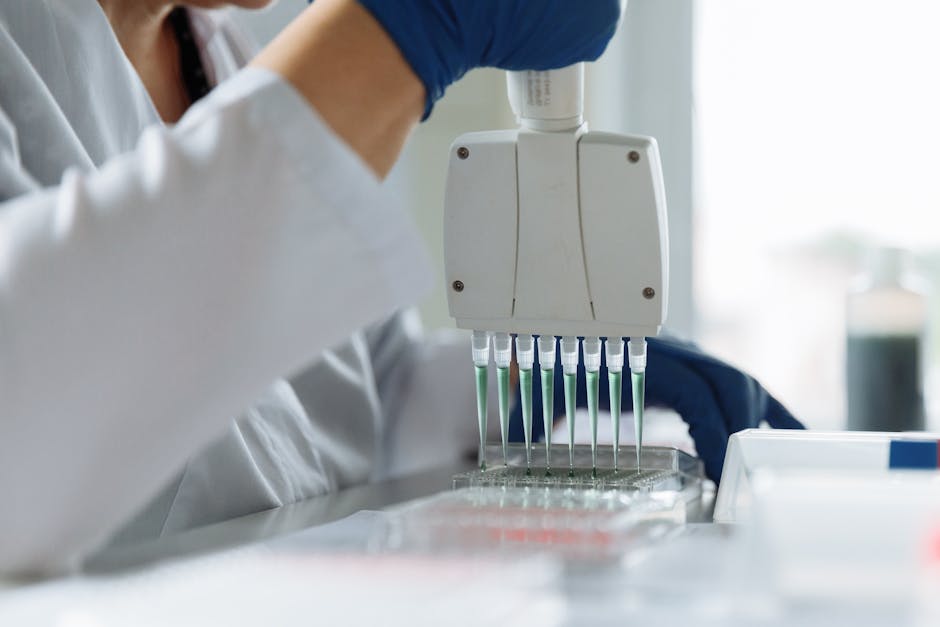
Photo by Thirdman on Pexels
DNA's structure is perfectly suited for its job:
* Stability: The double helix is very stable, protecting the genetic information.
* Replication: The complementary base pairing allows DNA to be copied accurately. When the strands separate, each original strand can serve as a template to build a new, complementary strand, ensuring that genetic information is passed on faithfully from parent cell to daughter cell during cell division, and from parent to offspring.
* Expression: The base sequence can be "read" to create proteins, which carry out most of the functions in a cell. This process involves transcription (DNA to RNA) and translation (RNA to protein).
3. Worked Example
Let's say you have a single strand of DNA with the sequence:
5'- A T G C G T A C G -3'
What would be the sequence of its complementary strand?
- Remember the base pairing rules: A pairs with T, and C pairs with G.
- Also remember that the strands are antiparallel, so if one strand runs 5' to 3', its complementary strand will run 3' to 5'.
Original strand: 5'- A T G C G T A C G -3'
Complementary strand (matching base by base):
A pairs with T
T pairs with A
G pairs with C
C pairs with G
G pairs with C
T pairs with A
A pairs with T
C pairs with G
G pairs with C
So, the complementary strand would be: 3'- T A C G C A T G C -5'
4. Key Takeaways
- DNA is a double helix formed by two antiparallel strands of nucleotides.
- Each nucleotide consists of a deoxyribose sugar, a phosphate group, and one of four nitrogenous bases (A, T, C, G).
- Adenine (A) always pairs with Thymine (T), and Guanine (G) always pairs with Cytosine (C).
- The sequence of these bases carries the genetic instructions for an organism.
- DNA's structure allows for accurate copying (replication) and faithful transmission of genetic information.
- Genetic information flows from DNA to RNA to protein (central dogma).
Common mistakes to avoid:
- Confusing the components of a nucleotide (sugar, phosphate, base).
- Forgetting the specific base pairing rules (A-T, C-G).
- Not understanding that the sequence of bases is what carries the genetic code, not just their presence.
- Thinking DNA is a single strand rather than a double helix.
5. Now Try It
Imagine you have a segment of one DNA strand with the sequence 5'- G G A T C C A G -3'. Write out the sequence of its complementary strand, including the 3' and 5' ends. You should end up with a sequence of 8 bases running in the opposite direction.
Frequently asked about DNA: Structure and Genetic Information
More from Science
Get the full Science curriculum
Clone the complete plan to your dashboard for unlimited AI-generated notes, practice quizzes, and a personalised revision schedule.
Save this course free