RNA: Types and Role in Gene Expression
From the Science curriculum
TL;DR
RNA is a vital nucleic acid that plays several key roles in expressing genetic information. It acts as an intermediate messenger, helps build proteins, and regulates gene activity. Different types of RNA specialize in these diverse functions, working together to turn DNA instructions into functional molecules.
1. The Mental Model
Think of DNA as the master blueprint in a library (the nucleus). RNA molecules are like specialized photocopies or workers who read parts of that blueprint and carry out specific tasks in the factory (the ribosome) to build things (proteins).
2. The Core Material
RNA (Ribonucleic Acid) is a single-stranded nucleic acid, similar to DNA but with a few key differences: it contains ribose sugar instead of deoxyribose, and it has uracil (U) instead of thymine (T). Its primary function is to enable the synthesis of proteins based on the genetic code stored in DNA, a process called gene expression.
Gene expression involves two main steps:
1. Transcription: DNA's genetic information is copied into an RNA molecule.
2. Translation: The RNA molecule's information is used to synthesize a protein.
Types of RNA
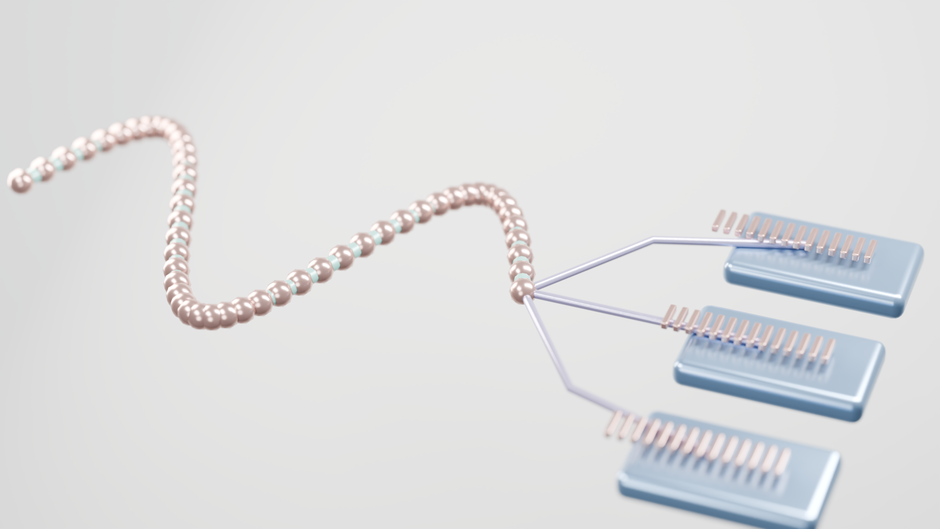
Photo by Santhosh Kanthala on Pexels
There are several types of RNA, each with a specific role:
- Messenger RNA (mRNA): This is the intermediary molecule that carries genetic information from DNA in the nucleus to the ribosomes in the cytoplasm. It's essentially a copy of a gene that codes for a specific protein. mRNA sequences are read in three-nucleotide units called codons, each specifying a particular amino acid.
- Ribosomal RNA (rRNA): A major component of ribosomes, the cellular machinery responsible for protein synthesis. rRNA molecules help catalyze the formation of peptide bonds between amino acids during translation.
- Transfer RNA (tRNA): Small RNA molecules that act as adaptors during translation. Each tRNA carries a specific amino acid and recognizes a corresponding codon on the mRNA through an anticodon sequence. This ensures the correct amino acid is added to the growing protein chain.
- Small Nuclear RNA (snRNA): Involved in the processing of pre-mRNA (splicing) in eukaryotes, removing non-coding regions (introns) and joining coding regions (exons).
- MicroRNA (miRNA) and Small Interfering RNA (siRNA): These are small, non-coding RNAs involved in gene regulation, often by silencing gene expression (preventing mRNA from being translated or even degrading it).
Role in Gene Expression
Photo by Google DeepMind on Pexels
The journey from DNA to protein is a coordinated effort involving these RNA types:
graph TD
    A["DNA (Gene)"] -->|Transcription| B["Pre-mRNA (in nucleus)"];
    B -->|Splicing (snRNA involved)| C["Mature mRNA (moves to cytoplasm)"];
    C -->|Binds to ribosome (rRNA)| D["mRNA on Ribosome"];
    D -->|Translation (tRNA brings amino acids)| E["Polypeptide Chain (Protein)"];
    E -->|Folds into functional protein| F["Functional Protein"];
Transcription in Detail

Photo by Breakingpic on Pexels
During transcription, the enzyme RNA polymerase binds to a gene's promoter region on the DNA. It unwinds the DNA double helix and synthesizes an mRNA molecule using one DNA strand as a template. The base pairing rule is A with U (instead of T) and G with C.
Translation in Detail

Photo by freestocks.org on Pexels
Once mature mRNA reaches the ribosome, translation begins. The ribosome moves along the mRNA, reading codons. Each tRNA molecule, with its specific anticodon, recognizes a codon and delivers the corresponding amino acid. The ribosome then forms a peptide bond between the amino acids, extending the protein chain until a stop codon is reached.
3. Worked Example
Let's trace a short sequence: If a segment of DNA has the sequence 3'-TAC GGC CTA TTA-5', here's how it would lead to a protein:
-
Transcription to mRNA: The RNA polymerase would synthesize an mRNA strand complementary to the DNA template.
DNA template:3'-TAC GGC CTA TTA-5'
mRNA sequence:5'-AUG CCG GAU AAU-3' -
Translation to Amino Acids: Now, we'd look at the mRNA codons and use a genetic code table (which you'd typically be provided with) to find the corresponding amino acids.
AUGcodes for Methionine (Met)
CCGcodes for Proline (Pro)
GAUcodes for Aspartic Acid (Asp)
AAUcodes for Asparagine (Asn)So, the resulting short protein segment would be: Met-Pro-Asp-Asn.
4. Key Takeaways
- RNA is a single-stranded nucleic acid crucial for protein synthesis, differing from DNA by having ribose sugar and uracil.
- mRNA carries genetic instructions from DNA to ribosomes for protein synthesis.
- rRNA forms the structural and catalytic core of ribosomes, facilitating protein assembly.
- tRNA molecules transport specific amino acids to the ribosome, matching them to mRNA codons.
- Gene expression proceeds from transcription (DNA to RNA) to translation (RNA to protein).
- Other RNA types, like snRNA, miRNA, and siRNA, play roles in RNA processing and gene regulation.
Common mistakes to avoid:
- Confusing uracil (U) in RNA with thymine (T) in DNA.
- Thinking that all RNA directly codes for proteins; only mRNA does.
- Forgetting that transcription occurs in the nucleus (for eukaryotes) and translation in the cytoplasm.
- Mixing up the roles of mRNA (messenger), tRNA (transfer), and rRNA (ribosomal).
5. Now Try It
Imagine a DNA template strand with the sequence 3'-ATA GCA CTG-5'. First, write out the complementary mRNA sequence. Then, using a standard genetic code chart (you can easily find one online if needed), determine the sequence of amino acids that would be produced from this mRNA.
Frequently asked about RNA: Types and Role in Gene Expression
More from Science
Get the full Science curriculum
Clone the complete plan to your dashboard for unlimited AI-generated notes, practice quizzes, and a personalised revision schedule.
Save this course free