Introduction to the Cell Cycle and Cell Structure
From the biology cell cycle curriculum
Introduction to the Cell Cycle and Cell Structure
TL;DR
The cell cycle is how cells grow and divide, making new cells, and involves distinct phases for preparation and division. Understanding basic cell structure is key because organelles perform specific jobs essential for the cell cycle's progression. Prokaryotic cells are simpler with no nucleus, while eukaryotic cells are complex with many specialized compartments.
1. The Mental Model
Think of a cell's life like a carefully planned construction project. It starts small, grows, gathers materials, duplicates blueprints, then splits into two identical new projects. This entire process is tightly controlled, ensuring everything is ready before the next step.
2. The Core Material
You're probably aware that all living things are made of cells. But how do these cells come to be, and what are they made of? Let's break it down.
First, let's talk about cell structure. There are two main types of cells:
2.1 Prokaryotic Cells

Photo by turek on Pexels
These are the simpler, older cells, like bacteria. They don't have a nucleus or other membrane-bound organelles. Their genetic material (DNA) just floats around in the cytoplasm.
2.2 Eukaryotic Cells
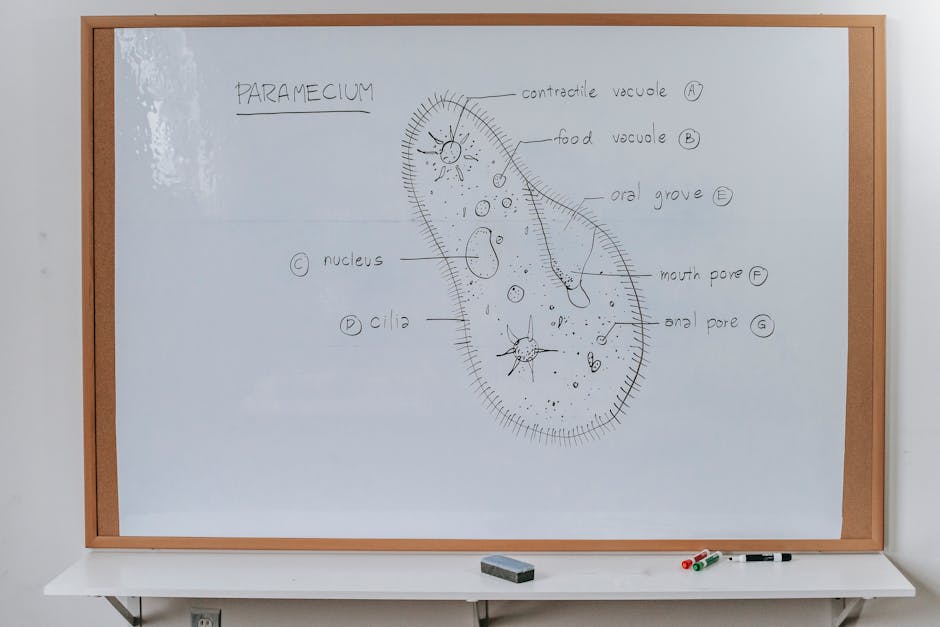
Photo by Katerina Holmes on Pexels
These are more complex, found in animals, plants, fungi, and protists. They have a true nucleus that houses their DNA, and many other specialized compartments called organelles, each with a specific job.
Here are some key eukaryotic organelles you should know:
* Nucleus: The control center; contains DNA.
* Mitochondria: The cell's "powerhouses"; produce energy (ATP).
* Ribosomes: Build proteins.
* Endoplasmic Reticulum (ER): Network for protein and lipid synthesis.
* Golgi Apparatus: Modifies, sorts, and packages proteins and lipids.
* Cell Membrane: The outer boundary that controls what enters and leaves the cell.
* Cytoplasm: The jelly-like substance filling the cell, holding organelles in place.
Now, let's get into the cell cycle. This is the series of events a cell goes through from its "birth" until it divides into two daughter cells. It's crucial for growth, repair, and reproduction.
The cell cycle has two main phases: Interphase and M Phase (Mitotic Phase).
graph LR
    A["Interphase"] --> B["G1 (Growth)"]
    B --> C["S (DNA Synthesis)"]
    C --> D["G2 (Preparation for Division)"]
    D --> E["M Phase (Cell Division)"]
    E --> F["Cytokinesis (Cytoplasm Division)"]
    F --> A
-
Interphase: This is the longest part of the cell cycle, where the cell grows, copies its DNA, and prepares for division. It's divided into three sub-phases:
- G1 Phase (First Gap): The cell grows, produces new proteins and organelles. It's essentially getting ready for DNA replication.
- S Phase (Synthesis): This is where the cell replicates its entire genome. Each chromosome now consists of two identical sister chromatids joined at the centromere.
- G2 Phase (Second Gap): The cell continues to grow, produces proteins needed for cell division, and checks its DNA for errors. It's a final preparation stage before mitosis.
-
M Phase (Mitotic Phase): This is the actual division phase, where the cell's nucleus and cytoplasm divide.
- Mitosis: The division of the nucleus, resulting in two identical sets of chromosomes. (We'll cover the stages of mitosis in detail later.)
- Cytokinesis: The division of the cytoplasm, which completely separates the two new daughter cells.
The cell cycle is tightly regulated by checkpoints to ensure everything goes smoothly. If there are errors, the cell can pause the cycle, fix the problem, or even trigger programmed cell death (apoptosis) to prevent faulty cells from replicating.
3. Worked Example
Imagine a human skin cell. It needs to replace old or damaged cells constantly.
- G1 Phase: A newly formed skin cell starts to grow, making more proteins, ribosomes, and mitochondria. It's performing its normal skin cell functions while also getting ready to divide.
- S Phase: The cell duplicates its 46 chromosomes. After this phase, it still technically has 46 chromosomes, but each chromosome now consists of two identical sister chromatids. So, there are 92 chromatids in total.
- G2 Phase: The cell continues to grow, checks its DNA for any copying errors, and produces tubulin (a protein needed to form the spindle fibers for mitosis). It essentially makes sure it has enough "machinery" for two cells.
- M Phase (Mitosis & Cytokinesis): The cell divides its nucleus, separating the sister chromatids into two full sets of 46 chromosomes. Then, the cytoplasm divides, physically splitting into two identical daughter skin cells, each ready to start its own G1 phase. This whole process, from one division to the next, is the cell cycle.
4. Key Takeaways
- The cell cycle is the series of growth and division events a cell undergoes, fundamental for growth, repair, and reproduction.
- Interphase is the longest part of the cell cycle, including G1, S, and G2 phases, where the cell grows and replicates its DNA.
- The S phase is critical for DNA replication, ensuring each daughter cell receives a complete set of genetic material.
- M phase consists of mitosis (nuclear division) and cytokinesis (cytoplasmic division), leading to two new daughter cells.
- Prokaryotic cells are simpler, lacking a nucleus and membrane-bound organelles, unlike complex eukaryotic cells.
- Eukaryotic organelles like the nucleus, mitochondria, and ribosomes perform specialized functions vital for cell life and division.
Common Mistakes to Avoid:
- Don't confuse the S phase (DNA replication) with mitosis (nuclear division); they are distinct stages.
- Don't think a cell is "resting" during interphase; it's very active, growing and preparing for division.
- Don't assume prokaryotes have organelles; their cellular machinery is much less compartmentalized.
- Don't forget that after S phase, a chromosome still counts as one chromosome, even though it now has two sister chromatids.
5. Now Try It
Take 15 minutes to sketch a diagram of a generalized eukaryotic cell. Label at least five key organelles (nucleus, mitochondria, ribosomes, cell membrane, cytoplasm) and briefly describe their function in one short sentence next to each label. Then, below your sketch, briefly explain in your own words why a cell needs to go through the S phase before it can divide into two identical daughter cells. What would happen if it skipped S phase? What success looks like is having a clear, labeled diagram and a concise explanation that shows you understand the importance of DNA replication in cell division.
Frequently asked about Introduction to the Cell Cycle and Cell Structure
More from biology cell cycle
Get the full biology cell cycle curriculum
Clone the complete plan to your dashboard for unlimited AI-generated notes, practice quizzes, and a personalised revision schedule.
Create Free Account