Advanced Robotics Concepts and Future Trends
From the Robotics curriculum
TL;DR
You'll explore how robots are becoming more intelligent and adaptable through AI, learning, and better perception. We'll look at concepts like soft robotics and human-robot interaction, which are key for future applications. Finally, we'll cover ethical considerations and where robotics is headed next.
1. The Mental Model
Think of advanced robotics as moving beyond fixed, pre-programmed tasks. It's about robots that can see, understand, learn, and adapt to complex, changing environments, often working safely alongside humans.
2. The Core Material
Advanced robotics isn't just about building better mechanical systems; it's heavily influenced by advancements in artificial intelligence (AI), machine learning (ML), and sensor technologies. These allow robots to perform tasks that were previously impossible or required constant human supervision.
Perception and Sensor Fusion

Photo by Ulrick Trappschuh on Pexels
Robots need to understand their environment. Perception involves interpreting data from various sensors like cameras, lidar (light detection and ranging), radar, and touch sensors. Sensor fusion is combining data from multiple sensors to get a more complete and reliable understanding of the world. For example, a robot might use a camera to see colors and textures, and lidar to precisely measure distances and build a 3D map.
Robot Learning (Machine Learning in Robotics)
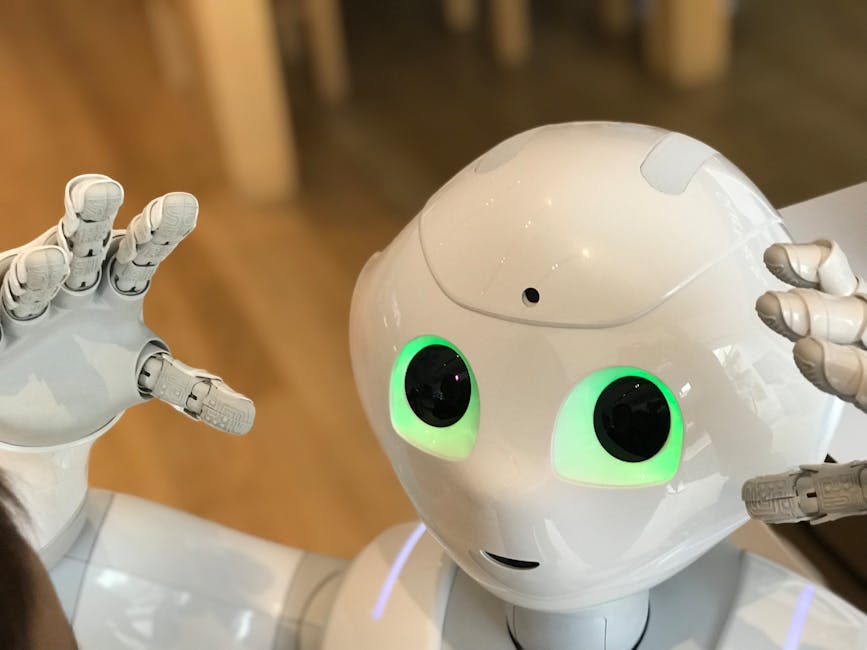
Photo by Laura Musikanski on Pexels
Instead of being explicitly programmed for every scenario, robots can learn from data or experience.
* Reinforcement Learning (RL): A robot learns by trial and error, receiving rewards for desired actions and penalties for undesired ones. It's how a robot might learn to grasp an object by repeatedly trying and adjusting its grip.
* Imitation Learning/Learning from Demonstration (LfD): A human demonstrates a task, and the robot tries to mimic it. This is great for teaching complex manipulation tasks without intricate programming.
Human-Robot Interaction (HRI)

Photo by Pavel Danilyuk on Pexels
As robots enter more human environments, their ability to interact naturally and safely with people is crucial. This includes:
* Safe Interaction: Ensuring robots don't harm humans, often through force/torque sensors, compliant actuators (which can "give" a little), and collision avoidance algorithms.
* Intuitive Communication: Robots understanding human gestures, speech, and intentions, and communicating their own status clearly (e.g., through lights, screens, or simple speech).
Collaborative Robotics (Cobots)
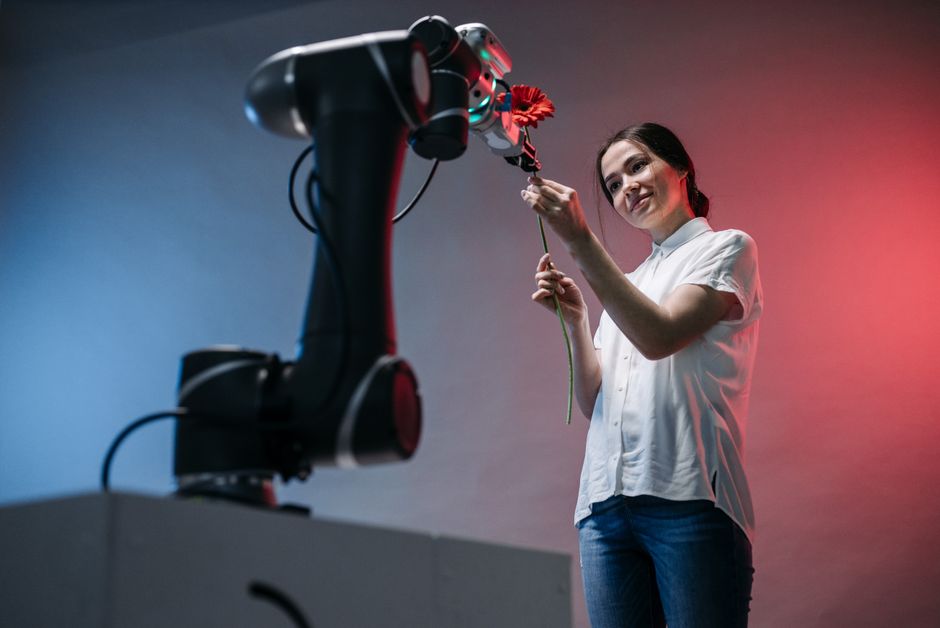
Photo by Pavel Danilyuk on Pexels
These are robots designed to work directly alongside humans in shared workspaces, often without safety cages. They typically have built-in safety features like force limits and proximity sensors.
Soft Robotics
Unlike rigid, metallic robots, soft robots are made from compliant (flexible) materials like silicone. This makes them inherently safer for human interaction, more adaptable to irregular shapes, and resilient to damage. They're often powered by pneumatics (air pressure) or hydraulics (fluid pressure).
Swarm Robotics
This involves multiple simple robots working together as a collective to achieve a common goal. Inspired by insect swarms, these systems can be highly robust (if one robot fails, others can pick up the slack) and scalable.
graph TD
    A["Advanced Robotics (Future Trends)"] --> B["Intelligent Perception"]
    A --> C["Robot Learning"]
    A --> D["Human-Robot Interaction (HRI)"]
    A --> E["Novel Robot Structures"]

    B --> B1["Sensor Fusion (Lidar, Camera, Tactile)"]
    B --> B2["Environmental Understanding"]

    C --> C1["Reinforcement Learning (RL)"]
    C --> C2["Learning from Demonstration (LfD)"]

    D --> D1["Safe Collaboration (Cobots)"]
    D --> D2["Intuitive Communication (Speech, Gesture)"]
    D --> D3["Ethical Considerations (Trust, Bias)"]

    E --> E1["Soft Robotics (Flexible Materials)"]
    E --> E2["Swarm Robotics (Decentralized Control)"]
    E --> E3["Biomimetic Robots (Nature-Inspired)"]
Ethical and Societal Implications
As robots become more autonomous and capable, ethical questions arise:
* Job Displacement: How will increased automation affect employment?
* Accountability: Who is responsible if an autonomous robot causes harm?
* Bias: Can AI-driven robots perpetuate or amplify human biases present in their training data?
* Privacy: How is data collected by robots used and protected?
* Trust: How can humans build appropriate trust in autonomous systems?
3. Worked Example
Let's consider a scenario where a cobot needs to learn to assemble a new component on a factory floor while working next to a human.
Traditional Approach (Pre-programmed): You'd manually program each joint movement, force, and sequence for the cobot to pick up, orient, and place the component. If the component's shape or position changes slightly, the program breaks.
Advanced Robotics Approach (Using Learning from Demonstration and Safe HRI):
- Human Demonstration: A human worker physically guides the cobot's arm through the assembly process several times, demonstrating the correct path, grip force, and final placement. The cobot's internal sensors record the joint angles, forces, and end-effector position during these demonstrations. This is Learning from Demonstration (LfD).
- Learning and Generalization: The cobot uses machine learning algorithms to generalize from these demonstrations. It learns a policy – a set of rules – that maps its current state (where it is, what it sees) to the actions it should take to perform the assembly. It can learn to pick up components even if their exact position varies slightly within a tolerance.
- Safe Interaction: During operation, the cobot continuously monitors its surroundings with proximity sensors and its own force sensors. If a human unexpectedly enters its immediate workspace or touches it, the cobot immediately slows down or stops, ensuring safe human-robot interaction.
- Error Handling and Re-learning: If the cobot repeatedly fails to grasp a component, it might signal to the human, who can then provide another demonstration to correct its understanding (active learning).
This advanced approach allows the cobot to adapt to new tasks quickly, operate safely with humans, and improve its performance over time without extensive re-programming.
4. Key Takeaways
- Robots are becoming more intelligent through AI, machine learning (like RL and LfD), and sophisticated sensor fusion for better environmental understanding.
- Human-Robot Interaction (HRI) is crucial for robots to work safely and effectively alongside people, especially with collaborative robots (cobots).
- Soft robotics offers new possibilities for compliant, safer, and more adaptable robot designs compared to traditional rigid robots.
- Swarm robotics leverages multiple simple robots for robust, scalable solutions in complex environments.
- Future trends include bio-inspired designs and increasingly autonomous systems across various sectors like healthcare and logistics.
- Ethical considerations, including job displacement, accountability, and data privacy, are becoming paramount as robots become more capable.
Common Mistakes to Avoid:
- Don't confuse robot autonomy (ability to act independently) with robot intelligence (ability to reason and learn). They often go together but are distinct concepts.
- Thinking that "learning" in robots means they understand concepts like humans do; it's typically pattern recognition and optimization based on data.
- Underestimating the complexity of real-world environments for robot perception; what's easy for humans is hard for robots.
- Ignoring the ethical implications of advanced robotics; these aren't just technical problems.
5. Now Try It
Spend 15 minutes researching a real-world example of soft robotics in action. What specific problem does it solve that a traditional rigid robot couldn't, or couldn't do as well? Think about its materials, power source, and how it interacts with its environment or humans. Your success looks like you can explain the unique benefits of the soft robot for its application.
Frequently asked about Advanced Robotics Concepts and Future Trends
More from Robotics
Get the full Robotics curriculum
Clone the complete plan to your dashboard for unlimited AI-generated notes, practice quizzes, and a personalised revision schedule.
Save this course free