Introduction to Motion and Kinematics Review
From the Acceleration curriculum
TL;DR
Kinematics describes how objects move without worrying about why they move. We focus on position, velocity, and acceleration to understand motion. Understanding these basic concepts is crucial for tackling more complex physics problems.
1. The Mental Model
Imagine you're watching a ball roll across a field. Kinematics is like describing that roll: where the ball is at any moment, how fast it's going, and if it's speeding up or slowing down. We're just the observers, not trying to figure out who kicked it or why.
2. The Core Material
Kinematics is the study of motion. It gives us the tools to describe how objects move in terms of position, displacement, distance, speed, velocity, and acceleration.
2.1 Position, Distance, and Displacement
Position tells you where an object is relative to a reference point (like the starting line of a race). We often use a coordinate system (like an x-axis) to define position. For example, x = 5 meters means 5 meters from the origin.
Distance is the total length of the path an object travels, regardless of direction. If you walk 5 meters forward and then 3 meters backward, your total distance traveled is 8 meters. It's a scalar quantity, meaning it only has magnitude (a number).
Displacement is the change in an object's position. It's the straight-line distance from your starting point to your ending point, with direction. If you walk 5 meters forward and then 3 meters backward, your displacement is 2 meters forward (5 - 3 = 2). It's a vector quantity, meaning it has both magnitude and direction.
2.2 Speed and Velocity
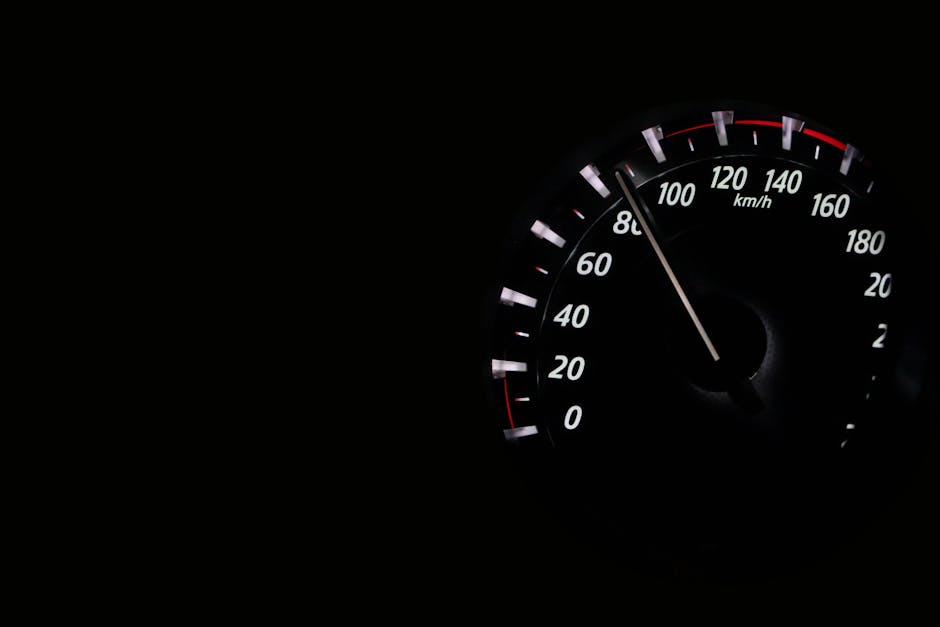
Photo by Pixabay on Pexels
Speed is how fast an object is moving. It's the distance traveled per unit of time. Like distance, it's a scalar quantity. If you cover 10 meters in 2 seconds, your speed is 5 meters per second (m/s).
Velocity is how fast an object is moving and in what direction. It's the displacement per unit of time. Velocity is a vector quantity. If you walk 10 meters east in 2 seconds, your velocity is 5 m/s east. A car traveling at a constant speed around a curve has a changing velocity because its direction is changing.
Average velocity is your total displacement divided by the total time taken.
Instantaneous velocity is your velocity at a specific moment in time. Think of your car's speedometer – that's instantaneous speed, and if you knew your direction, it'd be instantaneous velocity.
2.3 Acceleration
Acceleration is the rate at which velocity changes. Since velocity is a vector, acceleration can mean:
1. Speeding up: Your velocity's magnitude is increasing.
2. Slowing down: Your velocity's magnitude is decreasing (often called deceleration, but it's still acceleration in the opposite direction).
3. Changing direction: Even if your speed is constant, changing direction means your velocity is changing, so you're accelerating.
The standard unit for acceleration is meters per second squared (m/s²).
Here's a diagram to help visualize the relationships between these core concepts:
graph TD
    A["Motion Description"] --> B["Position (where)"]
    B --> C["Change in Position"]
    C --> D["Distance (total path)"]
    C --> E["Displacement (net change + direction)"]

    A --> F["Rate of Motion"]
    F --> G["Speed (how fast)"]
    G --> H["Average Speed"]
    G --> I["Instantaneous Speed"]

    F --> J["Velocity (how fast + direction)"]
    J --> K["Average Velocity"]
    J --> L["Instantaneous Velocity"]

    J --> M["Change in Velocity"]
    M --> N["Acceleration (rate of velocity change)"]
3. Worked Example
Let's consider a person jogging.
A jogger starts at a point, jogs 100 meters east, then turns around and jogs 40 meters west. The entire trip takes 20 seconds.
-
What is the total distance traveled?
Distance = 100 meters (east) + 40 meters (west) = 140 meters. -
What is the jogger's final displacement?
Let's say east is the positive direction (+).
Displacement = (+100 meters) + (-40 meters) = +60 meters.
So, the final displacement is 60 meters east of the starting point. -
What is the jogger's average speed?
Average Speed = Total Distance / Total Time
Average Speed = 140 meters / 20 seconds = 7 m/s. -
What is the jogger's average velocity?
Average Velocity = Total Displacement / Total Time
Average Velocity = +60 meters / 20 seconds = +3 m/s.
So, the average velocity is 3 m/s east.
4. Key Takeaways
- Kinematics focuses on how objects move, not why.
- Distance is the total path length (scalar), while displacement is the net change in position with direction (vector).
- Speed is how fast an object moves (scalar), and velocity is how fast it moves in a specific direction (vector).
- Velocity can change in magnitude (speed up/slow down) or direction.
- Acceleration is the rate at which velocity changes, whether it's speeding up, slowing down, or changing direction.
- Understanding the difference between scalar and vector quantities is fundamental.
Common Mistakes to Avoid:
- Confusing distance and displacement: Remember distance is total path, displacement is start-to-end with direction.
- Confusing speed and velocity: Speed is just a number, velocity includes direction.
- Thinking acceleration only means speeding up: Slowing down or changing direction are also forms of acceleration.
- Ignoring units: Always include proper units (m, s, m/s, m/s²) to avoid errors and clarify your answers.
5. Now Try It
Imagine you're driving a car. You start from your house, drive 3 km north to the grocery store, spend 5 minutes there, then drive 4 km west to your friend's house. The drive to the store took 5 minutes, and the drive to your friend's house took 7 minutes.
For this trip, calculate:
1. Your total distance traveled.
2. Your final displacement (magnitude and direction relative to your house).
3. Your average speed for the entire driving portion of the trip (exclude time spent in the store).
4. Your average velocity for the entire trip (including time in the store).
Success looks like clearly stating your answers with correct units and directions, and correctly distinguishing between scalar and vector quantities.
Frequently asked about Introduction to Motion and Kinematics Review
Study this next
Get the full Acceleration curriculum
Clone the complete plan to your dashboard for unlimited AI-generated notes, practice quizzes, and a personalised revision schedule.
Save this course free