Introduction to Motion and Kinematics in One Dimension
From the motion curriculum
TL;DR
Kinematics is about describing how things move without worrying about why they move. We'll start with motion in a straight line, defining position, distance, displacement, speed, and velocity. Understanding these basics lets you precisely describe an object's movement.
1. The Mental Model
Imagine you're tracking a toy car moving only forwards and backwards on a long, straight track. Kinematics gives us the language and tools to precisely describe where that car is, how far it's gone, and how fast it's moving, all without caring if a battery or a push made it go.
2. The Core Material
When we talk about motion in one dimension, we're thinking about things moving along a single straight line, like left/right or up/down. To describe this, we need a few key ideas.
Reference Frames and Position

Photo by Filip Szyller on Pexels
To say where something is, you first need a reference point (an origin, usually 0) and a direction. For example, if you're talking about a car on a road, you might say "the gas station is at 0 meters" and "the diner is at +500 meters."
- Position ($x$): This tells you an object's location relative to your chosen origin. It's a vector quantity, meaning it has both magnitude (how far) and direction (which way). For one-dimensional motion, we often use positive and negative signs to indicate direction (e.g., +5m is 5 meters to the right, -3m is 3 meters to the left).
Distance vs. Displacement
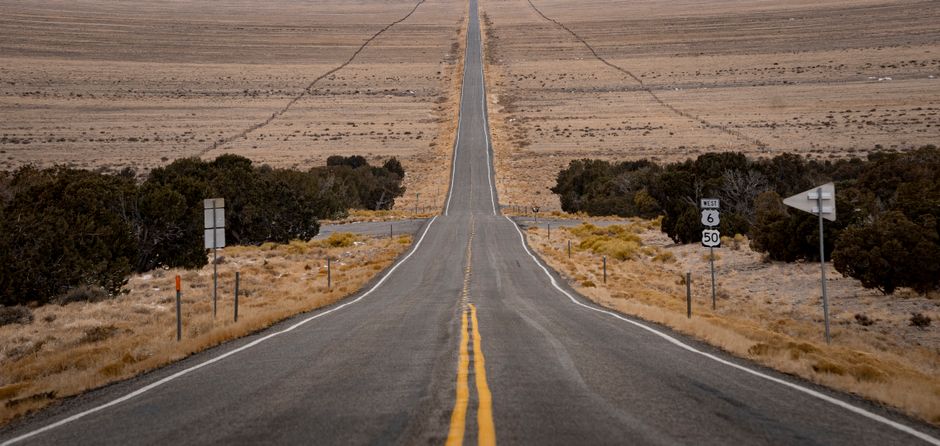
Photo by Intricate Explorer on Pexels
These terms are often confused, but they're different!
- Distance: This is the total path length traveled, regardless of direction. It's always a positive number. If you walk 5 meters forward and then 2 meters backward, you've covered a total distance of 7 meters.
- Displacement ($\Delta x$): This is the change in position from your starting point to your ending point. It's a vector quantity. If you walk 5 meters forward (+5m) and then 2 meters backward (-2m), your displacement is +3 meters (you ended up 3 meters forward from where you started).
- $\Delta x = x_{final} - x_{initial}$
Speed vs. Velocity
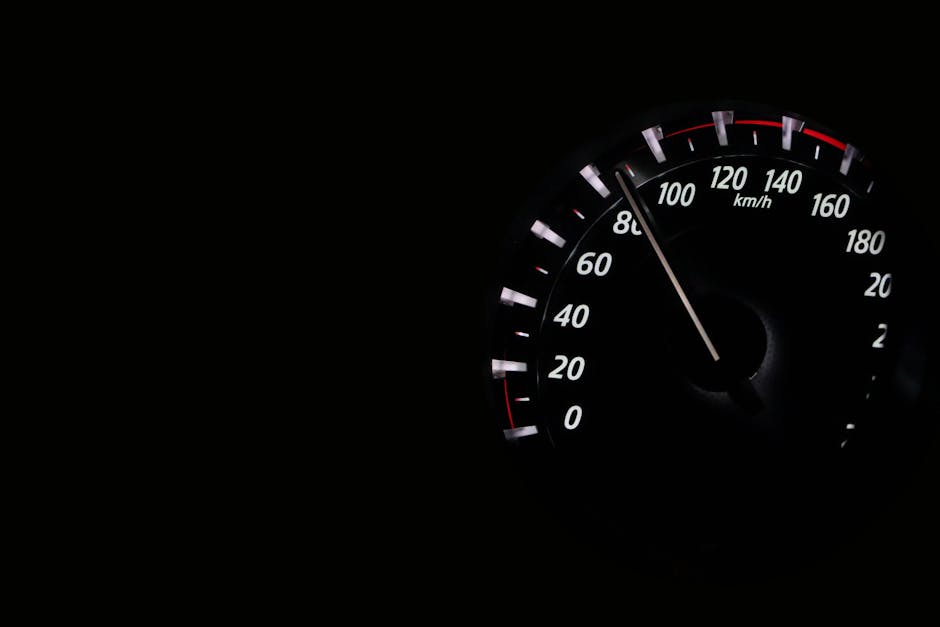
Photo by Pixabay on Pexels
Similarly, speed and velocity are related but distinct.
- Speed: How fast an object is moving, regardless of direction. It's a scalar quantity (just a number).
- Average Speed = Total Distance / Total Time
- Velocity ($v$): How fast an object is moving and in what direction. It's a vector quantity.
- Average Velocity = Displacement / Total Time ($v_{avg} = \Delta x / \Delta t$)
Think of it this way: your car's speedometer tells you your speed. If you're driving north at 60 mph, your speed is 60 mph, but your velocity is 60 mph North. If you turn around and drive south at 60 mph, your speed is still 60 mph, but your velocity is now 60 mph South (or -60 mph if north is positive).
graph TD
    A["Start Motion Description"] --> B{Define Reference Frame?};
    B -- Yes --> C["Choose Origin (e.g., 0)"];
    B -- Yes --> D["Choose Positive Direction (e.g., Right)"];
    C --> E["Identify Initial Position (x_initial)"];
    D --> E;
    E --> F["Identify Final Position (x_final)"];
    F --> G{Calculate What?};
    G -- Total Path Length --> H["Distance = sum of all path segments"];
    G -- Change in Position --> I["Displacement (Δx) = x_final - x_initial"];
    G -- How Fast (no direction) --> J["Speed = Distance / Time"];
    G -- How Fast (with direction) --> K["Velocity (v) = Displacement / Time"];
3. Worked Example
Let's say you're tracking a very confused squirrel. It starts at a tree (which we'll call 0 meters).
- It runs 10 meters east (+10m) to a bird feeder.
- It then runs 4 meters west (-4m) to bury a nut.
- Finally, it runs 3 meters east (+3m) to grab another nut from the feeder.
Let's break this down:
- Initial Position ($x_{initial}$): 0 meters
- Final Position ($x_{final}$): It ends up at +10m - 4m + 3m = +9 meters from the tree.
1. What was the total distance the squirrel traveled?
Distance = |+10m| + |-4m| + |+3m| = 10m + 4m + 3m = 17 meters
2. What was the squirrel's total displacement?
Displacement ($\Delta x$) = $x_{final} - x_{initial}$ = 9m - 0m = +9 meters (or 9 meters east of the tree)
See the difference? The squirrel ran quite a bit (17m), but it only ended up 9m away from where it started.
4. Key Takeaways
- Motion in one dimension means movement along a single straight line.
- Position is your location relative to a chosen origin, with a direction (+/-).
- Distance is the total path length traveled, always positive.
- Displacement is the change in position from start to end ($x_{final} - x_{initial}$), and includes direction.
- Speed is how fast you're going (distance per time), always positive.
- Velocity is how fast you're going and in what direction (displacement per time).
Common Mistakes to Avoid:
* Mixing up distance and displacement; they are rarely the same unless motion is always in one direction.
* Forgetting that displacement and velocity are vector quantities, so their sign matters in 1D.
* Not establishing a clear reference frame (origin and positive direction) before solving a problem.
* Using total distance instead of displacement when calculating average velocity.
5. Now Try It
Imagine you're walking from your house (let's call it 0m) to a friend's house 200 meters east. You walk for 5 minutes, then realize you forgot your phone, so you turn around and walk 50 meters west back towards your house. This takes you 1 minute. You grab your phone and immediately turn around and walk the remaining distance to your friend's house (200m from your house). This final stretch takes 3 minutes.
- What was your total distance walked?
- What was your final displacement from your house?
- What was your average speed for the entire trip? (Convert time to seconds for consistency: 1 min = 60s)
- What was your average velocity for the entire trip?
What success looks like: You should have clear numerical answers for distance, displacement, average speed, and average velocity, showing your calculations and correct units.
Frequently asked about Introduction to Motion and Kinematics in One Dimension
Study this next
Get the full motion curriculum
Clone the complete plan to your dashboard for unlimited AI-generated notes, practice quizzes, and a personalised revision schedule.
Save this course free