Kinematics: Motion in 1D and 2D
From the Physics curriculum
TL;DR
Kinematics describes how things move without worrying about why they move. You'll learn about displacement, velocity, and acceleration in both straight lines and curves. Mastering these concepts helps you predict an object's future position.
1. The Mental Model
Imagine you're tracking a bug: kinematics is simply describing where it is, how fast it's going, and how its speed is changing, without caring if a cat is chasing it. It's all about position, velocity, and acceleration.
2. The Core Material
Kinematics is the study of motion. We break down an object's journey by looking at its position, displacement, velocity, and acceleration.
Position and Displacement

Photo by Pixabay on Pexels
Position tells you where something is relative to a reference point (like "5 meters to the right of the tree"). We often use symbols like x for 1D motion or (x, y) for 2D motion.
Displacement is the change in position. It's a vector, meaning it has both magnitude (how far) and direction. If you start at x=2m and end at x=7m, your displacement is Δx = x_final - x_initial = 7m - 2m = 5m. If you walk around a block and return to your starting point, your total displacement is zero, even though you covered a distance.
Velocity and Speed
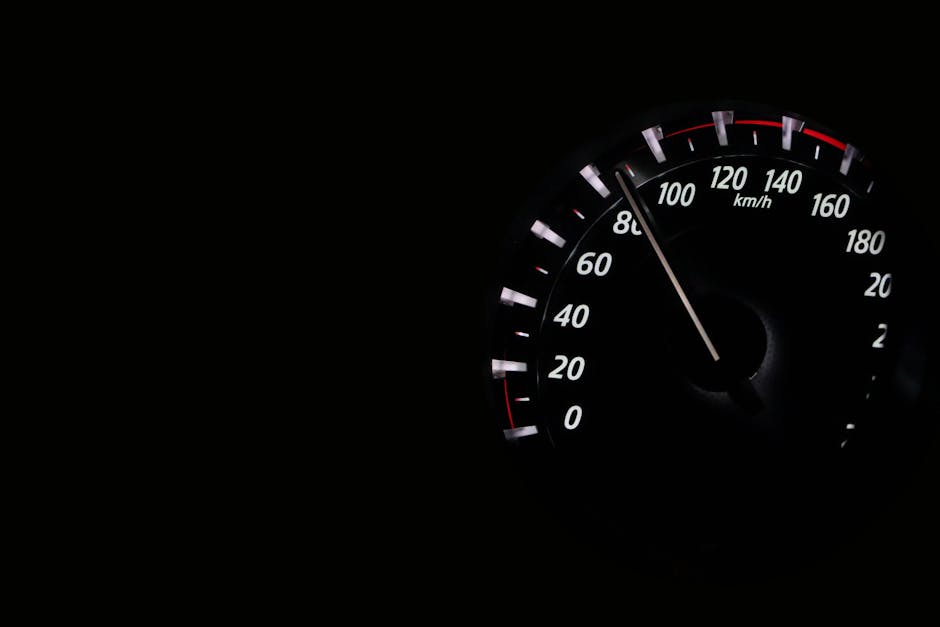
Photo by Pixabay on Pexels
Velocity is the rate at which your position changes. It's also a vector.
* Average velocity (v_avg) is your total displacement divided by the time taken: v_avg = Δx / Δt.
* Instantaneous velocity (v) is your velocity at a specific moment in time. If you know calculus, it's the derivative of position with respect to time (v = dx/dt).
Speed is just the magnitude of velocity; it doesn't include direction. Your speedometer tells you speed, not velocity.
Acceleration
Acceleration is the rate at which your velocity changes. It's also a vector.
* Average acceleration (a_avg) is the change in velocity divided by the time taken: a_avg = Δv / Δt.
* Instantaneous acceleration (a) is your acceleration at a specific moment. If you know calculus, it's the derivative of velocity with respect to time (a = dv/dt) or the second derivative of position (a = d^2x/dt^2).
Constant Acceleration Equations (Kinematic Equations)

Photo by Vitaly Gariev on Pexels
When acceleration is constant, you can use these handy equations for 1D motion:
v = v₀ + at(final velocity equals initial velocity plus acceleration times time)Δx = v₀t + ½at²(displacement equals initial velocity times time plus one-half acceleration times time squared)v² = v₀² + 2aΔx(final velocity squared equals initial velocity squared plus two times acceleration times displacement)Δx = ½(v₀ + v)t(displacement equals average velocity times time)
Here, v₀ is initial velocity, v is final velocity, a is constant acceleration, t is time, and Δx is displacement. Remember to pick a positive direction and stick to it!
Motion in 2D

Photo by Kechno Studio on Pexels
For 2D motion (like a projectile), you treat the horizontal (x) and vertical (y) movements independently. The key is that time is the same for both dimensions.
graph TD
    A["Object Starts Moving (t=0)"] --> B["Break Initial Velocity (v₀) into Components"]
    B --> C["Horizontal Velocity (v₀x)"]
    B --> D["Vertical Velocity (v₀y)"]
    C --> E["Horizontal Motion (x-direction)"]
    D --> F["Vertical Motion (y-direction)"]
    E --> G["Use 1D Kinematic Equations (a_x usually 0)"]
    F --> H["Use 1D Kinematic Equations (a_y usually -g)"]
    G & H --> I["Time (t) links x and y motions"]
    I --> J["Combine Results for 2D Position/Velocity"]
- Horizontal (x-direction): Usually, there's no acceleration in the horizontal direction (ignoring air resistance), so
a_x = 0. This simplifies things:v_x = v₀x(constant velocity) andΔx = v₀x * t. - Vertical (y-direction): Gravity is always acting downwards, so
a_y = -g(wheregis the acceleration due to gravity, approximately9.8 m/s²). You'll use the same 1D kinematic equations, but withyvariables anda_y = -g.
The initial velocity v₀ will often need to be resolved into its x and y components using trigonometry:
v₀x = v₀ cos(θ)
v₀y = v₀ sin(θ)
where θ is the angle of launch above the horizontal.
3. Worked Example
Let's say you throw a ball straight up with an initial velocity of 15 m/s. How high does it go before it starts falling back down?
-
Identify knowns and unknowns:
- Initial velocity (
v₀) =+15 m/s(we choose up as positive) - Acceleration (
a) =-9.8 m/s²(gravity always acts down) - Final velocity at the peak (
v) =0 m/s(it stops momentarily at its highest point) - Displacement (
Δy) = ? (This is what we want to find)
- Initial velocity (
-
Choose the right kinematic equation:
We havev₀,v, anda, and we wantΔy. The equationv² = v₀² + 2aΔyfits perfectly. -
Solve for the unknown:
0² = (15 m/s)² + 2(-9.8 m/s²)Δy
0 = 225 m²/s² - 19.6 m/s² * Δy
19.6 m/s² * Δy = 225 m²/s²
Δy = 225 m²/s² / 19.6 m/s²
Δy ≈ 11.48 m
So, the ball goes approximately 11.48 meters high.
4. Key Takeaways
- Kinematics describes motion using position, displacement, velocity, and acceleration.
- Displacement, velocity, and acceleration are vector quantities, meaning they have both magnitude and direction.
- Speed is the magnitude of velocity, without direction.
- For constant acceleration, you can use the four kinematic equations to solve for unknowns.
- 2D motion can be analyzed by treating horizontal and vertical components independently, linked by time.
- Gravity (approximated as
9.8 m/s²downwards) is the primary acceleration in vertical motion. - Always establish a positive direction and maintain consistency throughout your calculations.
Common Mistakes to Avoid
- Confusing distance (scalar) with displacement (vector) or speed (scalar) with velocity (vector).
- Forgetting that acceleration due to gravity is always downwards, even when an object is moving upwards.
- Mixing up units or not converting them to a consistent system (e.g., meters and seconds).
- Assuming acceleration is zero when an object changes direction or slows down.
5. Now Try It
A car starts from rest and accelerates uniformly at 3.0 m/s² for 5.0 seconds. What is its final velocity and how far did it travel? After 5.0 seconds, if the car immediately brakes, decelerating at 4.0 m/s², how long does it take to come to a complete stop?
Frequently asked about Kinematics: Motion in 1D and 2D
Study this next
Get the full Physics curriculum
Clone the complete plan to your dashboard for unlimited AI-generated notes, practice quizzes, and a personalised revision schedule.
Save this course free