"topics": [
From the Integrated Science curriculum
TL;DR
Chemical reactions are processes where atoms rearrange to form new substances with different properties. They involve breaking existing bonds and forming new ones, and are often accompanied by energy changes. We can represent these changes using chemical equations.
1. The Mental Model
Imagine you have a Lego structure. A chemical reaction is like taking that structure apart piece by piece and then using those same pieces to build an entirely different structure. You still have the same number and types of Lego bricks, but they're now connected in new ways, forming something new.
2. The Core Material
Chemical reactions are all about change! Reactants (your starting materials) transform into products (your new materials). This transformation involves the breaking of chemical bonds in the reactants and the formation of new chemical bonds in the products.
2.1 What Happens During a Reaction?
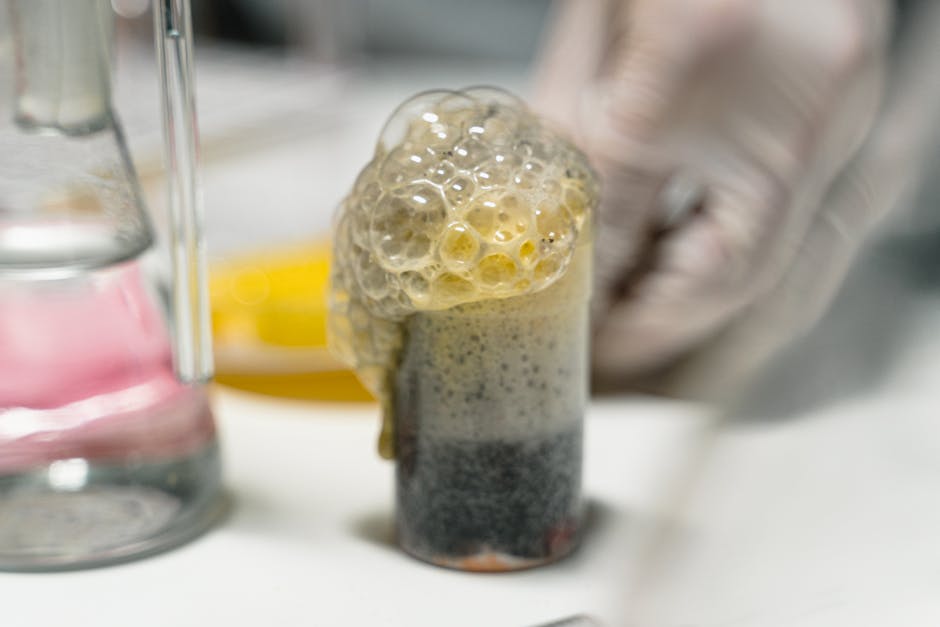
Photo by MART PRODUCTION on Pexels
Atoms themselves aren't created or destroyed; they just rearrange. This is a fundamental principle called the Law of Conservation of Mass. It means that the total mass of the reactants must equal the total mass of the products.
2.2 Indicators of a Chemical Reaction

Photo by Kindel Media on Pexels
How do you know if a chemical reaction has occurred? Look for these common signs:
* Color change: Like rust forming on iron.
* Temperature change: The reaction gets hotter (exothermic) or colder (endothermic).
* Gas production: Bubbles form (e.g., fizzing antacid in water).
* Precipitate formation: A solid forms in a liquid solution.
* Light emission: Think of a glow stick.
2.3 Types of Chemical Reactions

Photo by Ron Lach on Pexels
There are many ways to classify reactions, but here are some common ones:
- Combination (Synthesis): Two or more reactants combine to form a single, more complex product.
- A + B → AB
- Decomposition: A single reactant breaks down into two or more simpler products.
- AB → A + B
- Single Displacement: One element replaces another element in a compound.
- A + BC → AC + B
- Double Displacement: The positive ions (cations) of two different compounds swap places.
- AB + CD → AD + CB
- Combustion: A substance rapidly reacts with oxygen, often producing heat and light (flame). Usually involves hydrocarbons (compounds of hydrogen and carbon).
- Fuel + O₂ → CO₂ + H₂O (for complete combustion of hydrocarbons)
2.4 Chemical Equations

Photo by Vitaly Gariev on Pexels
We use chemical equations to represent reactions. They show the reactants on the left, an arrow pointing to the products on the right, and sometimes the physical states (s for solid, l for liquid, g for gas, aq for aqueous solution).
Example:
2 H₂(g) + O₂(g) → 2 H₂O(l)
This equation tells us that two molecules of hydrogen gas react with one molecule of oxygen gas to produce two molecules of liquid water. The numbers in front (the coefficients) are crucial for balancing the equation, ensuring the Law of Conservation of Mass is followed.
Here's a simple flowchart illustrating how reactants become products:
graph TD
    A["Reactants (Original Substances)"] --> B["Bonds Break (in Reactants)"]
    B --> C["Atoms Rearrange"]
    C --> D["New Bonds Form (in Products)"]
    D --> E["Products (New Substances)"]
3. Worked Example
Let's look at the reaction of methane gas with oxygen during combustion. Methane is a common fuel.
Unbalanced Equation:
CH₄(g) + O₂(g) → CO₂(g) + H₂O(g)
Step 1: Count atoms on both sides.
* Reactants:
* C: 1
* H: 4
* O: 2
* Products:
* C: 1
* H: 2
* O: 3 (2 from CO₂ + 1 from H₂O)
Step 2: Balance carbon atoms.
They're already balanced (1 on each side).
Step 3: Balance hydrogen atoms.
There are 4 H on the left and 2 H on the right. To balance, put a coefficient of 2 in front of H₂O on the right:
CH₄(g) + O₂(g) → CO₂(g) + 2 H₂O(g)
Step 4: Re-count atoms and balance oxygen.
* Reactants:
* C: 1
* H: 4
* O: 2
* Products:
* C: 1
* H: 4 (2 * 2)
* O: 4 (2 from CO₂ + 2 * 1 from H₂O)
Now there are 2 O on the left and 4 O on the right. To balance, put a coefficient of 2 in front of O₂ on the left:
CH₄(g) + 2 O₂(g) → CO₂(g) + 2 H₂O(g)
Step 5: Final check.
* Reactants:
* C: 1
* H: 4
* O: 4
* Products:
* C: 1
* H: 4
* O: 4
The equation is now balanced!
4. Key Takeaways
- Chemical reactions involve the rearrangement of atoms to form new substances.
- The Law of Conservation of Mass means atoms are conserved; their total number and type remain constant.
- Observable signs like color change, gas production, or temperature change indicate a reaction.
- Chemical equations use formulas and coefficients to represent reactants, products, and their proportions.
- Balancing chemical equations ensures that the number of each type of atom is equal on both sides.
- Common reaction types include combination, decomposition, single displacement, double displacement, and combustion.
- Energy changes (releasing or absorbing heat) are a fundamental part of chemical reactions.
Common Mistakes to Avoid:
- Changing subscripts: Never change the small numbers within a chemical formula (e.g., changing H₂O to H₄O to balance hydrogen). This changes the substance itself.
- Ignoring states of matter: While not always required for balancing, including (s), (l), (g), (aq) gives important context about the reaction conditions.
- Forgetting to count all atoms: Be meticulous when counting atoms, especially oxygen, which often appears in multiple product molecules.
- Assuming all changes are chemical: Melting ice (physical change) is not a chemical reaction; burning wood (chemical change) is.
5. Now Try It
Take the unbalanced equation for the reaction between aluminum metal and oxygen gas to form aluminum oxide:
Al(s) + O₂(g) → Al₂O₃(s)
Your task is to balance this equation. Focus on ensuring the number of aluminum and oxygen atoms is the same on both sides. What coefficients did you use for Al, O₂, and Al₂O₃? Success means you have an equal count of each atom type on both the reactant and product sides.
Frequently asked about "topics": [
More from Integrated Science
Get the full Integrated Science curriculum
Clone the complete plan to your dashboard for unlimited AI-generated notes, practice quizzes, and a personalised revision schedule.
Save this course free