Pure Substances: Elements
From the Science, types of mixture, types of pure substance, types or compound, types of element, any topic in science grade seven term one for a pre-test curriculum
TL;DR
Elements are the simplest form of pure substances, meaning they can't be broken down into anything simpler by ordinary chemical reactions. Each element is made up of only one type of atom, and they're the basic building blocks of all matter. You can find all known elements organized on the Periodic Table.
1. The Mental Model
Imagine you have a box of LEGO bricks. An element is like having a box filled with only one type of LEGO brick – say, only red 2x4 bricks. You can build many things with them, but you can't break a single red 2x4 brick into smaller, different bricks.
2. The Core Material
In science, we classify matter based on what it's made of. One fundamental category is pure substances, which have a uniform and definite composition. Within pure substances, we have two main types: elements and compounds.
Today, we're focusing on elements. An element is a pure substance that consists of only one type of atom. This is super important: you can't break down an element into simpler substances using ordinary chemical methods like heating, cooling, or reacting it with other chemicals. Why? Because it's already in its simplest form!
Think about gold. If you have a pure gold bar, no matter how much you cut it, melt it, or try to react it, you'll always end up with smaller pieces of gold. You won't get silver or copper from it. That's because gold is an element, and all the atoms in that bar are gold atoms.
Here are some key characteristics of elements:
* Unique Atoms: Each element has its own unique type of atom. For example, a hydrogen atom is different from an oxygen atom.
* Symbols: Every element has a unique chemical symbol, usually one or two letters. The first letter is always capitalized, and the second (if there is one) is lowercase (e.g., H for Hydrogen, O for Oxygen, Na for Sodium, Cl for Chlorine).
* Periodic Table: All known elements are organized on the Periodic Table of Elements. This table is a fantastic tool that helps us understand their properties and how they relate to each other. There are currently 118 known elements.
* Building Blocks: Elements are the fundamental building blocks of all matter. Everything around you, from the air you breathe to the desk you're sitting at, is made up of different combinations of these elements.
Let's visualize the relationship between matter, pure substances, and elements:
graph TD
    A["Matter"] --> B["Pure Substances"]
    B --> C["Elements"]
    B --> D["Compounds"]
    A --> E["Mixtures"]
    E --> F["Homogeneous Mixtures"]
    E --> G["Heterogeneous Mixtures"]
Some common elements you might know include:
* Oxygen (O): What you breathe.
* Hydrogen (H): A key part of water.
* Carbon (C): Found in diamonds, charcoal, and all living things.
* Iron (Fe): Used in many tools and structures.
* Copper (Cu): Used in electrical wires.
Remember, even though elements can exist as individual atoms (like Helium gas) or as molecules made of two or more identical atoms (like O₂ for oxygen gas), they are still considered elements because they only contain one type of atom. O₂ is still pure oxygen, not a mixture of oxygen and something else.
Properties of Elements
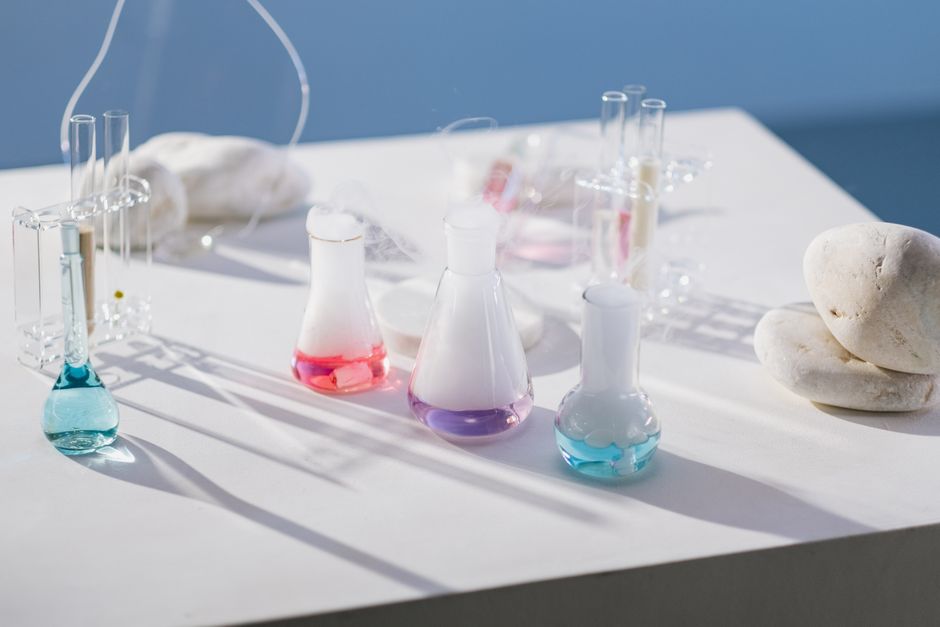
Photo by Ron Lach on Pexels
Each element has unique physical and chemical properties.
* Physical Properties: These are characteristics you can observe or measure without changing the substance's chemical identity. Examples include melting point, boiling point, density, color, and electrical conductivity. For instance, copper is reddish-brown and conducts electricity well, while sulfur is yellow and doesn't conduct electricity.
* Chemical Properties: These describe how an element reacts with other substances, changing its chemical identity. For example, iron rusts (reacts with oxygen and water), while gold does not readily react with many chemicals.
3. Worked Example
Let's say you're given three samples:
1. A piece of shiny, silver metal. After some tests, you find it has a melting point of 97.8°C and reacts vigorously with water to produce hydrogen gas. Its symbol is Na.
2. A clear, colorless liquid. When you heat it, it boils at 100°C, and when you try to break it down further, you get two different gases: hydrogen and oxygen.
3. A dull, black solid. You find its symbol is C. When you heat it in the presence of oxygen, it turns into a gas (carbon dioxide).
Which of these is an element?
Analysis:
* Sample 1: This is Sodium (Na). It's a single substance with definite properties, and it's represented by a single chemical symbol. It's listed on the Periodic Table. Even though it reacts, it's reacting as sodium, not breaking down into simpler elements. This is an element.
* Sample 2: This is water. It's a pure substance, but it can be broken down into simpler substances (hydrogen and oxygen gases) by chemical means. This means it's a compound, not an element.
* Sample 3: This is Carbon (C). It's a single substance with definite properties and a single chemical symbol. When it reacts with oxygen, it forms a new compound (carbon dioxide), but carbon itself remains carbon. This is an element.
So, samples 1 (Sodium) and 3 (Carbon) are elements.
4. Key Takeaways
- Elements are the simplest form of pure substances and cannot be broken down into simpler substances by ordinary chemical reactions.
- Each element is made up of only one unique type of atom.
- Every element has a unique chemical symbol, typically one or two letters.
- The Periodic Table organizes all known elements based on their properties.
- Elements are the fundamental building blocks from which all other matter is formed.
Common mistakes to avoid:
- Confusing elements with compounds: Remember, compounds can be broken down into elements.
- Thinking that a substance reacting means it's not an element: Elements undergo chemical reactions, but they don't break down into simpler elements during those reactions.
- Forgetting that an element can exist as molecules (e.g., O₂) as long as it's only one type of atom.
5. Now Try It
Imagine you have three unlabeled containers.
1. Container A holds a shiny, metallic substance that melts at 327°C. Its chemical symbol is Pb.
2. Container B holds a yellow, powdery substance. When you heat it, it combines with oxygen to form a smelly gas, but the yellow substance itself cannot be broken down into anything simpler. Its chemical symbol is S.
3. Container C holds a pure, colorless liquid that boils at 78°C. When scientists analyze it, they find it's made up of carbon, hydrogen, and oxygen atoms joined together.
For each container, decide whether the substance inside is an element or not. Explain your reasoning briefly for each.
What success looks like: You'll correctly identify which containers hold elements and which do not, based on the definition that elements cannot be broken down into simpler substances and are made of only one type of atom.
Frequently asked about Pure Substances: Elements
More from Science, types of mixture, types of pure substance, types or compound, types of element, any topic in science grade seven term one for a pre-test
Get the full Science, types of mixture, types of pure substance, types or compound, types of element, any topic in science grade seven term one for a pre-test curriculum
Clone the complete plan to your dashboard for unlimited AI-generated notes, practice quizzes, and a personalised revision schedule.
Save this course free