Diffusion: Fundamentals, Factors & Types
From the Diffusion curriculum
TL;DR
Diffusion is the net movement of particles from an area of higher concentration to an area of lower concentration. This movement is driven by the random motion of individual particles, eventually leading to a uniform distribution. It's a fundamental process in nature, crucial for everything from nutrient uptake in cells to pollutant dispersion.
1. The Mental Model
Imagine a crowded room. If you open a door to an empty adjacent room, people will naturally spread out until the crowd is evenly distributed. This "spreading out" from high density to low density, driven by random movement, is essentially what diffusion is.
2. The Core Material
Diffusion is a passive process, meaning it doesn't require external energy input. It's driven by the concentration gradient, which is the difference in concentration between two regions. The greater the concentration gradient, the faster the rate of diffusion.
Here's how it generally works:
Factors Affecting Diffusion Rate
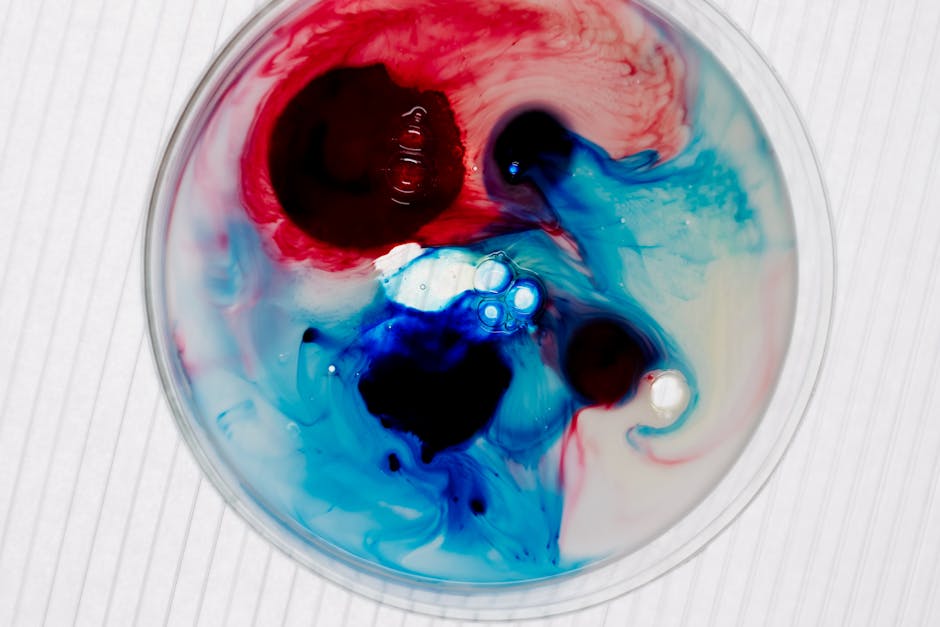
Photo by Ron Lach on Pexels
Several factors influence how quickly diffusion occurs:
- Concentration Gradient: A larger difference in concentration leads to faster diffusion.
- Temperature: Higher temperatures mean particles have more kinetic energy and move faster, increasing diffusion.
- Particle Size: Smaller particles diffuse faster than larger ones because they can move more easily.
- Medium Viscosity: Diffusion is slower in thicker (more viscous) mediums because there's more resistance to particle movement.
- Surface Area: For diffusion across a boundary, a larger surface area allows more particles to cross simultaneously.
- Diffusion Distance: The longer the distance particles need to travel, the longer diffusion takes.
Let's visualize the cause-and-effect relationship of these factors:
graph TD
    A["Initial High Concentration"] --> B["Random Particle Motion"]
    B --> C["Net Movement Down Concentration Gradient"]
    C --> D["Eventually Uniform Distribution"]

    subgraph "Influencing Factors"
        E["Temperature (Higher -> Faster)"]
        F["Particle Size (Smaller -> Faster)"]
        G["Medium Viscosity (Lower -> Faster)"]
        H["Concentration Gradient (Steeper -> Faster)"]
        I["Surface Area (Larger -> Faster)"]
        J["Diffusion Distance (Shorter -> Faster)"]
    end

    E --> C
    F --> C
    G --> C
    H --> C
    I --> C
    J --> C
Types of Diffusion

Photo by cottonbro studio on Pexels
While the basic principle is the same, diffusion can manifest in various ways:
- Simple Diffusion: Particles pass directly through a membrane or medium without help. This typically happens with small, uncharged molecules like oxygen or carbon dioxide across cell membranes.
- Facilitated Diffusion: Particles move across a membrane with the help of specific protein channels or carriers. This is still passive (down the concentration gradient) but is faster and more selective than simple diffusion.
3. Worked Example
Imagine you drop a sugar cube into a still cup of hot tea. Initially, the sugar is highly concentrated at the bottom. Over time, the sugar molecules will randomly move. Because there are more sugar molecules at the bottom, there's a higher probability that they'll move upwards into the tea where there's less sugar. Simultaneously, tea molecules will move into the area where the sugar was, but the net movement of sugar will be away from the cube. Eventually, the sugar will be evenly distributed throughout the tea, and the tea will taste uniformly sweet. The heat of the tea increases the rate at which this happens compared to cold tea.
4. Key Takeaways
- Diffusion is the net movement of particles from high to low concentration.
- It's a passive process, driven by the inherent random motion of particles and the concentration gradient.
- A steeper concentration gradient, higher temperature, and smaller particle size all increase the rate of diffusion.
- Diffusion continues until equilibrium is reached, meaning particles are evenly distributed.
- It's critical for many biological and chemical processes, such as gas exchange in lungs and nutrient absorption.
Common Mistakes to Avoid:
- Don't confuse diffusion with active transport; diffusion doesn't require external energy.
- Remember that individual particles still move randomly at equilibrium, but there's no net change in concentration.
- Don't forget that diffusion occurs in gases and solids too, not just liquids.
- Avoid thinking of it as particles actively "knowing" where to go; it's purely statistical probability.
5. Now Try It
Think about how the smell of perfume spreads across a room. Sketch out a simple diagram showing the initial state (perfume bottle just sprayed) and the final state (smell distributed). On your diagram, briefly explain how the factors of concentration gradient, temperature, and diffusion distance play a role in how quickly you notice the smell at the other side of the room. What would happen if the room was very cold or very large?
Frequently asked about Diffusion: Fundamentals, Factors & Types
Study this next
Get the full Diffusion curriculum
Clone the complete plan to your dashboard for unlimited AI-generated notes, practice quizzes, and a personalised revision schedule.
Save this course free