Factors Affecting Equilibrium: Le Chatelier's Principle
From the chemistry curriculum
TL;DR
Le Chatelier's Principle helps us predict how a system at equilibrium will respond to a disturbance, like changing concentration, temperature, or pressure. The system will always try to counteract the change to re-establish a new equilibrium. This principle is super useful for optimizing chemical reactions in industry and labs.
1. The Mental Model
Imagine a balanced seesaw. If you add weight to one side, the seesaw tips. To get it back to balance, you'd shift weight to the other side. Chemical equilibrium works similarly: if you disturb it, the reaction "shifts" to relieve the stress and find a new balance.
2. The Core Material
Chemical equilibrium is a dynamic state where the rates of the forward and reverse reactions are equal, and the concentrations of reactants and products remain constant. Le Chatelier's Principle states that if a change of condition (stress) is applied to a system in equilibrium, the system will shift in a direction that relieves the stress.
Let's break down the main factors that cause these shifts:
Concentration Changes
If you add or remove a reactant or product, the system will shift to use up the added substance or replace the removed one.
- Adding a reactant: The equilibrium shifts to the right (towards products) to consume the added reactant.
- Removing a reactant: The equilibrium shifts to the left (towards reactants) to produce more of the removed reactant.
- Adding a product: The equilibrium shifts to the left (towards reactants) to consume the added product.
- Removing a product: The equilibrium shifts to the right (towards products) to produce more of the removed product.
Temperature Changes
Temperature affects the equilibrium constant and the direction of the shift. You need to know if the reaction is exothermic or endothermic.
- Exothermic reactions (ΔH < 0): Release heat. Think of heat as a product.
- Increasing temperature: Shifts to the left (reactants) to absorb the excess heat.
- Decreasing temperature: Shifts to the right (products) to produce more heat.
- Endothermic reactions (ΔH > 0): Absorb heat. Think of heat as a reactant.
- Increasing temperature: Shifts to the right (products) to absorb the added heat.
- Decreasing temperature: Shifts to the left (reactants) to produce more heat.
Pressure Changes (for reactions involving gases)
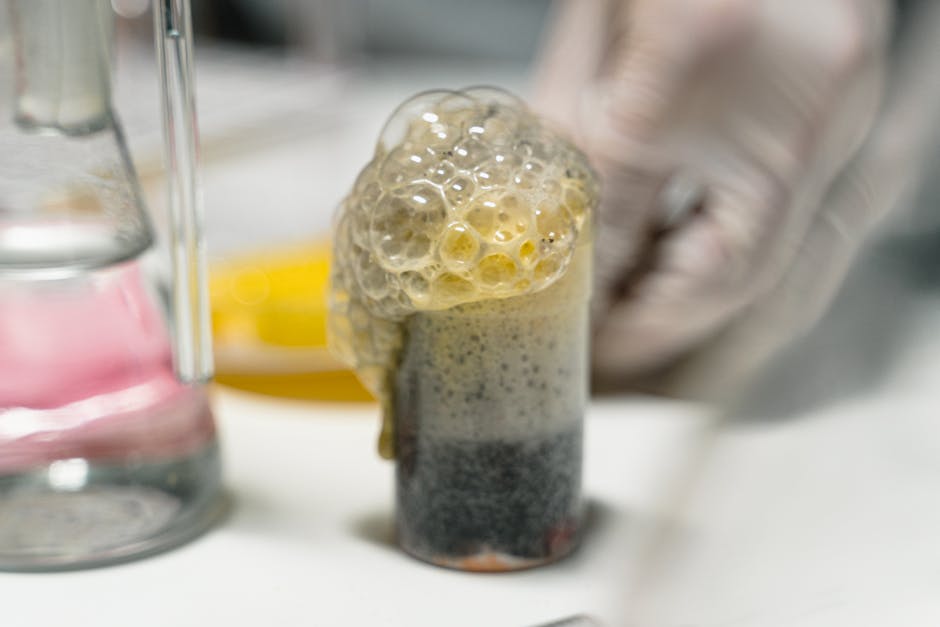
Photo by MART PRODUCTION on Pexels
Pressure changes primarily affect reactions where the number of gas moles changes.
- Increasing pressure: The equilibrium shifts to the side with fewer moles of gas to reduce the pressure.
- Decreasing pressure: The equilibrium shifts to the side with more moles of gas to increase the pressure.
- If the number of gas moles is the same on both sides: Pressure changes have no effect on the equilibrium position.
- Adding an inert gas: If the volume is constant, adding an inert gas (one that doesn't react) increases the total pressure but doesn't change the partial pressures of the reacting gases. Therefore, it has no effect on the equilibrium.
graph TD
    A["System at Equilibrium"] --> B{Stress Applied?}
    B --> C{Change in Concentration?}
    C --> C1["Add Reactant: Shift Right"]
    C --> C2["Remove Reactant: Shift Left"]
    C --> C3["Add Product: Shift Left"]
    C --> C4["Remove Product: Shift Right"]

    B --> D{Change in Temperature?}
    D --> D1{Exothermic Reaction?}
    D1 --> D1a["Increase Temp: Shift Left (absorb heat)"]
    D1 --> D1b["Decrease Temp: Shift Right (release heat)"]
    D --> D2{Endothermic Reaction?}
    D2 --> D2a["Increase Temp: Shift Right (absorb heat)"]
    D2 --> D2b["Decrease Temp: Shift Left (release heat)"]

    B --> E{Change in Pressure (Gases only)?}
    E --> E1["Increase Pressure: Shift to Fewer Moles of Gas"]
    E --> E2["Decrease Pressure: Shift to More Moles of Gas"]
    E --> E3["Same Moles/Inert Gas: No Shift"]
Catalysts
A catalyst speeds up both the forward and reverse reactions equally. It helps the system reach equilibrium faster but does not change the position of the equilibrium. It just gets you to the balanced seesaw quicker, it doesn't change where the seesaw balances.
3. Worked Example
Consider the Haber-Bosch process for synthesizing ammonia:
$\text{N}_2(\text{g}) + 3\text{H}_2(\text{g}) \rightleftharpoons 2\text{NH}_3(\text{g})$ $\Delta H = -92 \text{ kJ/mol}$
Let's apply Le Chatelier's Principle to this reaction:
-
Increase $\text{N}_2$ concentration:
- Stress: Adding $\text{N}_2$.
- Response: The system will try to consume the added $\text{N}_2$.
- Shift: The equilibrium shifts to the right (towards products), increasing $\text{NH}_3$ production.
-
Increase temperature:
- Stress: Adding heat.
- Response: The reaction is exothermic ($\Delta H$ is negative), meaning it releases heat. To absorb the added heat, the system will favor the endothermic (reverse) reaction.
- Shift: The equilibrium shifts to the left (towards reactants), decreasing $\text{NH}_3$ production.
-
Decrease total pressure:
- Stress: Reducing pressure.
- Response: The system will try to increase the pressure by favoring the side with more moles of gas.
- Reactant side: 1 mole $\text{N}_2$ + 3 moles $\text{H}_2$ = 4 moles of gas.
- Product side: 2 moles $\text{NH}_3$ = 2 moles of gas.
- Shift: The equilibrium shifts to the left (towards reactants), decreasing $\text{NH}_3$ production.
-
Remove $\text{NH}_3$ as it forms:
- Stress: Removing a product.
- Response: The system will try to replenish the removed $\text{NH}_3$.
- Shift: The equilibrium shifts to the right (towards products), increasing $\text{NH}_3$ production. This is a common industrial trick!
4. Key Takeaways
- Le Chatelier's Principle helps predict the direction an equilibrium will shift to counteract a disturbance.
- Increasing reactant concentration or removing product favors product formation.
- For exothermic reactions, lower temperatures favor products; for endothermic, higher temperatures favor products.
- Increasing pressure favors the side with fewer moles of gas.
- Catalysts speed up the attainment of equilibrium but don't change its position.
- Remember to consider the nature of the reaction (exothermic/endothermic) and the states of matter (especially gases) when applying the principle.
Common mistakes to avoid:
- Confusing the effect of temperature with the effect of a catalyst; catalysts change speed, not position.
- Incorrectly counting moles of gas for pressure changes (only gaseous species count).
- Forgetting to consider if a reaction is exothermic or endothermic when predicting temperature effects.
- Applying pressure changes to reactions with only liquids or solids, or where the number of gas moles doesn't change.
5. Now Try It
Consider the equilibrium: $\text{CO}(\text{g}) + \text{Cl}_2(\text{g}) \rightleftharpoons \text{COCl}_2(\text{g})$ (phosgene synthesis) $\Delta H = -108 \text{ kJ/mol}$. Predict how the equilibrium will shift (left, right, or no change) if you:
1. Add $\text{Cl}_2(\text{g})$.
2. Increase the temperature.
3. Decrease the total volume of the reaction container.
4. Add a catalyst.
Success looks like you correctly identifying the stress, predicting the system's response, and stating the resulting shift for each of the four scenarios.
Try it yourself: The Haber process simulator
Frequently asked about Factors Affecting Equilibrium: Le Chatelier's Principle
More from chemistry
Get the full chemistry curriculum
Clone the complete plan to your dashboard for unlimited AI-generated notes, practice quizzes, and a personalised revision schedule.
Save this course free