Temperature Effects and Enthalpy Changes
From the Le Chatelier's Principle curriculum
TL;DR
When you change the temperature of a reversible reaction, the system shifts to counteract that change. This shift depends on whether the reaction is endothermic (absorbs heat) or exothermic (releases heat). Essentially, temperature acts as either a reactant or a product in the equilibrium expression.
1. The Mental Model
Imagine your reaction wants to stay at a certain temperature. If you heat it up, it'll try to cool down by favoring the heat-absorbing direction. If you cool it down, it'll try to warm up by favoring the heat-releasing direction.
2. The Core Material
When a system at equilibrium experiences a change in temperature, it will shift in a direction that either produces or consumes heat to re-establish equilibrium. This is where enthalpy ($\Delta H$) comes in.
Exothermic Reactions ($\Delta H < 0$)
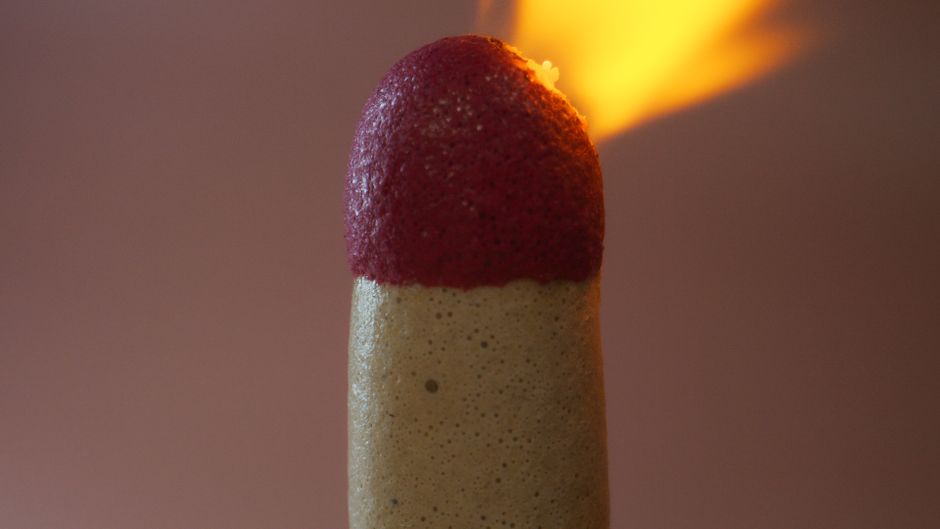
Photo by Tima Miroshnichenko on Pexels
Exothermic reactions release heat to the surroundings. You can think of heat as a product in an exothermic reaction:
$A + B \rightleftharpoons C + D + \text{Heat}$
- Increasing temperature: If you add heat (a product), the equilibrium will shift to the left (towards reactants) to consume the added heat. This decreases the concentration of products and increases reactants.
- Decreasing temperature: If you remove heat (a product), the equilibrium will shift to the right (towards products) to produce more heat. This increases the concentration of products and decreases reactants.
Endothermic Reactions ($\Delta H > 0$)
Photo by Vitaly Gariev on Pexels
Endothermic reactions absorb heat from the surroundings. You can think of heat as a reactant in an endothermic reaction:
$A + B + \text{Heat} \rightleftharpoons C + D$
- Increasing temperature: If you add heat (a reactant), the equilibrium will shift to the right (towards products) to consume the added heat. This increases the concentration of products and decreases reactants.
- Decreasing temperature: If you remove heat (a reactant), the equilibrium will shift to the left (towards reactants) to produce more heat. This decreases the concentration of products and increases reactants.
Impact on the Equilibrium Constant ($K_{eq}$)
Photo by Pixabay on Pexels
Temperature is the only factor that changes the value of the equilibrium constant ($K_{eq}$).
- For exothermic reactions: As temperature increases, $K_{eq}$ decreases (less product at equilibrium). As temperature decreases, $K_{eq}$ increases.
- For endothermic reactions: As temperature increases, $K_{eq}$ increases (more product at equilibrium). As temperature decreases, $K_{eq}$ decreases.
Here's how temperature changes influence equilibrium shifts:
graph TD
    A["Temperature Change"] --> B{Reaction Type?};
    B --> C["Exothermic ($\Delta H < 0$)"];
    B --> D["Endothermic ($\Delta H > 0$)"];

    C --> E{"Increase Temp?"};
    C --> F{"Decrease Temp?"};

    D --> G{"Increase Temp?"};
    D --> H{"Decrease Temp?"};

    E --> I["Shift Left (towards reactants)"];
    E --> J["K_eq Decreases"];

    F --> K["Shift Right (towards products)"];
    F --> L["K_eq Increases"];

    G --> M["Shift Right (towards products)"];
    G --> N["K_eq Increases"];

    H --> O["Shift Left (towards reactants)"];
    H --> P["K_eq Decreases"];
3. Worked Example
Consider the Haber-Bosch process for synthesizing ammonia:
$N_2(g) + 3H_2(g) \rightleftharpoons 2NH_3(g)$ with $\Delta H = -92.2 \text{ kJ/mol}$
Since $\Delta H$ is negative, this is an exothermic reaction. We can write it as:
$N_2(g) + 3H_2(g) \rightleftharpoons 2NH_3(g) + \text{Heat}$
Scenario 1: Increasing the temperature
If you increase the temperature, the system will try to consume the added heat. Since heat is a "product" in this exothermic reaction, the equilibrium will shift to the left, favoring the reactants ($N_2$ and $H_2$). This means less ammonia ($NH_3$) will be produced, and the value of $K_{eq}$ will decrease.
Scenario 2: Decreasing the temperature
If you decrease the temperature, the system will try to produce more heat. Since heat is a "product," the equilibrium will shift to the right, favoring the products ($NH_3$). This means more ammonia ($NH_3$) will be produced, and the value of $K_{eq}$ will increase.
4. Key Takeaways
- Temperature changes cause the equilibrium to shift to counteract the change in heat.
- For exothermic reactions ($\Delta H < 0$), heat is a product; increasing temperature shifts equilibrium left.
- For endothermic reactions ($\Delta H > 0$), heat is a reactant; increasing temperature shifts equilibrium right.
- Decreasing temperature has the opposite effect for both types of reactions.
- Temperature is the only factor that alters the numerical value of the equilibrium constant ($K_{eq}$).
- Exothermic reactions show a decrease in $K_{eq}$ with increasing temperature.
- Endothermic reactions show an increase in $K_{eq}$ with increasing temperature.
5. Now Try It
For the following reaction: $PCl_5(g) + \text{Heat} \rightleftharpoons PCl_3(g) + Cl_2(g)$
Describe what happens to the concentrations of $PCl_5$, $PCl_3$, and $Cl_2$, as well as the value of $K_{eq}$, if you were to:
1. Increase the temperature.
2. Decrease the temperature.
Success looks like clearly stating the shift direction, how each concentration changes, and whether $K_{eq}$ increases or decreases for both scenarios.
Frequently asked about Temperature Effects and Enthalpy Changes
Study this next
Get the full Le Chatelier's Principle curriculum
Clone the complete plan to your dashboard for unlimited AI-generated notes, practice quizzes, and a personalised revision schedule.
Save this course free