Introduction to Electrochemistry and Its Applications
From the Engineering Chemistry curriculum
TL;DR
Electrochemistry studies the relationship between chemical reactions and electrical energy, involving the conversion of chemical energy into electrical energy (and vice-versa). It's crucial for understanding batteries, corrosion, and many industrial processes. You'll learn how redox reactions drive electron flow to produce or consume electricity.
1. The Mental Model
Think of electrochemistry as the bridge between chemistry and electricity. It's all about how electrons move during chemical changes, either to generate an electric current or to make a non-spontaneous chemical reaction happen by supplying electricity.
2. The Core Material
Electrochemistry is fundamentally about redox reactions (reduction-oxidation reactions). In these reactions, electrons are transferred between chemical species.
* Oxidation is the loss of electrons (oxidation state increases).
* Reduction is the gain of electrons (oxidation state decreases).
These two processes always occur together. One species is oxidized, and another is reduced.
Electrochemical Cells

Photo by Tyler Lastovich on Pexels
An electrochemical cell is a device that facilitates these redox reactions to either produce electrical energy (a voltaic or galvanic cell) or to use electrical energy to drive a non-spontaneous reaction (an electrolytic cell).
The key components of an electrochemical cell are:
* Anode: Where oxidation occurs. It's the negative electrode in a galvanic cell and positive in an electrolytic cell.
* Cathode: Where reduction occurs. It's the positive electrode in a galvanic cell and negative in an electrolytic cell.
* Electrolyte: An ion-conducting solution or paste that allows charge to flow.
* External Circuit: Wires and a load (e.g., a light bulb) for electron flow.
* Salt Bridge (in galvanic cells): Connects the two half-cells, allowing ion migration to maintain charge neutrality and complete the circuit.
Voltaic (Galvanic) Cells
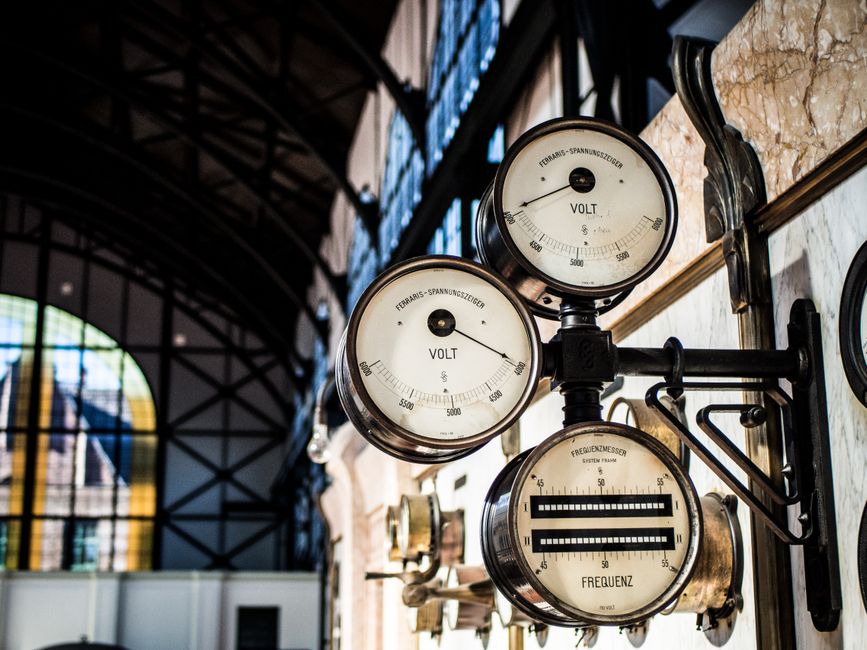
Photo by Jakob Schlothane on Pexels
These cells generate electricity from a spontaneous chemical reaction.
* Electrons flow spontaneously from the anode (where oxidation happens) to the cathode (where reduction happens) through the external circuit.
* Example: A standard battery.
graph TD
    A[Zn Anode (Oxidation)] -->|Electrons (e-)| C[Cu Cathode (Reduction)]
    C -->|Ions| B(Salt Bridge)
    B -->|Ions| A
    A -->|Zn2+ into solution| E(ZnSO4 Electrolyte)
    C -->|Cu2+ out of solution| D(CuSO4 Electrolyte)
    E --x B
    D --x B
    A --x C
    C --x A
    subgraph External Circuit
        A -- Wire --> LightBulb((Load))
        LightBulb -- Wire --> C
    end
Electrolytic Cells
Photo by Tyler Lastovich on Pexels
These cells use electrical energy from an external source to drive a non-spontaneous chemical reaction.
* Here, the external power source forces electrons to flow in the non-spontaneous direction.
* Example: Electroplating, refining metals, producing hydrogen from water.
Applications of Electrochemistry

Photo by Pixabay on Pexels
- Batteries: Convert chemical energy to electrical energy. E.g., lead-acid car batteries, lithium-ion phone batteries.
- Corrosion: The electrochemical degradation of metals (e.g., rusting of iron). Understanding its mechanism helps in prevention.
- Electroplating: Using an electrolytic cell to deposit a thin layer of one metal onto another (e.g., chrome plating).
- Electrosynthesis: Producing chemicals using electricity (e.g., chlorine, sodium hydroxide).
- Sensors: Electrochemical sensors detect specific chemicals by measuring changes in electrical properties.
3. Worked Example
Let's consider a Daniell cell, a classic example of a voltaic cell. It uses zinc and copper electrodes.
-
Identify the half-reactions:
- Zinc is more easily oxidized than copper. So, Zinc will be the anode.
- Oxidation (Anode): $\text{Zn(s)} \rightarrow \text{Zn}^{2+}\text{(aq)} + 2\text{e}^{-}$
- Copper ions will be reduced. So, Copper will be the cathode.
- Reduction (Cathode): $\text{Cu}^{2+}\text{(aq)} + 2\text{e}^{-} \rightarrow \text{Cu(s)}$
- Zinc is more easily oxidized than copper. So, Zinc will be the anode.
-
Overall reaction: Add the half-reactions, ensuring electrons cancel out.
- $\text{Zn(s)} + \text{Cu}^{2+}\text{(aq)} \rightarrow \text{Zn}^{2+}\text{(aq)} + \text{Cu(s)}$
-
Electron flow: Electrons are released at the zinc anode, travel through the external circuit (doing work, like lighting a bulb), and are consumed at the copper cathode.
-
Ion movement: In the zinc half-cell, $\text{Zn}^{2+}$ ions are produced, increasing positive charge. In the copper half-cell, $\text{Cu}^{2+}$ ions are consumed, decreasing positive charge. A salt bridge containing inert ions (e.g., $\text{K}^+$, $\text{Cl}^-$) is essential. Negative ions ($\text{Cl}^-$) flow into the anode compartment, and positive ions ($\text{K}^+$) flow into the cathode compartment to maintain charge neutrality.
This continuous flow of electrons is the electrical current generated by the cell.
4. Key Takeaways
- Electrochemistry links chemical reactions with electrical energy transfer, primarily through redox reactions.
- Oxidation is electron loss at the anode, and reduction is electron gain at the cathode.
- Voltaic (galvanic) cells spontaneously generate electricity from chemical reactions.
- Electrolytic cells use external electricity to drive non-spontaneous chemical reactions.
- The flow of electrons in the external circuit and ions in the electrolyte (and salt bridge) completes the electrical circuit.
- Electrochemistry is fundamental to batteries, corrosion, and various industrial processes like electroplating.
Common Mistakes to Avoid:
* Confusing anode and cathode, especially their charge in galvanic vs. electrolytic cells. Remember: Anode = Oxidation, Reduction = Cathode (mnemonic: "An Ox and a Red Cat").
* Forgetting the role of the salt bridge in maintaining charge neutrality in galvanic cells.
* Mixing up oxidation (loss of electrons) and reduction (gain of electrons).
* Assuming all electrochemical processes produce electricity; electrolytic cells consume it.
5. Now Try It
Design a simple voltaic cell using an aluminum electrode and a silver electrode, both immersed in solutions of their respective ions.
- Identify which metal will act as the anode (oxidation) and which as the cathode (reduction) by looking up their standard reduction potentials (you can find these online or in a textbook).
- Write down the balanced half-reactions for oxidation and reduction.
- Write the balanced overall cell reaction.
- Describe the direction of electron flow in the external circuit and the general direction of ion flow in the salt bridge.
Success looks like: You've correctly identified the anode and cathode, written the balanced half and overall reactions, and explained the electron and ion movement in the cell.
Frequently asked about Introduction to Electrochemistry and Its Applications
Study this next
Get the full Engineering Chemistry curriculum
Clone the complete plan to your dashboard for unlimited AI-generated notes, practice quizzes, and a personalised revision schedule.
Save this course free