Review and Problem Solving
From the chemistry chapter 4, chapter 5 curriculum
TL;DR
This chapter review will help you connect concepts from Chapters 4 and 5, focusing on solutions, solubility, and chemical reactions. We'll practice stoichiometry with solutions and understand how factors affect reaction rates. Mastering these topics is key for predicting and explaining chemical behavior.
1. The Mental Model
Imagine chemistry as a puzzle: Chapter 4 gives you the pieces (molecules, reactions), and Chapter 5 helps you understand how those pieces move and fit together in solutions. Our goal is to use the rules from both chapters to solve more complex problems.
2. The Core Material
2.1 Solution Concentration & Dilution

Photo by cottonbro studio on Pexels
Molarity (M) is moles of solute per liter of solution. It's a key way to express concentration.
$M = \frac{\text{moles of solute}}{\text{liters of solution}}$
Dilution involves reducing the concentration of a solution by adding more solvent. The total moles of solute remain constant.
$M_1V_1 = M_2V_2$ (where $M$ is molarity and $V$ is volume)
2.2 Solubility Rules & Precipitate Formation

Photo by Markus Winkler on Pexels
Knowing the solubility rules helps you predict whether an ionic compound will dissolve in water or form a precipitate (an insoluble solid) when two solutions are mixed.
graph TD
    A["Is compound ionic?"] -->|Yes| B{"Contains Li+, Na+, K+, NH4+, NO3-, C2H3O2-?"}
    B -->|Yes| C["Soluble"]
    B -->|No| D{"Contains Cl-, Br-, I-?"}
    D -->|Yes| E{"Paired with Ag+, Pb2+, Hg2^2+?"}
    E -->|Yes| F["Insoluble (Precipitate)"]
    E -->|No| C
    D -->|No| G{"Contains SO4^2-?"}
    G -->|Yes| H{"Paired with Ba2+, Pb2+, Sr2+, Ca2+?"}
    H -->|Yes| F
    H -->|No| C
    G -->|No| I{"Contains CO3^2-, PO4^3-, S^2-, OH-?"}
    I -->|Yes| J{"Paired with Li+, Na+, K+, NH4+?"}
    J -->|Yes| C
    J -->|No| F
    I -->|No| F
    A -->|No| K["Generally Insoluble (Covalent)"]
2.3 Stoichiometry with Solutions

Photo by Tara Winstead on Pexels
You can use solution concentrations (like molarity) as a bridge to calculate moles, which are essential for stoichiometric problems.
Steps:
1. Write and balance the chemical equation.
2. Calculate moles of known substance using its volume and molarity.
3. Use the mole ratio from the balanced equation to find moles of the unknown substance.
4. Convert moles of the unknown substance to the desired unit (e.g., volume using molarity, mass using molar mass).
2.4 Reaction Rates
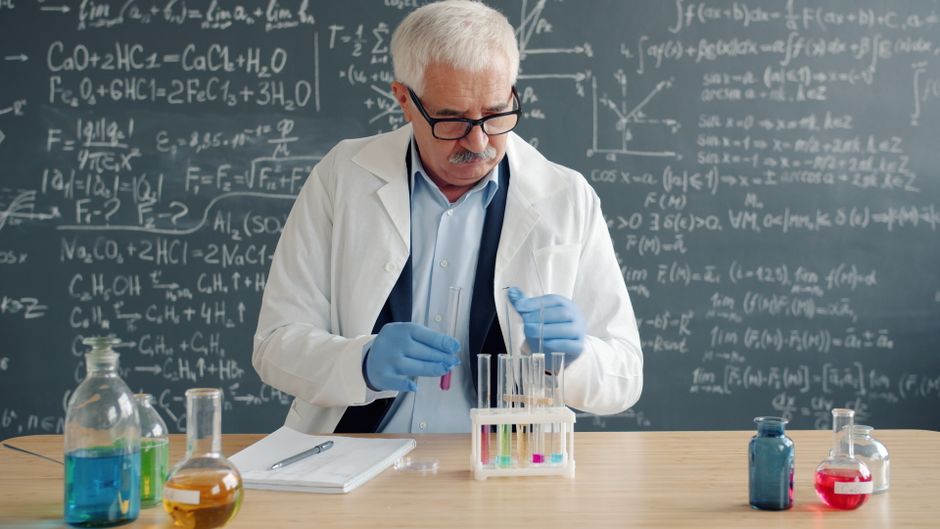
Photo by Vitaly Gariev on Pexels
Several factors influence how fast a reaction proceeds:
* Concentration: Higher concentration usually means faster reaction (more collisions).
* Temperature: Higher temperature means faster reaction (molecules move faster, more energetic collisions).
* Surface Area: For solids, larger surface area means faster reaction (more sites for reaction).
* Catalysts: A catalyst speeds up a reaction without being consumed itself.
3. Worked Example
Let's say you mix 50.0 mL of 0.200 M silver nitrate ($AgNO_3$) solution with 75.0 mL of 0.100 M sodium chloride ($NaCl$) solution. How many grams of silver chloride ($AgCl$) precipitate will form?
-
Balanced Equation:
$AgNO_3(aq) + NaCl(aq) \rightarrow AgCl(s) + NaNO_3(aq)$ -
Calculate moles of reactants:
- Moles $AgNO_3 = 0.200 \text{ M} \times 0.0500 \text{ L} = 0.0100 \text{ mol}$
- Moles $NaCl = 0.100 \text{ M} \times 0.0750 \text{ L} = 0.00750 \text{ mol}$
-
Identify Limiting Reactant:
From the balanced equation, $AgNO_3$ and $NaCl$ react in a 1:1 mole ratio.
Since you have fewer moles of $NaCl$ (0.00750 mol) than $AgNO_3$ (0.0100 mol), $NaCl$ is the limiting reactant. It will determine the amount of product. -
Calculate moles of product ($AgCl$):
Using the 1:1 mole ratio from the balanced equation:
Moles $AgCl = 0.00750 \text{ mol } NaCl \times \frac{1 \text{ mol } AgCl}{1 \text{ mol } NaCl} = 0.00750 \text{ mol } AgCl$ -
Convert moles of product to grams:
Molar mass of $AgCl = 107.87 \text{ (Ag)} + 35.45 \text{ (Cl)} = 143.32 \text{ g/mol}$
Grams $AgCl = 0.00750 \text{ mol } \times 143.32 \text{ g/mol} = 1.07 \text{ g } AgCl$
4. Key Takeaways
- Molarity is a crucial concentration unit for aqueous solutions, linking volume to moles.
- Dilution calculations ($M_1V_1 = M_2V_2$) allow you to prepare solutions of desired concentrations.
- Solubility rules help predict if a precipitate will form in a double displacement reaction.
- Stoichiometry with solutions involves using molarity and volume to find moles, then applying mole ratios.
- Limiting reactants are important in solution stoichiometry, as they dictate the maximum product yield.
- Factors like concentration, temperature, surface area, and catalysts all influence reaction rates.
Common mistakes to avoid:
- Forgetting to convert volumes to liters when using molarity.
- Not balancing the chemical equation before performing stoichiometric calculations.
- Misinterpreting solubility rules, especially for exceptions.
- Confusing limiting reactant calculations with excess reactant calculations.
5. Now Try It
You have a stock solution of 1.50 M $HCl$. You need to prepare 250.0 mL of a 0.300 M $HCl$ solution for an experiment. Additionally, if you react 100.0 mL of this 0.300 M $HCl$ with an excess of solid magnesium, how many grams of hydrogen gas ($H_2$) would be produced? Assume the reaction is: $Mg(s) + 2HCl(aq) \rightarrow MgCl_2(aq) + H_2(g)$.
What to do:
1. Calculate the volume of the 1.50 M $HCl$ stock solution needed for the dilution.
2. Then, use the volume and concentration of the diluted $HCl$ to find the grams of $H_2$ produced.
Success looks like:
* You correctly calculate the volume of stock solution needed.
* You correctly calculate the mass of hydrogen gas produced, showing your steps.
Frequently asked about Review and Problem Solving
Study this next
Get the full chemistry chapter 4, chapter 5 curriculum
Clone the complete plan to your dashboard for unlimited AI-generated notes, practice quizzes, and a personalised revision schedule.
Save this course free