States of Matter: Liquids and Solids
From the chemistry chapter 4, chapter 5 curriculum
TL;DR
Liquids and solids are condensed states of matter characterized by stronger intermolecular forces compared to gases. These forces dictate properties like viscosity, surface tension, and melting points. Understanding these forces helps explain why different substances behave the way they do at various temperatures and pressures.
1. The Mental Model
Imagine molecules as tiny magnets. In gases, they barely interact. In liquids, they're attracted enough to stick together but can still slide past each other. In solids, they're locked into a fixed position, vibrating in place.
2. The Core Material
When we talk about liquids and solids, we're really focusing on intermolecular forces (IMFs). These are the attractive forces between molecules, not within molecules (those are intramolecular bonds like covalent or ionic bonds). IMFs are much weaker than intramolecular bonds, but they're strong enough to hold molecules close together in liquids and solids.
Types of Intermolecular Forces

Photo by Alex Lain on Pexels
There are three main types of IMFs, listed from weakest to strongest:
- London Dispersion Forces (LDFs): These are present in ALL molecules, nonpolar and polar. They arise from temporary, fluctuating dipoles caused by the random movement of electrons. Larger molecules (with more electrons) tend to have stronger LDFs.
- Dipole-Dipole Forces: Occur between polar molecules (molecules with a permanent dipole moment). The positive end of one molecule is attracted to the negative end of another.
- Hydrogen Bonding: A special, very strong type of dipole-dipole interaction. It occurs when hydrogen is directly bonded to a highly electronegative atom (N, O, or F). The H atom effectively acts as a bridge between two electronegative atoms.
Properties of Liquids
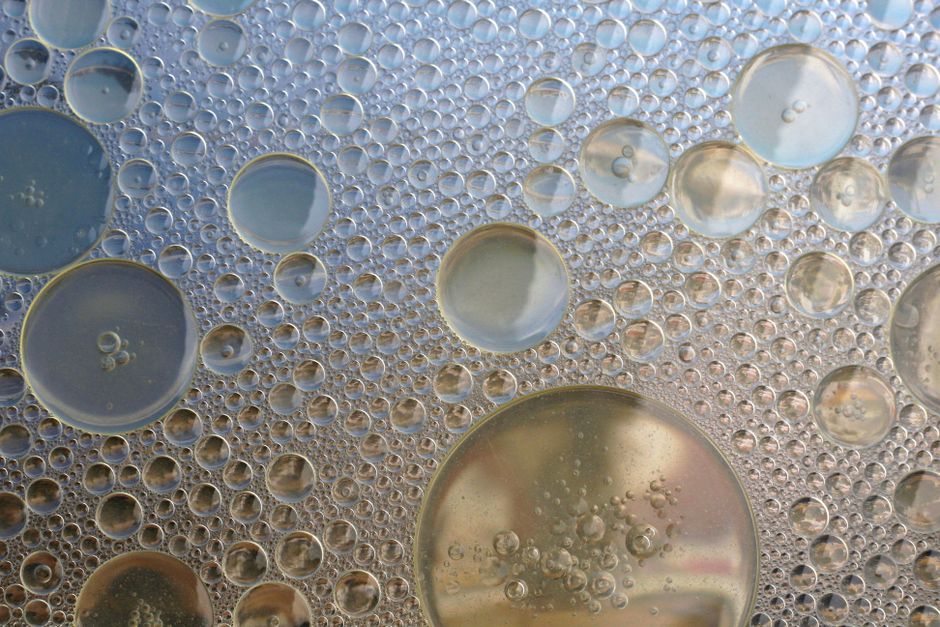
Photo by Landiva Weber on Pexels
IMFs significantly influence liquid properties:
- Viscosity: A liquid's resistance to flow. Stronger IMFs lead to higher viscosity (e.g., honey is more viscous than water).
- Surface Tension: The energy required to increase the surface area of a liquid. Stronger IMFs mean higher surface tension (e.g., water's surface tension allows insects to walk on it).
- Capillary Action: The ability of a liquid to flow in narrow spaces against gravity. It's a balance between cohesive forces (IMFs within the liquid) and adhesive forces (IMFs between the liquid and the container).
- Vapor Pressure: The pressure exerted by the vapor in equilibrium with its liquid phase. Weaker IMFs mean more molecules can escape into the gas phase, leading to higher vapor pressure.
- Boiling Point: The temperature at which a liquid's vapor pressure equals the external atmospheric pressure. Stronger IMFs require more energy to overcome, leading to higher boiling points.
Solids
Solids have molecules, atoms, or ions held in fixed positions, giving them a definite shape and volume. They can be classified as:
- Crystalline Solids: Have a highly ordered, repeating 3D structure called a crystal lattice. Examples include salt (NaCl) and diamond.
- Amorphous Solids: Lack a long-range ordered structure. Their particles are arranged randomly. Examples include glass and rubber.
The type of bonding within the solid also categorizes them:
- Molecular Solids: Formed by discrete molecules held together by IMFs (e.g., ice, sugar). Low melting points.
- Ionic Solids: Formed by ions held together by strong electrostatic forces (ionic bonds) in a lattice (e.g., NaCl). High melting points.
- Metallic Solids: Consist of metal atoms with delocalized electrons ("sea of electrons"). Good conductors, variable melting points.
- Covalent-Network Solids: Atoms held together by a network of strong covalent bonds throughout the entire structure (e.g., diamond, silicon dioxide). Very high melting points, very hard.
graph TD
    A["States of Matter"] --> B["Liquids"]
    A --> C["Solids"]

    B --> B1["Properties Influenced by IMFs"]
    B1 --> BP["Boiling Point"]
    B1 --> VP["Vapor Pressure"]
    B1 --> Vis["Viscosity"]
    B1 --> ST["Surface Tension"]

    C --> C1["Classification of Solids"]
    C1 --> Crys["Crystalline Solids"]
    C1 --> Amorph["Amorphous Solids"]

    Crys --> MS["Molecular Solids"]
    Crys --> IS["Ionic Solids"]
    Crys --> MetS["Metallic Solids"]
    Crys --> CNS["Covalent-Network Solids"]

    MS -- "Held by IMFs" --> BP
    IS -- "Held by Ionic Bonds" --> HP["High Melting Point"]
    MetS -- "Held by Metallic Bonds" --> ElecCon["Electrical Conductivity"]
    CNS -- "Held by Covalent Bonds" --> VHMP["Very High Melting Point"]

    IMFs["Intermolecular Forces (IMFs)"]
    IMFs --> LDF["London Dispersion Forces"]
    IMFs --> DD["Dipole-Dipole Forces"]
    IMFs --> HB["Hydrogen Bonding"]
    LDF --> All["Present in all molecules"]
    DD --> Polar["Between polar molecules"]
    HB --> "H-N, H-O, H-F"
3. Worked Example
Let's compare the boiling points of three simple substances: methane ($\text{CH}_4$), ammonia ($\text{NH}_3$), and water ($\text{H}_2\text{O}$).
- Methane ($\text{CH}_4$): This is a nonpolar molecule. The only IMFs present are London Dispersion Forces. It has a small molar mass.
- Ammonia ($\text{NH}_3$): This is a polar molecule. It has dipole-dipole forces. Critically, it also has hydrogen atoms bonded to nitrogen, so it exhibits hydrogen bonding.
- Water ($\text{H}_2\text{O}$): This is a polar molecule. It has dipole-dipole forces and strong hydrogen bonding (H atoms bonded to oxygen). Water can form two hydrogen bonds per molecule, whereas ammonia can only form one effectively.
Prediction: Based on IMF strength:
* Methane should have the lowest boiling point due to only LDFs.
* Ammonia should have a higher boiling point than methane due to hydrogen bonding.
* Water should have the highest boiling point due to stronger and more numerous hydrogen bonds.
Actual Boiling Points:
* Methane: -161.5 °C
* Ammonia: -33.3 °C
* Water: 100 °C
The observed boiling points perfectly align with the strength of the intermolecular forces: LDFs < Hydrogen Bonding (Ammonia) < Stronger Hydrogen Bonding (Water).
4. Key Takeaways
- Intermolecular forces (IMFs) are attractions between molecules, dictating the physical properties of liquids and solids.
- The three main IMFs are London Dispersion Forces, Dipole-Dipole Forces, and Hydrogen Bonding, in order of increasing strength.
- Stronger IMFs lead to higher boiling points, higher viscosity, higher surface tension, and lower vapor pressure.
- Solids can be crystalline (ordered) or amorphous (disordered) and are categorized by their bonding as molecular, ionic, metallic, or covalent-network.
- Hydrogen bonding is a particularly strong type of dipole-dipole force occurring when hydrogen is directly bonded to N, O, or F.
- Comparing physical properties often involves identifying the strongest IMF present in each substance.
- LDFs increase with the size and surface area of a molecule.
5. Now Try It
Predict which substance in each pair will have a higher boiling point and explain why:
1. $\text{C}_2\text{H}_6$ (ethane) vs. $\text{C}_4\text{H}_{10}$ (butane)
2. $\text{CH}_3\text{OH}$ (methanol) vs. $\text{CH}_3\text{F}$ (fluoromethane)
3. $\text{HCl}$ (hydrogen chloride) vs. $\text{F}_2$ (fluorine)
Success looks like: For each pair, you correctly identify the substance with the higher boiling point and clearly state which type of intermolecular force is dominant for each substance, explaining how it leads to the difference in boiling points.
Frequently asked about States of Matter: Liquids and Solids
Study this next
Get the full chemistry chapter 4, chapter 5 curriculum
Clone the complete plan to your dashboard for unlimited AI-generated notes, practice quizzes, and a personalised revision schedule.
Save this course free