States of Matter: Gases
From the chemistry chapter 4, chapter 5 curriculum
TL;DR
Gases are highly compressible fluids with particles in constant, random motion, exerting pressure as they collide with container walls. Their behavior is largely predictable by simple gas laws relating pressure, volume, temperature, and amount. Understanding these laws helps explain everyday phenomena and underpins many chemical processes.
1. The Mental Model
Imagine tiny, invisible billiard balls flying around incredibly fast inside a room, bouncing off each other and the walls. That's essentially how you can think about gas particles. They don't stick together, and the space between them is mostly empty.
2. The Core Material
Gases are one of the fundamental states of matter, characterized by particles that are far apart, move randomly and rapidly, and have negligible forces of attraction between them. This leads to unique properties compared to solids and liquids.
Properties of Gases

Photo by Rafael Minguet Delgado on Pexels
- Compressibility: Gases can be easily squeezed into smaller volumes because of the large spaces between particles.
- Expansion: Gases expand to fill any container they're in.
- Low Density: Compared to solids and liquids, gases have very low densities.
- Fluidity: Gases flow easily, just like liquids.
- Pressure: Gas particles constantly collide with the walls of their container, creating pressure.
Ideal Gas vs. Real Gas
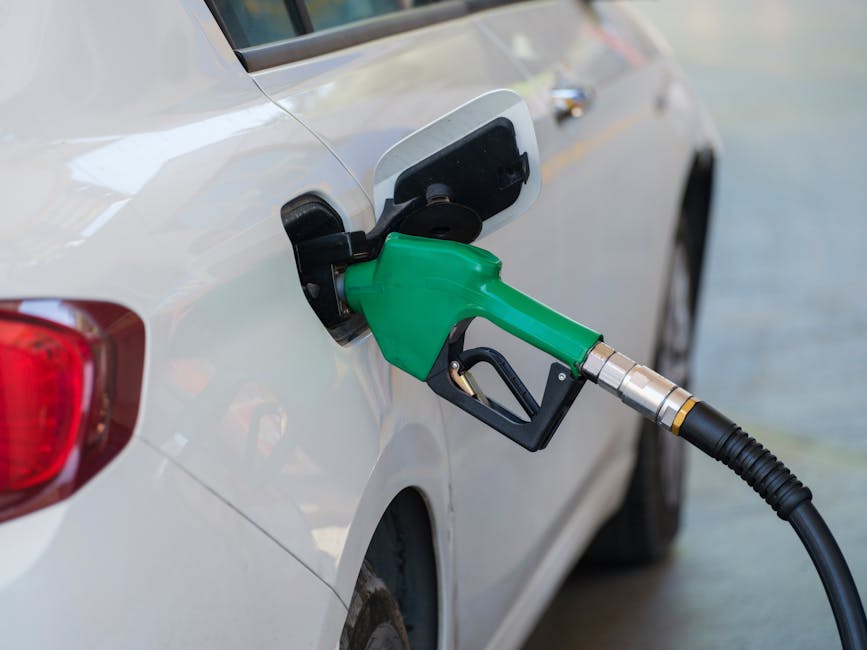
Photo by Engin Akyurt on Pexels
For most calculations, we use the ideal gas model. An ideal gas is a hypothetical gas whose particles have:
1. No volume (they're point masses).
2. No attractive or repulsive forces between them.
3. Perfectly elastic collisions (no energy loss).
Real gases deviate from ideal behavior, especially at high pressures (particles are closer, their volume becomes significant) and low temperatures (particles move slower, attractive forces become more important).
Gas Laws
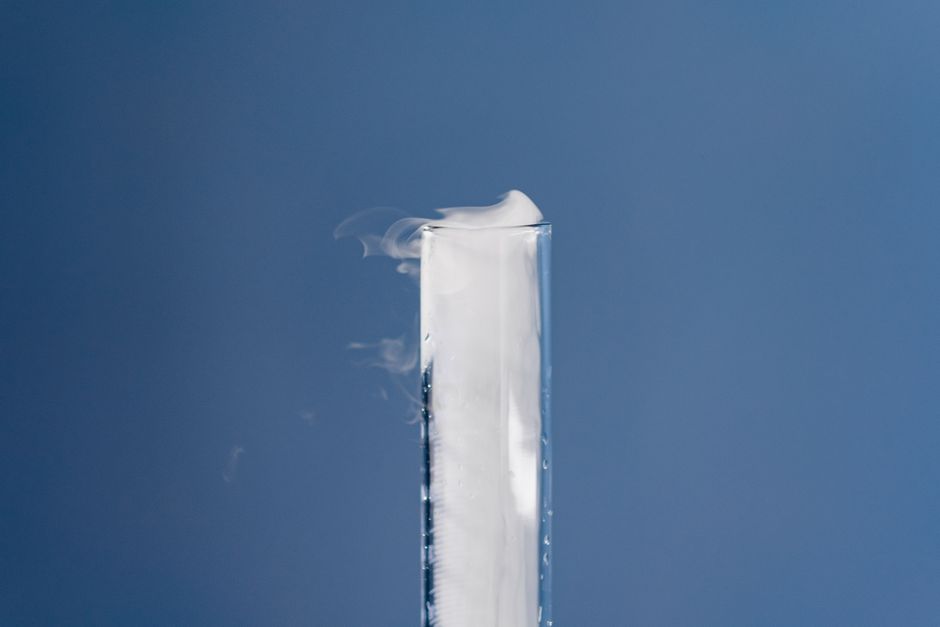
Photo by Ron Lach on Pexels
The relationships between pressure (P), volume (V), temperature (T), and amount of gas (n) are described by several gas laws:
Boyle's Law (P-V Relationship)
At constant temperature and amount of gas, pressure and volume are inversely proportional. If you decrease volume, pressure increases.
$P_1V_1 = P_2V_2$
Charles's Law (V-T Relationship)
At constant pressure and amount of gas, volume and absolute temperature are directly proportional. If you increase temperature, volume increases.
$V_1/T_1 = V_2/T_2$ (Temperature must be in Kelvin!)
Gay-Lussac's Law (P-T Relationship)
At constant volume and amount of gas, pressure and absolute temperature are directly proportional. If you increase temperature, pressure increases.
$P_1/T_1 = P_2/T_2$ (Temperature must be in Kelvin!)
Avogadro's Law (V-n Relationship)
At constant temperature and pressure, volume and the amount of gas (moles) are directly proportional.
$V_1/n_1 = V_2/n_2$
Combined Gas Law
When the amount of gas is constant but P, V, and T change, you can combine Boyle's, Charles's, and Gay-Lussac's laws:
$P_1V_1/T_1 = P_2V_2/T_2$ (Temperature must be in Kelvin!)
Ideal Gas Law
This law combines all the relationships into one equation, useful for finding any single variable if the others are known.
$PV = nRT$
Where:
* P = pressure (atm, kPa, mmHg)
* V = volume (L)
* n = moles (mol)
* R = ideal gas constant (0.08206 L·atm/(mol·K) or 8.314 J/(mol·K) or 8.314 L·kPa/(mol·K) – choose based on units of P)
* T = absolute temperature (K)
Remember to convert temperature to Kelvin ($K = °C + 273.15$) for all gas law calculations!
graph TD
    A["Gas Properties"] --> B{"Interparticle Forces?"}
    B -- "Strong" --> C["Solid or Liquid (Ch 5)"]
    B -- "Negligible" --> D["Gas (Ch 4)"]
    D --> E["Gas Behavior"]
    E --> F["Compressibility & Expansion"]
    E --> G["Pressure"]
    E --> H["Diffusion & Effusion"]
    G --> I{"Gas Laws"}
    I -- "Constant T, n" --> J["Boyle's Law (P ∝ 1/V)"]
    I -- "Constant P, n" --> K["Charles's Law (V ∝ T)"]
    I -- "Constant V, n" --> L["Gay-Lussac's Law (P ∝ T)"]
    I -- "Constant P, T" --> M["Avogadro's Law (V ∝ n)"]
    I -- "Varying P, V, T (Constant n)" --> N["Combined Gas Law"]
    I -- "Any conditions" --> O["Ideal Gas Law (PV = nRT)"]
    J --> O
    K --> O
    L --> O
    M --> O
    N --> O
Dalton's Law of Partial Pressures

Photo by Magda Ehlers on Pexels
In a mixture of non-reacting gases, the total pressure is the sum of the partial pressures of the individual gases.
$P_{total} = P_1 + P_2 + P_3 + ...$
The partial pressure of a gas is the pressure it would exert if it were the only gas in the container. It's related to its mole fraction ($X_A$) in the mixture:
$P_A = X_A \times P_{total}$
where $X_A = n_A / n_{total}$
Kinetic Molecular Theory (KMT)
This theory explains the behavior of ideal gases based on a few key postulates:
1. Gases consist of large numbers of tiny particles that are in continuous, random motion.
2. The volume of the individual particles is negligible compared to the volume of the container.
3. Collisions between particles and container walls are elastic (no energy lost).
4. There are no attractive or repulsive forces between particles.
5. The average kinetic energy of gas particles is proportional to the absolute temperature (K). At a given temperature, all gas particles have the same average kinetic energy.
3. Worked Example
You have a sample of gas with a volume of 3.50 L at 25.0 °C and 1.00 atm. If the temperature is increased to 50.0 °C and the pressure is decreased to 0.850 atm, what is the new volume of the gas?
-
Identify knowns and unknowns:
- $V_1 = 3.50 L$
- $T_1 = 25.0 °C$
- $P_1 = 1.00 atm$
- $V_2 = ?$
- $T_2 = 50.0 °C$
- $P_2 = 0.850 atm$
-
Convert temperatures to Kelvin:
- $T_1 = 25.0 + 273.15 = 298.15 K$
- $T_2 = 50.0 + 273.15 = 323.15 K$
-
Choose the correct law: Since P, V, and T are all changing (and n is constant), use the Combined Gas Law: $P_1V_1/T_1 = P_2V_2/T_2$
-
Rearrange the formula to solve for $V_2$:
$V_2 = (P_1V_1T_2) / (P_2T_1)$ -
Plug in the values and calculate:
$V_2 = (1.00 \text{ atm} \times 3.50 \text{ L} \times 323.15 \text{ K}) / (0.850 \text{ atm} \times 298.15 \text{ K})$
$V_2 = (1131.025) / (253.4275)$
$V_2 \approx 4.46 \text{ L}$
The new volume of the gas is approximately 4.46 L.
4. Key Takeaways
- Gases are characterized by widely spaced particles in constant, random motion, resulting in high compressibility and fluidity.
- The Ideal Gas Law ($PV=nRT$) is a fundamental equation that relates pressure, volume, moles, and temperature for gases.
- Always convert temperature to Kelvin ($K = °C + 273.15$) when doing gas law calculations to avoid errors.
- Boyle's, Charles's, and Gay-Lussac's laws describe specific relationships between two gas properties when others are held constant.
- Dalton's Law of Partial Pressures helps calculate total pressure or individual gas pressures in a mixture.
- The Kinetic Molecular Theory explains ideal gas behavior based on particle motion and negligible intermolecular forces.
Common Mistakes to Avoid:
- Forgetting to convert Celsius temperatures to Kelvin for any gas law calculation.
- Mixing units for pressure, volume, or temperature; ensure consistency, especially with the Ideal Gas Constant R.
- Applying ideal gas laws to real gases at very high pressures or very low temperatures, where deviations are significant.
- Confusing direct and inverse relationships (e.g., thinking P and V are directly proportional).
5. Now Try It
You have a 2.00 mol sample of helium gas in a 10.0 L container at 25.0 °C. What pressure, in atmospheres, does the gas exert on the container walls?
What success looks like: You'll use the Ideal Gas Law ($PV=nRT$), convert temperature to Kelvin, choose the correct value for R, and calculate the pressure in atmospheres, showing your steps clearly.
Frequently asked about States of Matter: Gases
Study this next
Get the full chemistry chapter 4, chapter 5 curriculum
Clone the complete plan to your dashboard for unlimited AI-generated notes, practice quizzes, and a personalised revision schedule.
Save this course free