Introduction to Kinematics and Basic Concepts
From the KINEMATICS curriculum
TL;DR
Kinematics describes how objects move without considering why they move, focusing on position, displacement, velocity, and acceleration. These concepts help us understand motion in terms of straight lines or curves. You'll use these basic ideas to predict where an object will be and how fast it's going.
1. The Mental Model
Imagine you're watching a car drive by. Kinematics helps you describe its journey: where it starts, where it ends up, how quickly it gets there, and if it's speeding up or slowing down. It's like narrating a story of motion without knowing the driver's intentions or the engine's power.
2. The Core Material
Kinematics is the branch of mechanics that studies the motion of points, objects, and systems of objects without considering the causes of their motion. We'll focus on these fundamental concepts:
Position and Displacement

Photo by Pixabay on Pexels
Position tells you an object's location relative to a reference point (like the origin of a coordinate system). It's a vector quantity, meaning it has both magnitude (how far) and direction. For 1D motion, we often use 'x' for horizontal or 'y' for vertical.
Displacement ($\Delta x$) is the change in an object's position. It's the straight-line distance and direction from the initial position ($x_i$) to the final position ($x_f$).
$\Delta x = x_f - x_i$
Displacement is also a vector. It's not the same as total distance traveled. If you walk 5m forward and 5m backward, your total distance is 10m, but your displacement is 0m.
Velocity and Speed
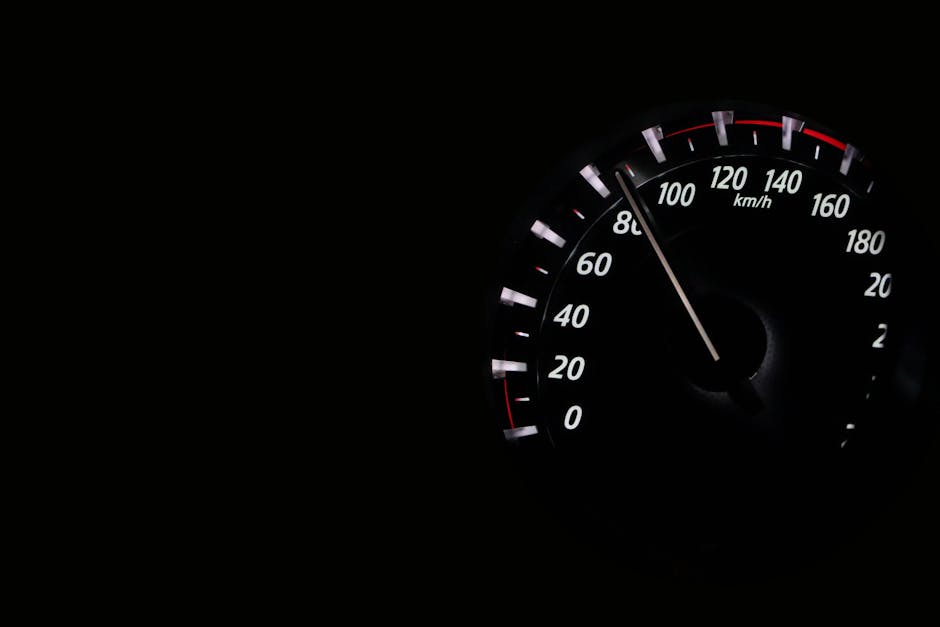
Photo by Pixabay on Pexels
Speed is how fast an object is moving, regardless of direction. It's a scalar quantity (only magnitude).
Average speed = Total distance / Total time
Velocity ($\vec{v}$) is the rate at which an object's position changes. It's a vector, including both speed and direction.
Average velocity = Displacement ($\Delta x$) / Time interval ($\Delta t$)
$\vec{v}_{avg} = \frac{\Delta x}{\Delta t} = \frac{x_f - x_i}{t_f - t_i}$
Instantaneous velocity is the velocity at a specific moment in time.
Acceleration
Acceleration ($\vec{a}$) is the rate at which an object's velocity changes. It's also a vector. An object accelerates if its speed changes, its direction changes, or both.
Average acceleration = Change in velocity ($\Delta \vec{v}$) / Time interval ($\Delta t$)
$\vec{a}_{avg} = \frac{\Delta \vec{v}}{\Delta t} = \frac{\vec{v}_f - \vec{v}_i}{t_f - t_i}$
A positive acceleration doesn't always mean speeding up; it depends on the direction of velocity. If velocity is negative and acceleration is positive, the object is slowing down (e.g., braking while moving backward).
Here's a simple way to visualize how these concepts relate:
graph TD
    A["Start Point (Reference)"] --> B["Position (x or y)"];
    B --> C{"Change in Position?"};
    C -- "Yes" --> D["Displacement (Δx)"];
    D --> E["Time Taken (Δt)"];
    E --> F["Velocity (Δx/Δt)"];
    F --> G{"Change in Velocity?"};
    G -- "Yes" --> H["Acceleration (Δv/Δt)"];
    C -- "No" --> I["No Motion"];
    G -- "No" --> J["Constant Velocity"];
3. Worked Example
Let's say a remote-controlled car starts at position $x_i = +2.0$ meters at $t_i = 0$ seconds. It moves to a final position $x_f = -8.0$ meters at $t_f = 5.0$ seconds.
-
Calculate the displacement:
$\Delta x = x_f - x_i = (-8.0 \text{ m}) - (2.0 \text{ m}) = -10.0 \text{ m}$The displacement is -10.0 meters. The negative sign indicates the displacement is in the negative direction (e.g., to the left of the origin).
-
Calculate the average velocity:
$\Delta t = t_f - t_i = 5.0 \text{ s} - 0 \text{ s} = 5.0 \text{ s}$
$\vec{v}_{avg} = \frac{\Delta x}{\Delta t} = \frac{-10.0 \text{ m}}{5.0 \text{ s}} = -2.0 \text{ m/s}$The average velocity is -2.0 meters per second. This means, on average, the car was moving at 2.0 m/s in the negative direction.
4. Key Takeaways
- Kinematics describes motion (how objects move) without explaining the forces causing it.
- Position is where an object is, relative to an origin.
- Displacement is the change in position ($\Delta x$), a vector quantity.
- Speed is how fast something is moving (scalar); velocity is how fast and in what direction (vector).
- Acceleration is the rate of change of velocity, also a vector.
- Be careful with signs: positive and negative indicate direction in 1D motion.
- Displacement and total distance traveled are generally not the same.
Common Mistakes to Avoid:
- Confusing distance with displacement.
- Confusing speed with velocity.
- Forgetting that velocity and acceleration are vector quantities (they have direction).
- Assuming positive acceleration always means speeding up.
5. Now Try It
Imagine you walk 30 meters east, then turn around and walk 10 meters west. If this whole journey took you 40 seconds:
- What is your total distance traveled?
- What is your final displacement from your starting point?
- What is your average speed?
- What is your average velocity?
Success looks like calculating both scalar (distance, speed) and vector (displacement, velocity) quantities correctly, remembering to include direction for the vector answers.
Frequently asked about Introduction to Kinematics and Basic Concepts
Study this next
Get the full KINEMATICS curriculum
Clone the complete plan to your dashboard for unlimited AI-generated notes, practice quizzes, and a personalised revision schedule.
Save this course free