"Classification and taxonomy (kingdoms, phyla, classes, orders, families, genera, species)",
From the Biology O'level curriculum
TL;DR
Classification is how scientists group living things based on their similarities, while taxonomy is the science of naming and classifying organisms. This system helps us understand the relationships between different life forms, from broad kingdoms down to specific species. It provides a universal way to identify and study the millions of organisms on Earth.
1. The Mental Model
Imagine organising a massive library: you'd start with big sections (like "Fiction" or "Science"), then smaller shelves (like "Fantasy" or "Physics"), then individual authors, and finally specific books. Biological classification works similarly, sorting living things from very general groups to very specific ones.
2. The Core Material
Classification is the process of arranging organisms into groups based on shared characteristics. Taxonomy is the branch of biology that deals with identifying, naming, and classifying organisms. This system was largely popularised by Carl Linnaeus and is hierarchical, meaning it has several levels or ranks.
The main ranks in order from broadest to most specific are:
- Kingdom: The largest and most inclusive group. Think of animals, plants, fungi, etc.
- Phylum: A major division within a Kingdom, grouping organisms with a common body plan.
- Class: A subdivision of a Phylum, sharing more specific characteristics.
- Order: A subdivision of a Class.
- Family: A subdivision of an Order, containing closely related genera.
- Genus: A group of closely related species. The first part of a scientific name.
- Species: The most specific group. Organisms within the same species can interbreed to produce fertile offspring. The second part of a scientific name.
The scientific name of an organism uses the binomial nomenclature system, which consists of two parts: the Genus name (capitalised) and the species name (lowercase), both italicised. For example, humans are Homo sapiens. Homo is the genus, and sapiens is the species.
This hierarchical system helps us see evolutionary relationships. Organisms in the same lower ranks (like genus or species) are more closely related than those only sharing higher ranks (like kingdom).
graph TD
    A["Life"] --> B["Domain"]
    B --> C["Kingdom"]
    C --> D["Phylum"]
    D --> E["Class"]
    E --> F["Order"]
    F --> G["Family"]
    G --> H["Genus"]
    H --> I["Species"]
Why Classify?
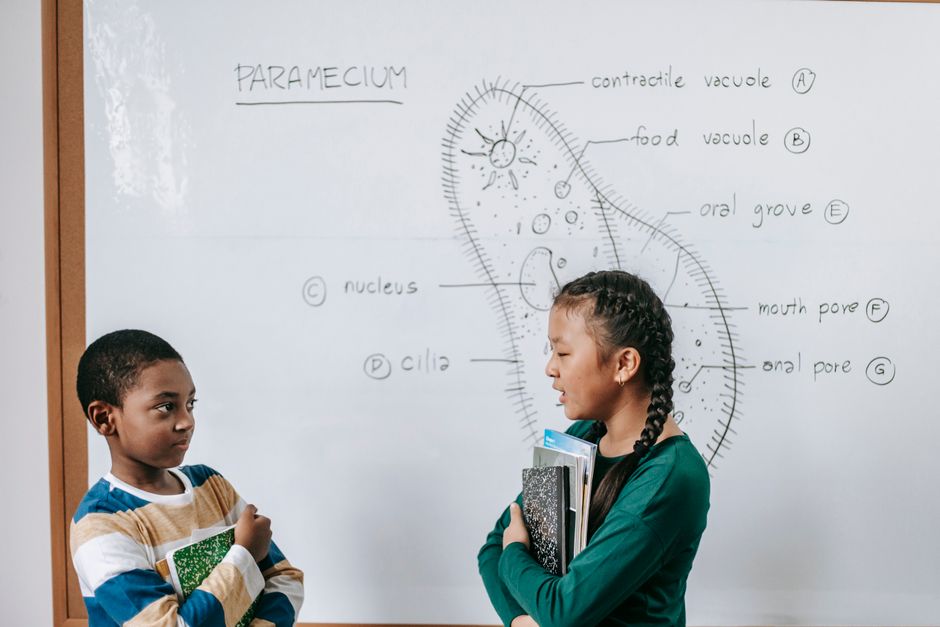
Photo by Katerina Holmes on Pexels
- Organisation: Makes the study of millions of organisms manageable.
- Identification: Helps to identify newly discovered organisms.
- Relationships: Shows evolutionary relationships and common ancestry.
- Universal Language: Provides a globally recognised naming system, avoiding confusion caused by different common names in various languages.
3. Worked Example
Let's take a common animal, the domestic cat, and classify it:
- Kingdom: Animalia (It's an animal)
- Phylum: Chordata (It has a backbone)
- Class: Mammalia (It's a mammal – fur, mammary glands)
- Order: Carnivora (It's a meat-eater)
- Family: Felidae (It's a cat-like animal)
- Genus: Felis (It belongs to the group of small cats)
- Species: catus (The specific domestic cat species)
So, the scientific name for the domestic cat is Felis catus.
4. Key Takeaways
- Classification organises living things into groups based on similarities.
- Taxonomy is the science of naming and classifying organisms.
- The classification hierarchy goes from Kingdom (broadest) down to Species (most specific).
- The order of classification ranks is Kingdom, Phylum, Class, Order, Family, Genus, Species.
- Binomial nomenclature uses the Genus and species names for an organism's scientific name (e.g., Homo sapiens).
- This system helps us understand relationships and provides a universal naming convention.
Common Mistakes to Avoid:
- Mixing up the order of the classification ranks. Remember a mnemonic like King Philip Came Over For Great Soup.
- Forgetting to italicise scientific names or capitalise the Genus name.
- Thinking that organisms in different Kingdoms can interbreed to produce fertile offspring.
- Confusing "classification" (the act of grouping) with "taxonomy" (the science of doing it).
5. Now Try It
Choose two very different organisms, for example, a rose plant and a dog. For each organism, try to list its classification from Kingdom all the way down to Species. Pay close attention to how much detail you can provide at each level. What success looks like: You should have two complete classification lists, one for the rose and one for the dog, with their correct scientific names.
Frequently asked about "Classification and taxonomy (kingdoms, phyla, classes, orders, families, genera, species)",
More from Biology O'level
Get the full Biology O'level curriculum
Clone the complete plan to your dashboard for unlimited AI-generated notes, practice quizzes, and a personalised revision schedule.
Create Free Account