Chemical Bonding and Stoichiometry
From the sec chemistry curriculum
TL;DR
Chemical bonds form to make atoms more stable, determining how substances behave. Stoichiometry uses these relationships to predict the amounts of reactants and products in chemical reactions. Understanding both helps you make sense of chemical formulas and balanced equations.
1. The Mental Model
Think of atoms as wanting to be "happy" by having a full outer shell of electrons. Chemical bonds are how they achieve this stability, either by sharing or transferring electrons. Stoichiometry is then like following a recipe, telling you exactly how much of each ingredient you need and how much product you'll get.
2. The Core Material
What is Chemical Bonding?
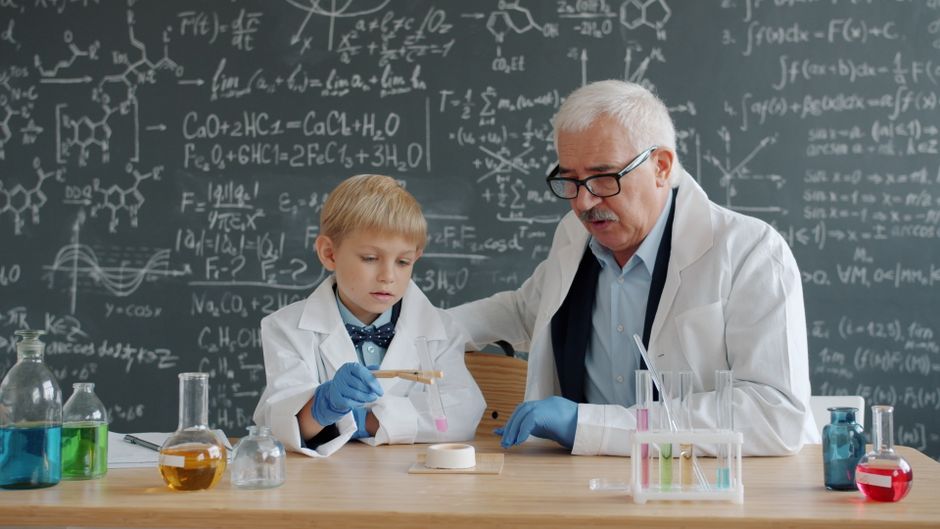
Photo by Vitaly Gariev on Pexels
Chemical bonds are the forces that hold atoms together to form molecules or compounds. They form because atoms strive to achieve a stable electron configuration, typically a full outer electron shell (like noble gases).
There are two main types of strong chemical bonds you'll encounter:
-
Ionic Bonding: This happens when electrons are transferred from one atom to another. It typically occurs between a metal and a non-metal. The metal loses electrons to become a positive ion (cation), and the non-metal gains electrons to become a negative ion (anion). These oppositely charged ions are then attracted to each other, forming a strong electrostatic bond.
Example: Sodium (Na) readily loses one electron to become Na$^+$, while Chlorine (Cl) readily gains one electron to become Cl$^-$. They form NaCl.
-
Covalent Bonding: This happens when atoms share electrons to achieve a stable outer shell. It typically occurs between two non-metals. The shared electrons are attracted to the nuclei of both atoms, holding them together.
Example: Two hydrogen atoms (H) each need one electron to complete their outer shell. They share their electrons to form an H$_2$ molecule. Oxygen (O$_2$) shares two pairs of electrons (a double bond).
What is Stoichiometry?

Photo by Ann H on Pexels
Stoichiometry is the study of the quantitative relationships between reactants and products in a chemical reaction. It's based on the Law of Conservation of Mass, which states that matter cannot be created or destroyed in a chemical reaction. This means the total mass of reactants must equal the total mass of products.
To perform stoichiometry calculations, you'll need to:
- Write a balanced chemical equation: This shows the correct chemical formulas and the relative number of moles of each reactant and product. Coefficients are used to balance the number of atoms of each element on both sides of the equation.
- Use mole ratios: The coefficients in a balanced equation provide the mole ratios, which are conversion factors between different substances in the reaction.
- Convert between mass, moles, and particles: You'll use molar mass to convert between mass (grams) and moles, and Avogadro's number ($6.022 \times 10^{23}$ particles/mol) to convert between moles and the number of atoms/molecules.
Here's how bonding helps you understand formulas, which are crucial for stoichiometry:
graph TD
    A["Atoms and their electron configurations"] --> B["Tendency to gain, lose, or share electrons"]
    B --> C{"Type of Bonding?"}
    C -->|Transfer electrons| D["Ionic Bond"]
    C -->|Share electrons| E["Covalent Bond"]
    D --> F["Formation of Ions (cations & anions)"]
    E --> G["Formation of Molecules"]
    F --> H["Formula writing (e.g., NaCl, CaCl2)"]
    G --> H
    H --> I["Balanced Chemical Equations"]
    I --> J["Stoichiometric Calculations (mole ratios, mass-mole conversions)"]
    J --> K["Predicting amounts of reactants/products"]
Balancing Chemical Equations

Photo by Vitaly Gariev on Pexels
Balancing an equation ensures that the number of atoms of each element is the same on both the reactant side (left) and the product side (right).
- Step 1: Write the unbalanced equation.
- Step 2: Count the number of atoms for each element on both sides.
- Step 3: Add coefficients (whole numbers) in front of the chemical formulas to balance the atoms. Start with elements that appear in only one reactant and one product. Leave H and O for last.
- Step 4: Recheck your counts.
Example: Unbalanced: H$_2$ + O$_2$ $\rightarrow$ H$_2$O
Balanced: 2H$_2$ + O$_2$ $\rightarrow$ 2H$_2$O
Mole Ratios and Calculations

Photo by Kindel Media on Pexels
Once an equation is balanced, you can use the coefficients as mole ratios to convert between moles of different substances.
Example: For 2H$_2$ + O$_2$ $\rightarrow$ 2H$_2$O:
The mole ratio of H$_2$ to O$_2$ is 2:1.
The mole ratio of H$_2$ to H$_2$O is 2:2 (or 1:1).
To convert mass to moles or moles to mass, use the molar mass (from the periodic table):
Moles = Mass / Molar Mass
Mass = Moles $\times$ Molar Mass
3. Worked Example
Let's consider the reaction of hydrogen gas with nitrogen gas to form ammonia (NH$_3$).
Problem: How many grams of ammonia (NH$_3$) can be produced from 10.0 g of hydrogen gas (H$_2$)?
Step 1: Write and balance the chemical equation.
Unbalanced: N$_2$ + H$_2$ $\rightarrow$ NH$_3$
Balanced: N$_2$ + 3H$_2$ $\rightarrow$ 2NH$_3$
Step 2: Convert the given mass of H$_2$ to moles.
Molar mass of H$_2$ = 2 $\times$ 1.01 g/mol = 2.02 g/mol
Moles of H$_2$ = 10.0 g / 2.02 g/mol $\approx$ 4.95 mol H$_2$
Step 3: Use the mole ratio from the balanced equation to find moles of NH$_3$.
From the balanced equation, 3 moles of H$_2$ produce 2 moles of NH$_3$.
Mole ratio: (2 mol NH$_3$) / (3 mol H$_2$)
Moles of NH$_3$ = 4.95 mol H$_2$ $\times$ (2 mol NH$_3$ / 3 mol H$_2$) $\approx$ 3.30 mol NH$_3$
Step 4: Convert moles of NH$_3$ to grams.
Molar mass of NH$_3$ = 14.01 g/mol (N) + 3 $\times$ 1.01 g/mol (H) = 17.04 g/mol
Mass of NH$_3$ = 3.30 mol $\times$ 17.04 g/mol $\approx$ 56.2 g NH$_3$
So, 10.0 g of hydrogen gas can produce approximately 56.2 g of ammonia.
4. Key Takeaways
- Atoms form chemical bonds (ionic or covalent) to achieve a stable electron configuration.
- Ionic bonds involve electron transfer, creating ions attracted by electrostatic forces.
- Covalent bonds involve electron sharing between atoms.
- Stoichiometry uses balanced chemical equations to quantify relationships in reactions.
- Balancing equations ensures the Law of Conservation of Mass is upheld.
- Mole ratios from balanced equations are essential for converting between substances.
- You'll frequently use molar mass to convert between grams and moles.
Common Mistakes to Avoid:
- Not balancing the chemical equation correctly before starting calculations.
- Using incorrect chemical formulas, which invalidates the entire calculation.
- Confusing mole ratios with mass ratios – ratios are always based on moles.
- Forgetting to convert mass to moles before using mole ratios.
5. Now Try It
Consider the combustion of methane: CH$_4$ + O$_2$ $\rightarrow$ CO$_2$ + H$_2$O. First, balance this equation. Then, if you have 16.0 grams of methane (CH$_4$), calculate how many grams of carbon dioxide (CO$_2$) would be produced.
What success looks like:
You should be able to balance the equation correctly, calculate the moles of methane, use the mole ratio to find moles of carbon dioxide, and finally convert that to grams of carbon dioxide, getting a final answer around 44.0 grams.
Frequently asked about Chemical Bonding and Stoichiometry
Study this next
Get the full sec chemistry curriculum
Clone the complete plan to your dashboard for unlimited AI-generated notes, practice quizzes, and a personalised revision schedule.
Create Free Account