Chemical Equations and Stoichiometry
From the chemical reactions (chemistry in biology) curriculum
Chemical Equations and Stoichiometry
TL;DR
Chemical equations are like recipes, showing what ingredients (reactants) you need to make what products. Stoichiometry uses these recipes to calculate the exact amounts of reactants and products involved. It's crucial for understanding how much of something you'll get or need in a reaction.
1. The Mental Model
Think of a chemical reaction as building with LEGOs: you have specific blocks (atoms/molecules) that combine in fixed ways to make new structures. A chemical equation shows the 'blueprint' for that transformation, and stoichiometry helps you count the exact number of blocks and structures.
2. The Core Material
When chemicals react, atoms aren't created or destroyed; they just rearrange. A chemical equation is a shorthand way to represent this process.
Reactants and Products
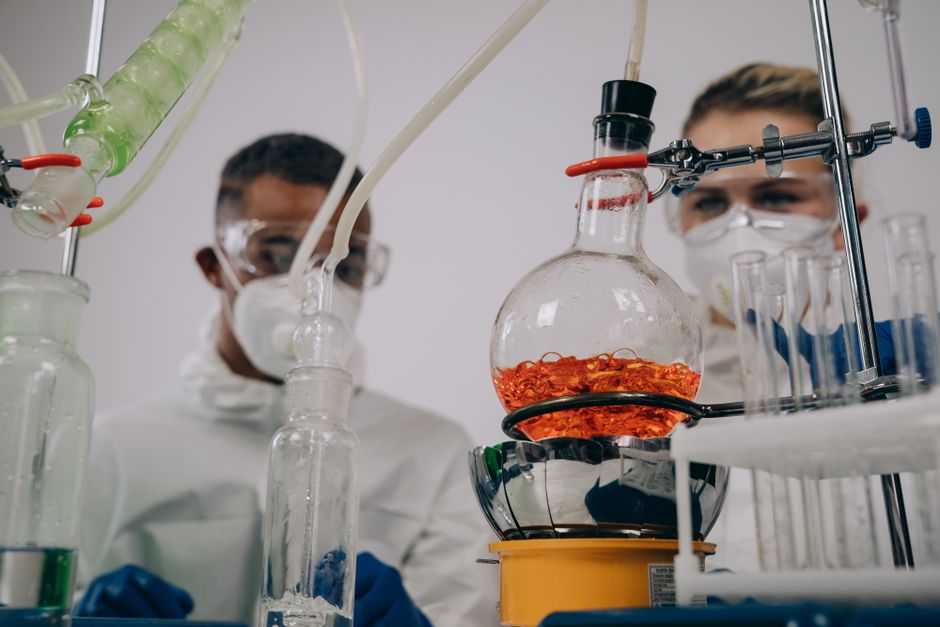
Photo by Mikhail Nilov on Pexels
On the left side of the arrow are your reactants – the starting materials. On the right are your products – what you end up with. The arrow itself means "reacts to form" or "yields."
For example, when hydrogen gas reacts with oxygen gas to form water:
$2H_2 + O_2 \longrightarrow 2H_2O$
Here, $H_2$ and $O_2$ are the reactants, and $H_2O$ is the product.
Balancing Chemical Equations

Photo by Vitaly Gariev on Pexels
Equations must be balanced to obey the Law of Conservation of Mass. This means you must have the same number of each type of atom on both sides of the equation. You achieve this by changing the coefficients (the numbers in front of the chemical formulas), never by changing the subscripts within a chemical formula.
Let's balance the reaction for making ammonia, $NH_3$, from nitrogen ($N_2$) and hydrogen ($H_2$):
$N_2 + H_2 \longrightarrow NH_3$
- Count atoms:
- Left: 2 N, 2 H
- Right: 1 N, 3 H
- Balance N: Put a 2 in front of $NH_3$ on the right.
$N_2 + H_2 \longrightarrow 2NH_3$ - Recount atoms:
- Left: 2 N, 2 H
- Right: 2 N, 6 H
- Balance H: Now you need 6 H on the left. Put a 3 in front of $H_2$.
$N_2 + 3H_2 \longrightarrow 2NH_3$ - Final check:
- Left: 2 N, 6 H
- Right: 2 N, 6 H. It's balanced!
Stoichiometry: The Mole Ratio

Photo by cottonbro studio on Pexels
Once an equation is balanced, the coefficients tell you the mole ratio between reactants and products. A mole is just a specific very large number of particles ($6.022 \times 10^{23}$, Avogadro's number), used because atoms are tiny. You can think of moles like 'dozen' – it's a way to count a specific amount.
From the balanced equation:
$N_2 + 3H_2 \longrightarrow 2NH_3$
This means:
* 1 mole of $N_2$ reacts with 3 moles of $H_2$ to produce 2 moles of $NH_3$.
* The ratio $N_2 : H_2 : NH_3$ is $1 : 3 : 2$.
You'll use these mole ratios to convert between amounts of different substances in a reaction.
graph TD
    A["Known Amount of Substance A (e.g., grams)"] --> B["Convert Substance A to Moles (using molar mass)"];
    B --> C["Use Mole Ratio (from balanced equation)"];
    C --> D["Convert Moles of Substance B to Desired Units (e.g., grams, liters)"];
Molar Mass
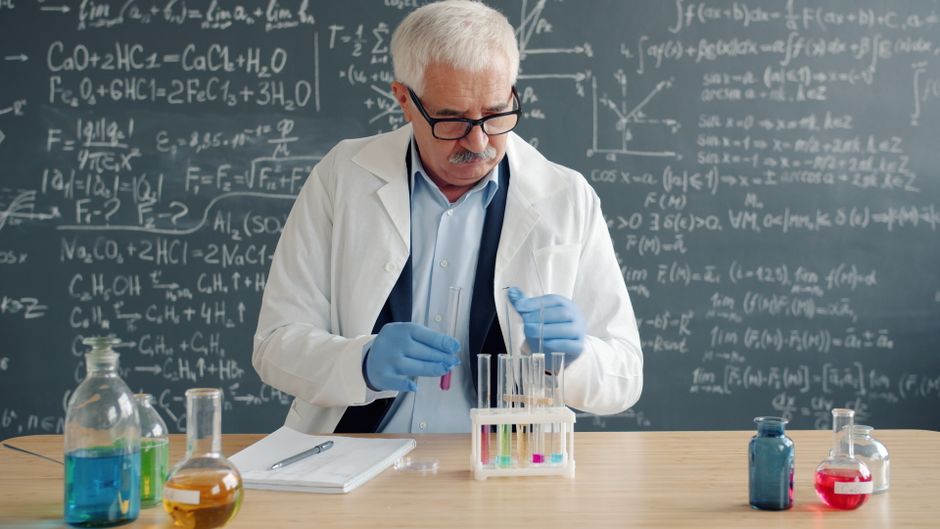
Photo by Vitaly Gariev on Pexels
To convert between grams (a common unit you measure in the lab) and moles, you use molar mass. The molar mass of a compound is the sum of the atomic masses of all atoms in that compound, expressed in grams per mole (g/mol). You find atomic masses on the periodic table.
- Molar mass of $H_2O$: (2 * atomic mass of H) + (1 * atomic mass of O) = (2 * 1.01 g/mol) + (1 * 16.00 g/mol) = 18.02 g/mol.
- If you have 36.04 g of $H_2O$, you have $36.04 \, \text{g} / 18.02 \, \text{g/mol} = 2 \, \text{moles}$ of $H_2O$.
3. Worked Example
Let's say you want to produce 50.0 grams of ammonia ($NH_3$) from nitrogen ($N_2$) and hydrogen ($H_2$). How many grams of $N_2$ would you need?
-
Write and balance the equation: (We already did this!)
$N_2 + 3H_2 \longrightarrow 2NH_3$ -
Calculate molar masses:
- $NH_3$: (1 * 14.01 g/mol N) + (3 * 1.01 g/mol H) = 17.04 g/mol
- $N_2$: (2 * 14.01 g/mol N) = 28.02 g/mol
-
Convert known grams of $NH_3$ to moles:
$50.0 \, \text{g} \, NH_3 \times \frac{1 \, \text{mol} \, NH_3}{17.04 \, \text{g} \, NH_3} = 2.934 \, \text{mol} \, NH_3$ -
Use mole ratio from the balanced equation to find moles of $N_2$:
From $N_2 + 3H_2 \longrightarrow 2NH_3$, the ratio of $N_2$ to $NH_3$ is 1:2.
$2.934 \, \text{mol} \, NH_3 \times \frac{1 \, \text{mol} \, N_2}{2 \, \text{mol} \, NH_3} = 1.467 \, \text{mol} \, N_2$ -
Convert moles of $N_2$ to grams:
$1.467 \, \text{mol} \, N_2 \times \frac{28.02 \, \text{g} \, N_2}{1 \, \text{mol} \, N_2} = 41.1 \, \text{g} \, N_2$
So, you'd need approximately 41.1 grams of nitrogen to produce 50.0 grams of ammonia.
4. Key Takeaways
- Chemical equations show reactants turning into products and must be balanced.
- Balancing equations means having the same number of each type of atom on both sides.
- You change coefficients to balance an equation, never subscripts.
- The coefficients in a balanced equation provide the crucial mole ratios.
- Molar mass is used to convert between grams and moles of a substance.
- Stoichiometry allows you to calculate exact amounts of substances in a reaction.
Common Mistakes to Avoid:
- Not balancing the equation first: All subsequent calculations will be wrong.
- Changing subscripts: This changes the chemical identity of a substance.
- Confusing grams with moles: These are different units and need molar mass for conversion.
- Incorrectly applying mole ratios: Always refer to the balanced equation carefully.
- Ignoring units during calculations: Units help you check your work and ensure you're converting correctly.
5. Now Try It
You have 10.0 grams of glucose ($C_6H_{12}O_6$). How many grams of carbon dioxide ($CO_2$) can be produced if it completely reacts with oxygen ($O_2$) according to the following unbalanced equation: $C_6H_{12}O_6 + O_2 \longrightarrow CO_2 + H_2O$?
Success looks like:
1. A correctly balanced chemical equation.
2. All molar masses calculated correctly.
3. A clear, step-by-step calculation showing conversion from grams of glucose to moles, then to moles of carbon dioxide using the mole ratio, and finally to grams of carbon dioxide.
4. A final answer in grams, rounded to an appropriate number of significant figures.
Frequently asked about Chemical Equations and Stoichiometry
Study this next
Get the full chemical reactions (chemistry in biology) curriculum
Clone the complete plan to your dashboard for unlimited AI-generated notes, practice quizzes, and a personalised revision schedule.
Create Free Account