Algebraic Foundations and Equations
From the MATHS curriculum
Algebraic Foundations and Equations
TL;DR
Algebra helps you solve problems by using letters (variables) to represent unknown numbers in equations. You learn to balance these equations to find the value of the unknowns. Mastering these basics sets you up for more complex math.
1. The Mental Model
Think of an equation as a balanced scale. Whatever you do to one side, you must do to the other to keep it balanced. Your goal is to isolate the mystery number (variable) on one side.
2. The Core Material
Algebra is all about figuring out unknown values. We use letters, like 'x' or 'y', to stand in for these unknowns. An equation is a statement that two things are equal, shown with an = sign.
What are Variables and Constants?

Photo by Markus Spiske on Pexels
- Variables are the letters (like 'x') that can represent different numbers. Their value can vary.
- Constants are the numbers (like 5 or -3) that have fixed values.
For example, in x + 5 = 10, 'x' is the variable and '5' and '10' are constants.
Algebraic Expressions vs. Equations
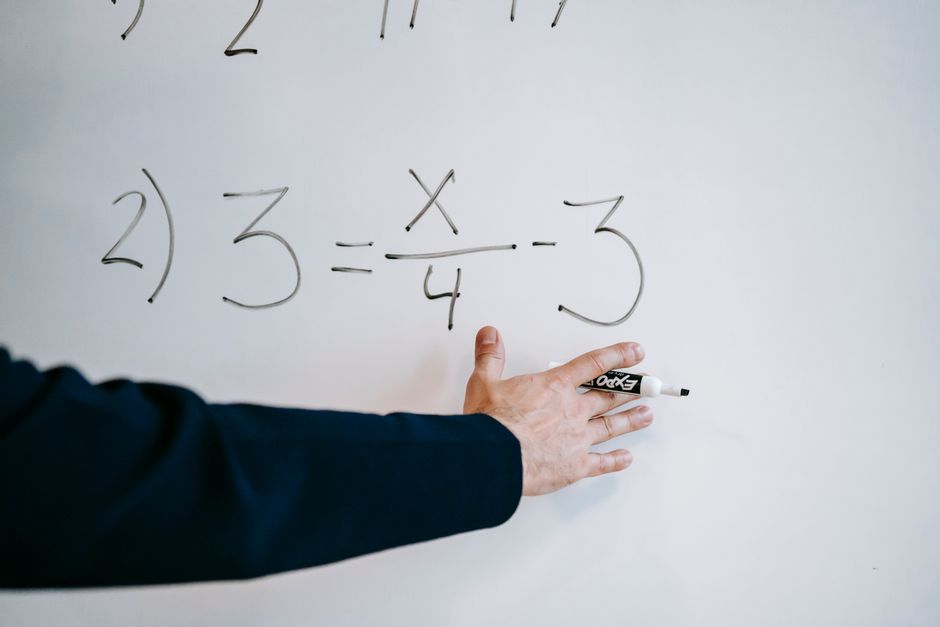
Photo by Vanessa Garcia on Pexels
- An expression is a combination of variables, numbers, and operations (like
2x + 3). It doesn't have an equals sign. - An equation does have an equals sign, stating that two expressions are equal (like
2x + 3 = 7). Our main goal is usually to solve equations.
Solving One-Step Equations

Photo by Vanessa Garcia on Pexels
To solve an equation, you want to get the variable by itself on one side of the equals sign. You do this by performing the opposite operation to both sides.
- Addition/Subtraction: If you have
x + 3 = 10, subtract 3 from both sides:
x + 3 - 3 = 10 - 3
x = 7 - Multiplication/Division: If you have
2x = 10, divide both sides by 2:
2x / 2 = 10 / 2
x = 5
Solving Two-Step Equations
Photo by Vanessa Garcia on Pexels
These involve two operations. You generally undo addition/subtraction first, then multiplication/division.
Let's look at the process for a two-step equation:
graph TD
    A["Start with equation (e.g., 2x + 5 = 11)"] --> B["Identify constant added/subtracted to variable term (+5)"]
    B --> C["Subtract/Add that constant to BOTH sides (2x + 5 - 5 = 11 - 5)"]
    C --> D["Simplify equation (2x = 6)"]
    D --> E["Identify coefficient multiplying variable (2)"]
    E --> F["Divide/Multiply by coefficient on BOTH sides (2x / 2 = 6 / 2)"]
    F --> G["Solve for variable (x = 3)"]
Checking Your Answer
Always plug your solution back into the original equation to make sure it works!
If x = 3 for 2x + 5 = 11:
2(3) + 5 = 6 + 5 = 11. It matches!
3. Worked Example
Let's solve the equation 3y - 7 = 14.
- Identify the operations: We have multiplication (3 times y) and subtraction (minus 7).
- Undo subtraction first: The opposite of subtracting 7 is adding 7. Do this to both sides:
3y - 7 + 7 = 14 + 7
3y = 21 - Undo multiplication next: The opposite of multiplying by 3 is dividing by 3. Do this to both sides:
3y / 3 = 21 / 3
y = 7 - Check your answer: Substitute
y = 7back into the original equation:
3(7) - 7 = 21 - 7 = 14
Since14 = 14, our answer is correct!
4. Key Takeaways
- Variables are letters that represent unknown numbers, while constants are fixed numbers.
- An equation uses an equals sign (
=) to show that two expressions are equivalent. - To solve an equation, isolate the variable by performing inverse operations on both sides to maintain balance.
- For two-step equations, generally undo addition/subtraction before multiplication/division.
- Always check your solution by plugging it back into the original equation.
- Algebra is a fundamental tool for problem-solving in many areas, not just math.
Common Mistakes to Avoid:
* Only performing an operation on one side of the equation, unbalancing it.
* Mixing up the order of operations when solving two-step equations (e.g., dividing before adding).
* Forgetting negative signs when moving terms across the equals sign.
* Mistaking an algebraic expression for an equation (no = sign means it's not an equation).
5. Now Try It
Solve the equation 4x + 9 = -3. Write down each step, what operation you performed, and then check your answer by substituting it back into the original equation. You should finish this within 15 minutes.
Frequently asked about Algebraic Foundations and Equations
Study this next
Get the full MATHS curriculum
Clone the complete plan to your dashboard for unlimited AI-generated notes, practice quizzes, and a personalised revision schedule.
Create Free Account