Algebraic Techniques and Equations
From the Math Olympiad curriculum
TL;DR
Math Olympiad algebra isn't just solving for 'x'; it's about cleverly transforming expressions to reveal hidden structures or simplify complex problems. You'll use factoring, expanding, and recognizing patterns to turn tough equations into manageable ones. Mastering these transformations is key to finding elegant solutions.
1. The Mental Model
Think of algebra as a set of tools that lets you reshape a mathematical expression without changing its fundamental value, just like a sculptor reshapes clay. You're looking for the simplest, most useful form to solve the problem at hand.
2. The Core Material
Math Olympiad algebra often involves more than just basic equation solving. It's about seeing the underlying structure and using powerful techniques to simplify or transform expressions.
2.1 Factoring and Expanding
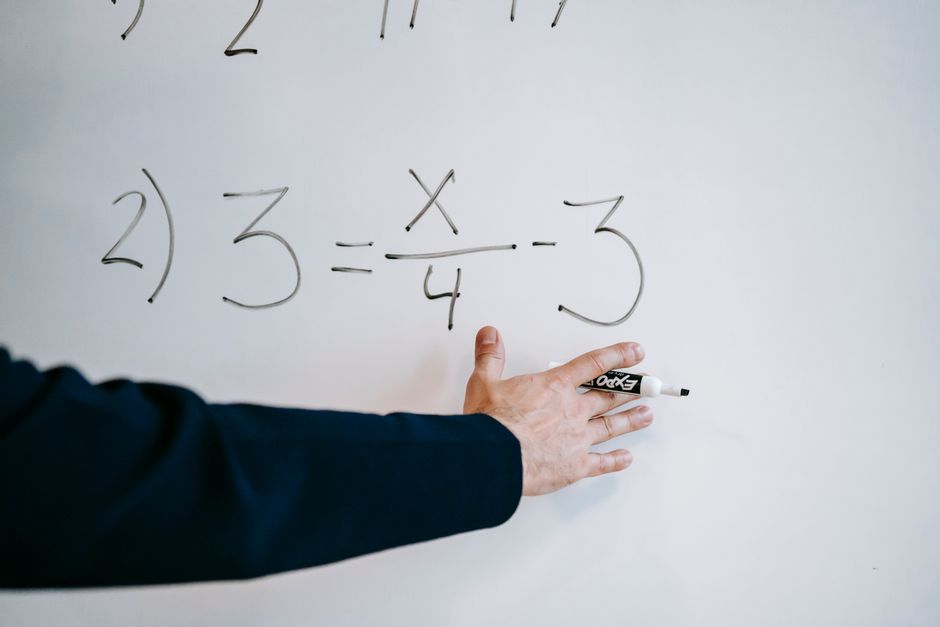
Photo by Vanessa Garcia on Pexels
These are inverse operations. Factoring breaks an expression into a product of simpler terms, while expanding multiplies out terms.
-
Factoring: This is super useful for finding roots, simplifying fractions, and solving equations.
- Common Factor:
ax + ay = a(x + y) - Difference of Squares:
x² - y² = (x - y)(x + y) - Perfect Square Trinomials:
x² + 2xy + y² = (x + y)²andx² - 2xy + y² = (x - y)² - Sum/Difference of Cubes:
x³ + y³ = (x + y)(x² - xy + y²)andx³ - y³ = (x - y)(x² + xy + y²) - Grouping: Sometimes you group terms to find a common factor.
ax + ay + bx + by = a(x + y) + b(x + y) = (a + b)(x + y)
- Common Factor:
-
Expanding: This helps eliminate parentheses and combine like terms.
a(b + c) = ab + ac(a + b)(c + d) = ac + ad + bc + bd
2.2 Substitution
Often, an equation looks complicated, but if you substitute a complex part with a single variable, it becomes much simpler. Solve for the new variable, then substitute back.
2.3 Clever Manipulations

Photo by MART PRODUCTION on Pexels
These are the "Aha!" moments.
* Adding/Subtracting the same value: A = B is equivalent to A + C = B + C. This can create perfect squares or simplify expressions.
* Multiplying/Dividing by the same non-zero value: A = B is equivalent to AC = BC (if C ≠ 0). Use this to clear denominators or rationalize expressions.
* Rearranging terms: Grouping related terms can reveal patterns.
2.4 Recognizing Patterns (Identities)

Photo by Markus Winkler on Pexels
Many Olympiad problems hinge on you recognizing familiar algebraic identities. Beyond the perfect squares and differences of squares, there are others:
* a² + b² + c² - ab - bc - ca = ½[(a-b)² + (b-c)² + (c-a)²]: This is a common one, especially when proving non-negativity or equality. If the expression equals zero, then a=b=c.
* a³ + b³ + c³ - 3abc = (a + b + c)(a² + b² + c² - ab - bc - ca): This is powerful. If a + b + c = 0, then a³ + b³ + c³ = 3abc.
graph LR
    Start["Problem Given (Complex Equation/Expression)"] --> Analyze["Analyze Structure (What does it look like?)"]
    Analyze --> IdentifyPattern["Identify Familiar Patterns/Identities?"]
    IdentifyPattern -- Yes --> ApplyIdentity["Apply Known Identity"]
    IdentifyPattern -- No --> ChooseTechnique["Choose an Algebraic Technique"]
    ChooseTechnique --> Factoring["Factoring (Common, Difference of Squares, Cubes)"]
    ChooseTechnique --> Expanding["Expanding (Clear Parentheses)"]
    ChooseTechnique --> Substitution["Substitution (Simplify Complex Parts)"]
    ChooseTechnique --> CleverManipulation["Clever Manipulation (Add/Subtract, Multiply/Divide)"]
    ApplyIdentity --> Simplify["Simplify/Transform"]
    Factoring --> Simplify
    Expanding --> Simplify
    Substitution --> SolveNewVar["Solve for New Variable"]
    CleverManipulation --> Simplify
    SolveNewVar --> SubstituteBack["Substitute Back"]
    Simplify --> CheckSolution["Check/Verify Solution"]
    SubstituteBack --> CheckSolution
    CheckSolution --> End["Solution Found"]
3. Worked Example
Problem: Solve for real numbers x, y, z given:
1. x + y + z = 1
2. x² + y² + z² = 1
3. x³ + y³ + z³ = 1
Solution:
Let's use some clever manipulation and identities.
From x + y + z = 1, we can square both sides:
(x + y + z)² = 1²
x² + y² + z² + 2(xy + yz + zx) = 1
We know x² + y² + z² = 1, so substitute that in:
1 + 2(xy + yz + zx) = 1
2(xy + yz + zx) = 0
xy + yz + zx = 0
Now, let's use the identity a³ + b³ + c³ - 3abc = (a + b + c)(a² + b² + c² - ab - bc - ca).
Substitute the given values:
1 - 3xyz = (1)(1 - 0)
1 - 3xyz = 1
3xyz = 0
So, xyz = 0.
We have three key pieces of information now:
1. x + y + z = 1
2. xy + yz + zx = 0
3. xyz = 0
If xyz = 0, then at least one of x, y, or z must be zero. Let's assume z = 0 without loss of generality (the problem is symmetric for x, y, z).
If z = 0:
1. x + y = 1
2. xy = 0 (since xy + y(0) + (0)x = xy)
From xy = 0, either x = 0 or y = 0.
- If
x = 0: Fromx + y = 1, we get0 + y = 1, soy = 1.
This gives us the solution(x, y, z) = (0, 1, 0). - If
y = 0: Fromx + y = 1, we getx + 0 = 1, sox = 1.
This gives us the solution(x, y, z) = (1, 0, 0).
Since the problem is symmetric, if we initially assumed x = 0 or y = 0, we'd get the third possibility: (0, 0, 1).
So, the solutions are the permutations of (1, 0, 0).
4. Key Takeaways
- Always look for common factors before doing anything else; it's often the simplest simplification.
- Know your basic algebraic identities cold (difference of squares, perfect squares, sum/difference of cubes).
- Substitution is a powerful tool to simplify complex-looking expressions or equations.
- Don't be afraid to add/subtract or multiply/divide terms to create desired forms like perfect squares.
- Rearranging terms can reveal hidden patterns or make factoring easier.
-
The
a³ + b³ + c³ - 3abcidentity is extremely useful in Olympiad problems, especially when a sum equals zero. -
Common Mistakes to Avoid:
- Dividing by a variable expression without considering if it could be zero.
- Incorrectly expanding or factoring (e.g.,
(a+b)² ≠ a²+b²). - Forgetting that when
AB = 0, it meansA = 0ORB = 0. - Not checking your solutions, especially for restrictions (like square roots or denominators).
5. Now Try It
Exercise: Given that a + b + c = 0, prove that a³ + b³ + c³ = 3abc. What does this tell you about solving cubic equations where the sum of the roots is zero?
What success looks like: You'll use the identity a³ + b³ + c³ - 3abc = (a + b + c)(a² + b² + c² - ab - bc - ca) and substitute the given condition to directly arrive at the proof. Then, consider how this property can help you identify roots or factor cubics under that specific condition.
Frequently asked about Algebraic Techniques and Equations
Study this next
Get the full Math Olympiad curriculum
Clone the complete plan to your dashboard for unlimited AI-generated notes, practice quizzes, and a personalised revision schedule.
Save this course free