Stoichiometry and Chemical Reactions
From the Chemistry curriculum
Stoichiometry and Chemical Reactions
TL;DR
Stoichiometry is all about measuring the amounts of reactants and products in a chemical reaction. It lets you predict how much stuff you'll make or need, based on balanced chemical equations. Mastering it means understanding moles, balanced equations, and how to use them for calculations.
1. The Mental Model
Think of a recipe: if you want to make a certain number of cookies, you need specific amounts of flour, sugar, and eggs. Chemistry is similar; a balanced equation is your recipe, and stoichiometry helps you figure out the exact "ingredients" (reactants) and "output" (products) you'll have.
2. The Core Material
When chemicals react, they do so in specific, fixed ratios. Stoichiometry is the part of chemistry that deals with these quantitative relationships. It all starts with a balanced chemical equation.
2.1. Balancing Chemical Equations

Photo by Vitaly Gariev on Pexels
A chemical equation represents a chemical reaction. It shows the reactants (starting materials) on the left and products (what's formed) on the right, separated by an arrow.
Reactants → Products
The Law of Conservation of Mass states that matter can't be created or destroyed. This means you must have the same number of each type of atom on both sides of the equation. Balancing involves adding coefficients (numbers in front of the chemical formulas) to achieve this. You can never change the subscripts within a chemical formula.
For example, burning methane (CH₄) in oxygen (O₂) produces carbon dioxide (CO₂) and water (H₂O).
Unbalanced: CH₄ + O₂ → CO₂ + H₂O
Let's balance it:
1. Carbon (C): 1 on left, 1 on right. (Balanced)
2. Hydrogen (H): 4 on left, 2 on right. Put a 2 in front of H₂O:
CH₄ + O₂ → CO₂ + 2H₂O
3. Oxygen (O): 2 on left, 2 (from CO₂) + 2 (from 2H₂O) = 4 on right. Put a 2 in front of O₂:
CH₄ + 2O₂ → CO₂ + 2H₂O
Now, check:
* C: 1 on left, 1 on right.
* H: 4 on left, 4 on right.
* O: 4 on left, 4 on right.
It's balanced!
2.2. The Mole Concept

Photo by ETaN on Pexels
The mole is the central unit in stoichiometry. It's a way to count atoms or molecules. One mole of any substance contains Avogadro's number (6.022 x 10²³) of particles.
The molar mass (or molecular weight) is the mass of one mole of a substance, expressed in grams per mole (g/mol). You calculate it by adding up the atomic masses of all atoms in the chemical formula (from the periodic table).
- Example: Molar mass of H₂O
- Hydrogen (H): ~1.01 g/mol
- Oxygen (O): ~16.00 g/mol
- H₂O = (2 * 1.01) + (1 * 16.00) = 2.02 + 16.00 = 18.02 g/mol
This means 1 mole of H₂O weighs 18.02 grams.
2.3. Stoichiometric Calculations: The Mole Ratio

Photo by Kindel Media on Pexels
Once you have a balanced equation, the coefficients tell you the mole ratio between reactants and products. This is the key to stoichiometry.
From CH₄ + 2O₂ → CO₂ + 2H₂O:
* 1 mole of CH₄ reacts with 2 moles of O₂.
* 1 mole of CH₄ produces 1 mole of CO₂ and 2 moles of H₂O.
* For every 2 moles of O₂ consumed, 1 mole of CO₂ is produced.
You'll often convert between mass and moles using molar mass:
* moles = mass / molar mass
* mass = moles * molar mass
The general flow for solving stoichiometry problems is:
graph TD
    A["Known Mass of Substance A (g)"] --> B["Convert to Moles of A (mol)"]
    B --> C{"Use Mole Ratio from Balanced Equation"}
    C --> D["Calculate Moles of Substance B (mol)"]
    D --> E["Convert to Mass of Substance B (g)"]
2.4. Limiting Reactants
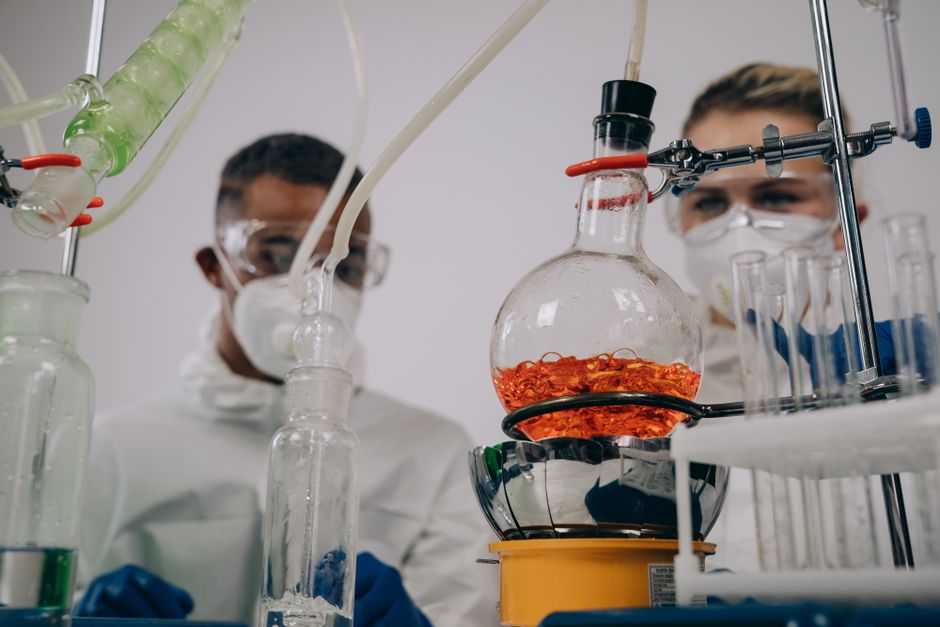
Photo by Mikhail Nilov on Pexels
In many reactions, you don't have the exact stoichiometric amounts of reactants. One reactant will run out first, stopping the reaction. This is the limiting reactant (or limiting reagent). The other reactant(s) are in excess. To find the limiting reactant, calculate how much product each reactant could make, assuming it's fully consumed. The reactant that produces the least amount of product is the limiting one.
3. Worked Example
Let's use the reaction: 2H₂ (g) + O₂ (g) → 2H₂O (l)
Suppose you have 10.0 grams of H₂ and 96.0 grams of O₂.
1. Calculate moles of each reactant:
* Molar mass of H₂ = 2 * 1.01 g/mol = 2.02 g/mol
* Moles H₂ = 10.0 g / 2.02 g/mol = 4.95 mol H₂
* Molar mass of O₂ = 2 * 16.00 g/mol = 32.00 g/mol
* Moles O₂ = 96.0 g / 32.00 g/mol = 3.00 mol O₂
-
Determine the limiting reactant:
We need to see which reactant would produce less H₂O.- From H₂: 4.95 mol H₂ * (2 mol H₂O / 2 mol H₂) = 4.95 mol H₂O
- From O₂: 3.00 mol O₂ * (2 mol H₂O / 1 mol O₂) = 6.00 mol H₂O
Since H₂ produces less H₂O (4.95 mol vs 6.00 mol), H₂ is the limiting reactant.
-
Calculate the maximum mass of H₂O produced:
- Molar mass of H₂O = 18.02 g/mol
- Mass H₂O = 4.95 mol H₂O * 18.02 g/mol = 89.2 g H₂O
You can produce a maximum of 89.2 grams of water.
4. Key Takeaways
- Always start with a balanced chemical equation to ensure conservation of mass.
- The mole is the fundamental unit for quantities in chemical reactions.
- Molar mass is your conversion factor between grams and moles.
- Coefficients in a balanced equation provide the mole ratios for reactants and products.
- In many reactions, one reactant will limit the amount of product formed; identify it first.
- Stoichiometry allows you to predict product yields or reactant needs accurately.
- It's a step-by-step process of converting mass to moles, using mole ratios, then converting back to mass.
Common Mistakes to Avoid:
- Forgetting to balance the equation before any calculations.
- Using incorrect molar masses, especially by forgetting to multiply by subscripts (e.g., O₂ is 32 g/mol, not 16 g/mol).
- Confusing coefficients with subscripts; coefficients can be changed, subscripts cannot.
- Not identifying the limiting reactant when given amounts of more than one reactant.
- Skipping units in calculations, which often leads to errors and makes troubleshooting harder.
5. Now Try It
Exercise: Ammonia (NH₃) is produced by the Haber process: N₂ (g) + 3H₂ (g) → 2NH₃ (g). If you start with 28.0 grams of N₂ and 10.0 grams of H₂, what is the maximum mass of NH₃ you can produce?
Success Looks Like: You'll correctly identify the limiting reactant and then use its amount to calculate the mass of NH₃ produced. Your final answer should be in grams of NH₃.
Frequently asked about Stoichiometry and Chemical Reactions
More from Chemistry
Get the full Chemistry curriculum
Clone the complete plan to your dashboard for unlimited AI-generated notes, practice quizzes, and a personalised revision schedule.
Create Free Account