Chemical Equations and Stoichiometry
From the chemical reactions (chemistry in biology) curriculum
Chemical Equations and Stoichiometry
TL;DR
Chemical equations are like recipes, showing what you start with and what you get, ensuring atoms are conserved. Stoichiometry uses these balanced equations to predict exact amounts of reactants and products. Mastering these helps you understand how much of each substance you need or will produce in a reaction.
1. The Mental Model
Think of a chemical reaction as building with LEGOs: you can't magically create or destroy blocks, just rearrange them. A chemical equation shows the exact "recipe" for rearranging atoms, and stoichiometry tells you how many of each "LEGO type" you'll need or produce.
2. The Core Material
When chemicals react, they rearrange their atoms to form new substances. A chemical equation is a shorthand way to represent this process.
Reactants and Products
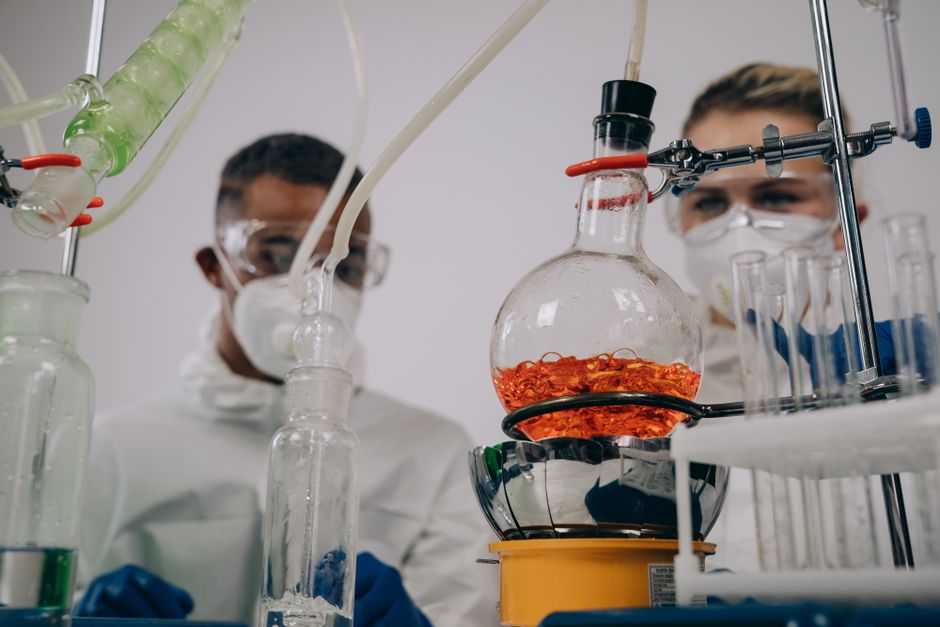
Photo by Mikhail Nilov on Pexels
The substances you start with are called reactants, and they're written on the left side of the equation. The new substances formed are called products, and they're written on the right. An arrow ($\rightarrow$) separates them, indicating the direction of the reaction.
For example, when hydrogen gas ($\text{H}_2$) reacts with oxygen gas ($\text{O}_2$) to form water ($\text{H}_2\text{O}$), the unbalanced equation looks like this:
$\text{H}_2 + \text{O}_2 \rightarrow \text{H}_2\text{O}$
Balancing Chemical Equations

Photo by Vitaly Gariev on Pexels
A fundamental principle in chemistry is the Law of Conservation of Mass, which states that matter cannot be created or destroyed. This means the number of atoms of each element must be the same on both sides of a chemical equation. Balancing an equation involves placing coefficients (whole numbers) in front of the chemical formulas to make the atom count equal. You can't change the subscripts within a chemical formula because that would change the substance itself (e.g., $\text{H}_2\text{O}$ is water, $\text{H}_2\text{O}_2$ is hydrogen peroxide, a different substance).
To balance the water formation equation:
1. Count atoms on both sides:
Reactants: H=2, O=2
Products: H=2, O=1
2. Oxygen isn't balanced. To get 2 oxygen atoms on the product side, put a coefficient of 2 in front of $\text{H}_2\text{O}$:
$\text{H}_2 + \text{O}_2 \rightarrow 2\text{H}_2\text{O}$
3. Re-count atoms:
Reactants: H=2, O=2
Products: H=4, O=2
4. Now hydrogen isn't balanced. To get 4 hydrogen atoms on the reactant side, put a coefficient of 2 in front of $\text{H}_2$:
$2\text{H}_2 + \text{O}_2 \rightarrow 2\text{H}_2\text{O}$
5. Final count:
Reactants: H=4, O=2
Products: H=4, O=2
The equation is now balanced!
graph TD
    A["Identify Reactants and Products"] --> B["Write Unbalanced Equation"]
    B --> C{"Count Atoms for Each Element on Both Sides"}
    C -- "Atoms Unequal?" --> D["Add Coefficients to Balance One Element"]
    D --> C
    C -- "Atoms Equal?" --> E["Check All Elements (Final Review)"]
    E --> F["Balanced Chemical Equation"]
Stoichiometry: Calculations with Balanced Equations
Photo by Vitaly Gariev on Pexels
Once an equation is balanced, the coefficients tell you the mole ratio between reactants and products. This is the core of stoichiometry, allowing you to calculate amounts.
- Moles are Key: Chemical equations relate substances in terms of moles. The coefficient '2' in $2\text{H}_2$ means 2 moles of hydrogen.
- Molar Mass: To go from grams (what you typically measure) to moles, you use the molar mass of the substance (found from the periodic table).
- Moles = Mass (g) / Molar Mass (g/mol)
- Mass (g) = Moles * Molar Mass (g/mol)
- Mole Ratio: Use the coefficients from the balanced equation to convert moles of one substance to moles of another.
- e.g., From $2\text{H}_2 + \text{O}_2 \rightarrow 2\text{H}_2\text{O}$, you know that 2 moles of $\text{H}_2$ react with 1 mole of $\text{O}_2$ to produce 2 moles of $\text{H}_2\text{O}$. So, if you have 4 moles of $\text{H}_2$, you'd need 2 moles of $\text{O}_2$.
This allows you to answer questions like: "If I start with X grams of A, how many grams of B can I make?"
3. Worked Example
Let's say you want to produce ammonia ($\text{NH}_3$) from nitrogen gas ($\text{N}_2$) and hydrogen gas ($\text{H}_2$). How much hydrogen (in grams) is needed to react completely with 28.0 grams of nitrogen?
-
Write the unbalanced equation:
$\text{N}_2 + \text{H}_2 \rightarrow \text{NH}_3$ -
Balance the equation:
- Nitrogen: 2 on left, 1 on right. Put 2 in front of $\text{NH}_3$:
$\text{N}_2 + \text{H}_2 \rightarrow 2\text{NH}_3$ - Hydrogen: 2 on left, 6 on right (from $2\text{NH}_3$). Put 3 in front of $\text{H}_2$:
$\text{N}_2 + 3\text{H}_2 \rightarrow 2\text{NH}_3$ - Check: N=2 on both sides, H=6 on both sides. It's balanced!
- Nitrogen: 2 on left, 1 on right. Put 2 in front of $\text{NH}_3$:
-
Identify knowns and unknowns:
- Known: 28.0 g of $\text{N}_2$
- Unknown: grams of $\text{H}_2$ needed
-
Convert grams of $\text{N}_2$ to moles of $\text{N}_2$:
- Molar mass of $\text{N}_2 = 2 \times 14.01 \text{ g/mol} = 28.02 \text{ g/mol}$
- Moles of $\text{N}_2 = 28.0 \text{ g} / 28.02 \text{ g/mol} \approx 0.999 \text{ mol}$
-
Use the mole ratio from the balanced equation to find moles of $\text{H}_2$:
- From the equation: 1 mole of $\text{N}_2$ reacts with 3 moles of $\text{H}_2$.
- Moles of $\text{H}_2 = 0.999 \text{ mol N}_2 \times (3 \text{ mol H}_2 / 1 \text{ mol N}_2) = 2.997 \text{ mol H}_2$
-
Convert moles of $\text{H}_2$ to grams of $\text{H}_2$:
- Molar mass of $\text{H}_2 = 2 \times 1.008 \text{ g/mol} = 2.016 \text{ g/mol}$
- Mass of $\text{H}_2 = 2.997 \text{ mol} \times 2.016 \text{ g/mol} \approx 6.04 \text{ g}$
So, you'd need approximately 6.04 grams of hydrogen to react completely with 28.0 grams of nitrogen.
4. Key Takeaways
- Chemical equations represent reactions, showing reactants turning into products.
- The Law of Conservation of Mass requires chemical equations to be balanced, meaning equal numbers of each type of atom on both sides.
- You balance equations by adding coefficients in front of chemical formulas, never by changing subscripts.
- Balanced equation coefficients give you the mole ratios between all substances in the reaction.
- Stoichiometry uses these mole ratios, along with molar masses, to convert between amounts (mass or moles) of different substances.
- Always convert to moles first when using mole ratios from a balanced equation.
Common mistakes you should avoid:
- Changing subscripts within a chemical formula when balancing.
- Forgetting to balance the equation before doing any stoichiometry calculations.
- Confusing grams with moles; you can't use mass ratios directly from coefficients.
- Incorrectly calculating molar masses.
- Not checking your final atom counts after balancing an equation.
5. Now Try It
Balance the following equation and then calculate how many grams of carbon dioxide ($\text{CO}_2$) are produced if 10.0 grams of propane ($\text{C}_3\text{H}_8$) are completely burned in oxygen ($\text{O}_2$). (Molar masses: C=12.01 g/mol, H=1.008 g/mol, O=16.00 g/mol).
Unbalanced equation: $\text{C}_3\text{H}_8 + \text{O}_2 \rightarrow \text{CO}_2 + \text{H}_2\text{O}$
Success looks like: A correctly balanced equation and a final answer for the mass of $\text{CO}_2$ in grams.
Frequently asked about Chemical Equations and Stoichiometry
Study this next
Get the full chemical reactions (chemistry in biology) curriculum
Clone the complete plan to your dashboard for unlimited AI-generated notes, practice quizzes, and a personalised revision schedule.
Create Free Account