Kinematic Equations for Constant Velocity
From the physics curriculum
Kinematic Equations for Constant Velocity
TL;DR
When an object moves at a steady speed in a straight line, we call that constant velocity. We use simple kinematic equations to describe its position, displacement, and time. Understanding these basic relationships is crucial for more complex motion later.
1. The Mental Model
Imagine you're walking at a steady pace without speeding up or slowing down. You know how far you'll go in a certain amount of time if you keep that pace. This is the essence of constant velocity.
2. The Core Material
When an object has constant velocity, its speed and direction don't change. This simplifies things greatly because we don't have to worry about acceleration.
Understanding Velocity and Displacement
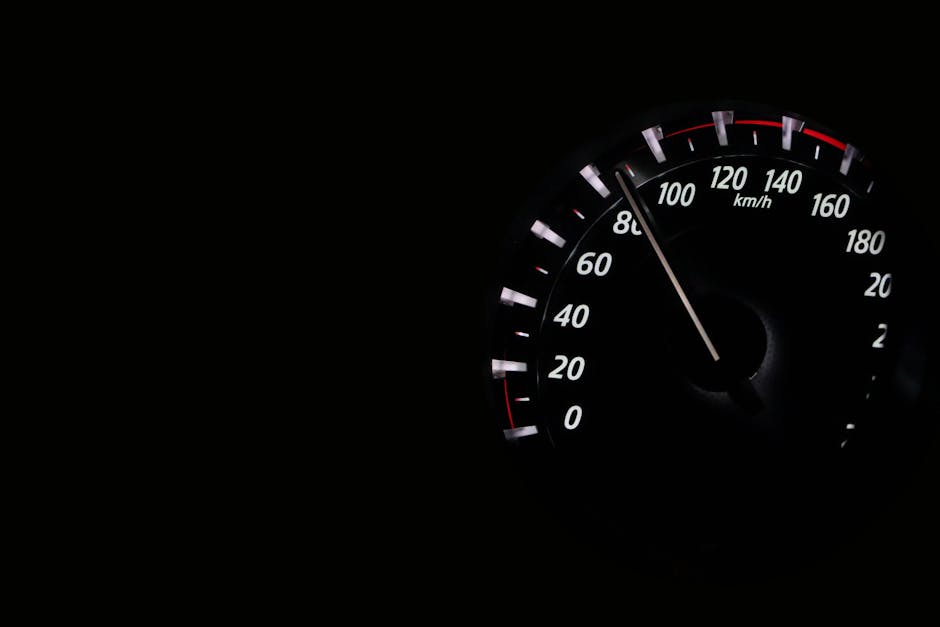
Photo by Pixabay on Pexels
Velocity ($\vec{v}$) is how fast an object is moving AND in what direction. It's a vector quantity. For constant velocity, it's just a single value.
Displacement ($\Delta \vec{x}$) is the change in an object's position. It's also a vector. It's not the total distance traveled, but the straight-line difference between the start and end points.
The fundamental relationship between these three for constant velocity is:
$\vec{v} = \frac{\Delta \vec{x}}{\Delta t}$
Where:
* $\vec{v}$ is the constant velocity
* $\Delta \vec{x}$ is the displacement (final position minus initial position, $\vec{x}_f - \vec{x}_i$)
* $\Delta t$ is the time interval (final time minus initial time, $t_f - t_i$)
We can rearrange this equation to solve for displacement or time.
The Kinematic Equation for Constant Velocity
Photo by Nothing Ahead on Pexels
The most common form you'll use is for finding the final position of an object given its initial position, constant velocity, and time:
$\vec{x}_f = \vec{x}_i + \vec{v} \cdot \Delta t$
- $\vec{x}_f$ is the final position
- $\vec{x}_i$ is the initial position
- $\vec{v}$ is the constant velocity
- $\Delta t$ is the time elapsed ($t_f - t_i$)
Often, we assume the initial time $t_i = 0$, so $\Delta t$ just becomes $t$.
Let's visualize the process of using these equations:
graph TD
    A["Know Constant Velocity (v)"] --> B{"Need to find:"};
    A --> C["Know Initial Position (x_i)"];
    A --> D["Know Time Elapsed (Δt)"];

    B -- "Final Position (x_f)?" --> E["x_f = x_i + v * Δt"];
    B -- "Displacement (Δx)?" --> F["Δx = v * Δt"];
    B -- "Time (Δt)?" --> G["Δt = (x_f - x_i) / v"];

    E --> H["Calculate x_f"];
    F --> H;
    G --> H;
This diagram shows that depending on what you know and what you need to find, you can rearrange and use the core equation.
Units Matter!

Photo by Brett Jordan on Pexels
Always use consistent units. If velocity is in meters per second (m/s), then displacement should be in meters (m) and time in seconds (s).
- Velocity: m/s, km/h, mi/h
- Displacement/Position: m, km, mi
- Time: s, h
3. Worked Example
You're driving your car at a constant velocity of 20 m/s East. If you start at a position of 50 meters East of a landmark and drive for 15 seconds, what's your final position?
Given:
* Initial Position ($\vec{x}_i$) = +50 m (East is positive)
* Constant Velocity ($\vec{v}$) = +20 m/s
* Time Elapsed ($\Delta t$) = 15 s
Required: Final Position ($\vec{x}_f$)
Equation: $\vec{x}_f = \vec{x}_i + \vec{v} \cdot \Delta t$
Calculation:
$\vec{x}_f = 50 \text{ m} + (20 \text{ m/s} \cdot 15 \text{ s})$
$\vec{x}_f = 50 \text{ m} + 300 \text{ m}$
$\vec{x}_f = 350 \text{ m}$
Your final position is 350 meters East of the landmark.
4. Key Takeaways
- Constant velocity means an object moves at a steady speed in a straight line without changing direction.
- The primary equation for constant velocity is $\vec{x}_f = \vec{x}_i + \vec{v} \cdot \Delta t$.
- Velocity and displacement are vector quantities, meaning direction matters (e.g., positive for one direction, negative for the opposite).
- Always ensure your units are consistent (e.g., meters, seconds, m/s).
- If acceleration is present, these specific equations don't apply.
Common Mistakes to Avoid:
* Forgetting that velocity and displacement have direction; always consider positive/negative signs.
* Confusing displacement (change in position) with total distance traveled.
* Applying these equations when velocity is NOT constant (i.e., when there's acceleration).
* Mixing up units (e.g., using km/h for velocity and seconds for time).
5. Now Try It
You're on a bike ride, and you maintain a constant velocity of 5 m/s North. You start 10 meters South of your friend's house. How long will it take you to reach a position 40 meters North of your friend's house?
What to do:
1. Define your positive direction (e.g., North = positive).
2. List your knowns ($\vec{x}_i$, $\vec{x}_f$, $\vec{v}$). Remember that South would be a negative value if North is positive.
3. Choose the correct rearranged kinematic equation.
4. Solve for the time ($\Delta t$).
What success looks like: You should get a time of 10 seconds.
Frequently asked about Kinematic Equations for Constant Velocity
Study this next
Get the full physics curriculum
Clone the complete plan to your dashboard for unlimited AI-generated notes, practice quizzes, and a personalised revision schedule.
Create Free Account