Introduction to Reaction Rates and Collision Theory
From the Chemistry curriculum
TL;DR
Chemical reactions happen at different speeds, which we call reaction rates. Collision Theory explains that for a reaction to occur, particles must collide with enough energy and in the correct orientation. Factors like concentration, temperature, and surface area directly affect how often effective collisions happen.
1. The Mental Model
Think of chemical reactions like dancing: for two people to truly dance together (react), they need to bump into each other (collide), have enough energy to move (activation energy), and be facing the right way to perform the steps (correct orientation).
2. The Core Material
You're probably used to seeing chemical equations that show what goes in and what comes out. But how fast does that actually happen? That's what reaction rates are all about – they tell us how quickly reactants are used up or products are formed over time. Some reactions are super fast (like an explosion), while others are incredibly slow (like rust forming).
2.1 What is Collision Theory?

Photo by pablo gomez on Pexels
Collision Theory is the fundamental idea explaining how and why chemical reactions occur. It says that for reactant particles to turn into product particles, three things must happen simultaneously:
- They must collide: The particles need to physically come into contact with each other. If they don't meet, they can't react.
- They must collide with sufficient energy: The collision has to be energetic enough to break existing bonds and form new ones. This minimum energy is called the activation energy (Ea). Think of it as the 'push' needed to get over a hill.
- They must collide with the correct orientation: The colliding particles need to be aligned in a specific way for the reacting parts of the molecules to interact. It's like trying to put two puzzle pieces together – they have to be lined up just right.
If any of these three conditions aren't met, the collision is ineffective, and no reaction occurs. Only effective collisions lead to product formation.
2.2 Factors Affecting Reaction Rates
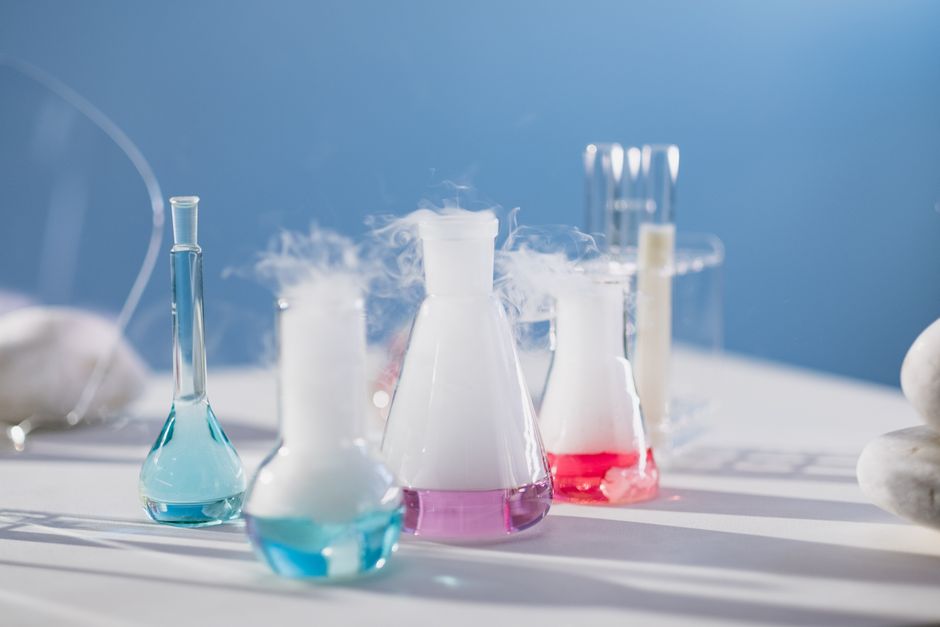
Photo by Ron Lach on Pexels
Understanding Collision Theory helps us predict how changing conditions will affect reaction rates. Essentially, anything that increases the frequency of effective collisions will speed up a reaction.
graph TD
    A["Factors Affecting Reaction Rate"] --> B{"Collision Frequency"};
    A --> C{"Energy of Collisions"};
    A --> D{"Orientation of Collisions"};

    B --> B1["Increase Concentration"];
    B --> B2["Increase Surface Area"];
    B --> B3["Increase Temperature"];

    C --> C1["Increase Temperature"];
    C --> C2["Add Catalyst"];

    D --> D1["Add Catalyst"];

    B1 --> F["More Effective Collisions"];
    B2 --> F;
    B3 --> F;
    C1 --> F;
    C2 --> F;
    D1 --> F;

    F --> G["Faster Reaction Rate"];
Let's break down the main factors:
- Concentration: If you have more reactant particles in the same space, there will be more opportunities for them to collide. More collisions generally mean more effective collisions.
- Example: A stronger acid (higher concentration of H⁺ ions) will react faster with a metal than a weaker acid.
- Temperature: When you increase the temperature, particles move faster. This has two effects:
- They collide more frequently.
- A larger proportion of collisions will have energy equal to or greater than the activation energy (Ea). Both contribute to a faster rate.
* Example: Food spoils faster at room temperature than in a refrigerator.
- Surface Area: For reactions involving solids, only the particles on the surface can collide. Breaking a solid into smaller pieces increases its total surface area, exposing more particles to collide.
- Example: Powdered sugar dissolves faster than a sugar cube.
- Catalysts: A catalyst is a substance that speeds up a reaction without being used up itself. It does this by providing an alternative reaction pathway with a lower activation energy. This means more collisions will now be energetic enough to react. Catalysts can also help with orientation.
- Example: Enzymes in your body are biological catalysts that speed up digestion.
- Pressure (for gases): Increasing the pressure of a gaseous reaction squeezes the gas particles closer together, effectively increasing their concentration. This leads to more frequent collisions.
3. Worked Example
Imagine you're trying to dissolve an antacid tablet (like Alka-Seltzer) in water. You have three scenarios:
- A whole tablet in cold water.
- A whole tablet in hot water.
- A crushed tablet in cold water.
Which one will dissolve fastest and why, based on Collision Theory?
- Scenario 1 (Whole tablet, cold water): This will be the slowest.
- Collision Frequency: Low surface area (tablet is whole) limits where water can interact.
- Collision Energy: Low temperature means water molecules have less kinetic energy, so fewer collisions meet the activation energy for dissolving.
- Scenario 2 (Whole tablet, hot water): This will be faster than Scenario 1.
- Collision Frequency: Still limited by surface area.
- Collision Energy: Higher temperature means water molecules have more kinetic energy, leading to more energetic collisions that overcome the activation energy.
- Scenario 3 (Crushed tablet, cold water): This will also be faster than Scenario 1, and potentially comparable to or even faster than Scenario 2 depending on how fine the powder is.
- Collision Frequency: Crushing the tablet drastically increases its surface area, exposing many more antacid particles to the water, leading to many more collisions.
- Collision Energy: Still low due to cold water, but the sheer increase in the number of collisions often compensates.
The crushed tablet in hot water (not one of our choices, but a combination) would be the fastest because both surface area and temperature would be optimized for effective collisions.
4. Key Takeaways
- Reaction rate measures how fast reactants are consumed or products are formed.
- Collision Theory states that particles must collide with sufficient energy (activation energy) and correct orientation to react.
- Increasing concentration boosts reaction rates by causing more collisions.
- Higher temperatures increase both collision frequency and the energy of collisions, speeding up reactions.
- Increasing surface area for solids allows more particles to collide, accelerating the reaction.
- Catalysts speed up reactions by lowering the activation energy, making more collisions effective.
Common Mistakes to Avoid:
- Assuming all collisions lead to a reaction; remember, energy and orientation are key.
- Confusing collision frequency with effective collision frequency; it's the effective ones that matter.
- Thinking catalysts are used up in a reaction; they participate but aren't consumed.
- Forgetting that activation energy is the minimum energy required, not just any energy.
5. Now Try It
Imagine you're trying to bake a cake. You need sugar, flour, eggs, etc. Using the principles of Collision Theory, describe two different ways you could speed up the chemical reactions involved in the baking process (beyond just increasing oven temperature) and explain why each method works. What would success look like in this context?
Frequently asked about Introduction to Reaction Rates and Collision Theory
Study this next
Get the full Chemistry curriculum
Clone the complete plan to your dashboard for unlimited AI-generated notes, practice quizzes, and a personalised revision schedule.
Save this course free