Investigation Skills and Reaction Rates
From the chemistry year 12 curriculum
Investigation Skills and Reaction Rates
TL;DR
Understanding reaction rates involves investigating how different factors affect how fast a chemical change occurs. You'll design experiments to test these factors, collect reliable data, and interpret it to explain observed changes in reaction speed. This topic combines practical experiment design with core chemistry concepts.
1. The Mental Model
Think of a reaction as a race. You're investigating what makes the runners (reactants) cross the finish line (products) faster or slower, and how to measure that speed accurately.
2. The Core Material
When you're investigating reaction rates, you're essentially playing detective to figure out what speeds up or slows down a chemical reaction. This involves designing experiments, collecting data, and then making sense of it.
Designing Your Investigation

Photo by cottonbro studio on Pexels
A good investigation starts with a clear aim and a hypothesis. Your aim states what you want to find out, and your hypothesis is your educated guess about the outcome.
You'll need to identify:
* Independent Variable: This is the one thing you change on purpose (e.g., temperature, concentration, surface area).
* Dependent Variable: This is what you measure to see the effect of your change (e.g., time for a precipitate to appear, volume of gas produced).
* Controlled Variables: These are all the things you must keep the same to ensure a fair test (e.g., total volume of solution, stirring rate).
Measuring Reaction Rates
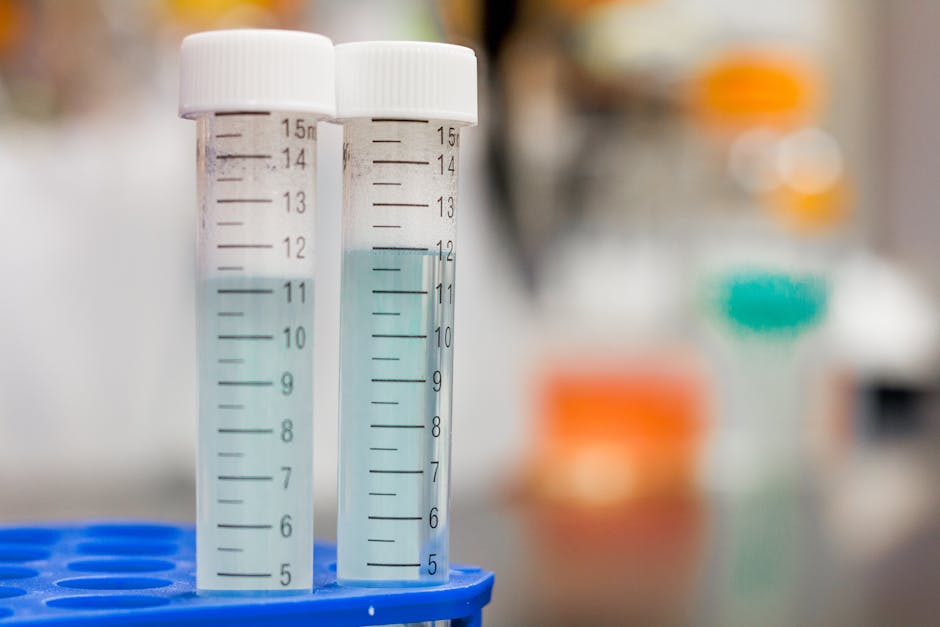
Photo by Martin Lopez on Pexels
How you measure the rate depends on the reaction. You're looking for a measurable change over time. Common methods include:
* Change in mass: If a gas is produced and escapes, the mass of the system decreases.
* Change in volume of gas produced: Use a gas syringe to collect and measure gas over time.
* Change in turbidity (cloudiness): If a precipitate forms, you can time how long it takes for a cross mark under the flask to disappear.
* Change in pH: If H+ or OH- ions are consumed or produced.
* Change in colour: Using a colorimeter to measure light absorption.
Factors Affecting Reaction Rates
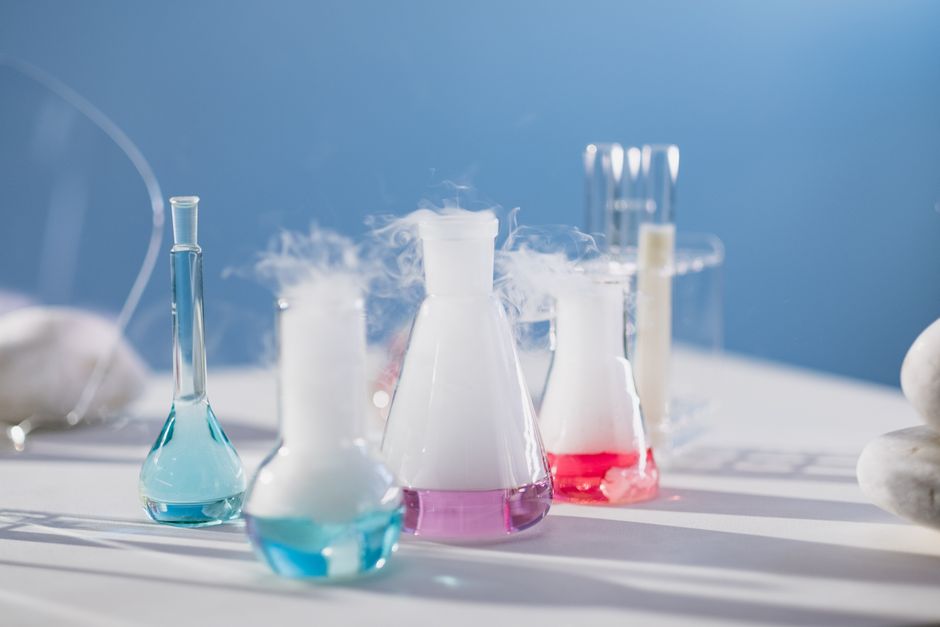
Photo by Ron Lach on Pexels
- Temperature: Generally, increasing temperature increases the rate. Particles have more kinetic energy, leading to more frequent and energetic collisions.
- Concentration (or Pressure for gases): Higher concentration means more particles in the same volume, leading to more frequent collisions.
- Surface Area: For solids, increasing surface area (e.g., using powder instead of a lump) exposes more particles to react, increasing collision frequency.
- Catalyst: A catalyst speeds up a reaction without being used up itself. It provides an alternative reaction pathway with a lower activation energy.
graph TD
    A["Identify Aim & Hypothesis"] --> B["Identify Variables (Independent, Dependent, Controlled)"]
    B --> C["Choose Measurement Method (e.g., Gas Volume, Turbidity)"]
    C --> D["Plan Experimental Steps & Repeat Trials"]
    D --> E["Collect Data (Quantitative & Qualitative)"]
    E --> F["Process Data (Graphing, Calculations)"]
    F --> G["Analyze Results & Draw Conclusion"]
    G --> H["Evaluate Experiment (Reliability, Validity, Improvements)"]
Data Collection and Analysis
Photo by Monstera Production on Pexels
- Reliability: Repeat your experiments multiple times and calculate averages. This reduces the impact of random errors.
- Validity: Make sure your experiment actually tests what you intend to test. Are your controlled variables truly controlled?
- Graphing: Plot your dependent variable against time (or your independent variable). A steeper gradient indicates a faster reaction rate.
3. Worked Example
Let's say you're investigating how the concentration of hydrochloric acid (HCl) affects its reaction rate with calcium carbonate (CaCO$_3$) chips.
Aim: To investigate how the concentration of HCl affects the rate of reaction with CaCO$_3$.
Hypothesis: As the concentration of HCl increases, the rate of reaction will increase because there will be more HCl particles available to collide with the CaCO$_3$.
Variables:
* Independent: Concentration of HCl (e.g., 0.5 M, 1.0 M, 1.5 M, 2.0 M).
* Dependent: Volume of CO$_2$ gas produced per unit time (or time taken to produce a certain volume of CO$_2$).
* Controlled: Mass/size of CaCO$_3$ chips, total volume of HCl used, temperature, stirring.
Method:
1. Set up an apparatus to collect gas (e.g., conical flask with a gas syringe).
2. Add a fixed mass of CaCO$_3$ chips to the flask.
3. Measure a specific volume (e.g., 50 mL) of 0.5 M HCl and add it to the flask, starting a timer immediately.
4. Record the volume of CO$_2$ gas collected in the syringe at regular intervals (e.g., every 30 seconds) for 5 minutes, or until the reaction stops.
5. Repeat steps 2-4 three times for 0.5 M HCl, then repeat the entire process for 1.0 M, 1.5 M, and 2.0 M HCl.
6. Calculate the average volume of CO$_2$ produced at each time interval for each concentration.
Expected Results & Analysis: You'd expect to see that for higher HCl concentrations, more CO$_2$ is produced in the same amount of time, or the reaction finishes faster. When you plot 'Volume of CO$_2$' vs. 'Time' for each concentration, the curve for the highest concentration should be the steepest, indicating the fastest rate.
4. Key Takeaways
- A well-designed experiment isolates one variable to test its effect accurately.
- You must control all other variables to ensure your experiment is valid.
- Reaction rates are often measured by monitoring changes in mass, volume of gas, or visual clarity over time.
- Higher temperature, concentration, and surface area generally increase reaction rates.
- Catalysts speed up reactions by lowering activation energy without being consumed.
- Repeating measurements improves the reliability of your data.
Common Mistakes to Avoid:
* Changing more than one independent variable in an experiment.
* Not controlling important variables (e.g., temperature when investigating concentration).
* Ignoring random errors and not repeating measurements.
* Drawing conclusions that aren't supported by your data.
5. Now Try It
Design a simple experiment to investigate how temperature affects the rate of a specific reaction. Choose a reaction you know (e.g., Alka-Seltzer in water, or sugar dissolving). Clearly state your aim, hypothesis, independent variable, dependent variable, and at least three controlled variables. Describe how you would measure the reaction rate.
What to do: Write down your experimental design.
What success looks like: You have a clear plan that addresses all variables and how to measure the rate accurately.
Frequently asked about Investigation Skills and Reaction Rates
Get the full chemistry year 12 curriculum
Clone the complete plan to your dashboard for unlimited AI-generated notes, practice quizzes, and a personalised revision schedule.
Create Free Account