Electricity and Magnetism: Basic Concepts
From the physics curriculum
TL;DR
Electricity and magnetism are two sides of the same fundamental force, both caused by charged particles. Electric charges create electric fields and currents, while moving charges also create magnetic fields. Understanding how these forces interact helps us explain everything from compasses to power generators.
1. The Mental Model
Imagine tiny invisible fields around charged particles. Electric fields are always there if a charge is present, pulling or pushing other charges. When charges move, they also create a second, related field: a magnetic field, which can pull on other moving charges or magnetic materials.
2. The Core Material
Electricity and magnetism are deeply linked. You can't really talk about one without the other in many situations. Let's break down the basic concepts of each and then see how they connect.
Electric Charge and Fields

Photo by Pixabay on Pexels
Everything is made of atoms, which have protons (positive charge), neutrons (no charge), and electrons (negative charge). The electric charge is a fundamental property of matter.
- Like charges repel (positive repels positive, negative repels negative).
- Opposite charges attract (positive attracts negative).
- The unit of charge is the Coulomb (C). A single electron or proton has a tiny charge (around 1.6 x 10^-19 C).
An electric field is a region around a charged particle where another charged particle would experience a force. Think of it like gravity, but for charges. The field lines point away from positive charges and towards negative charges.
Electric Current and Voltage
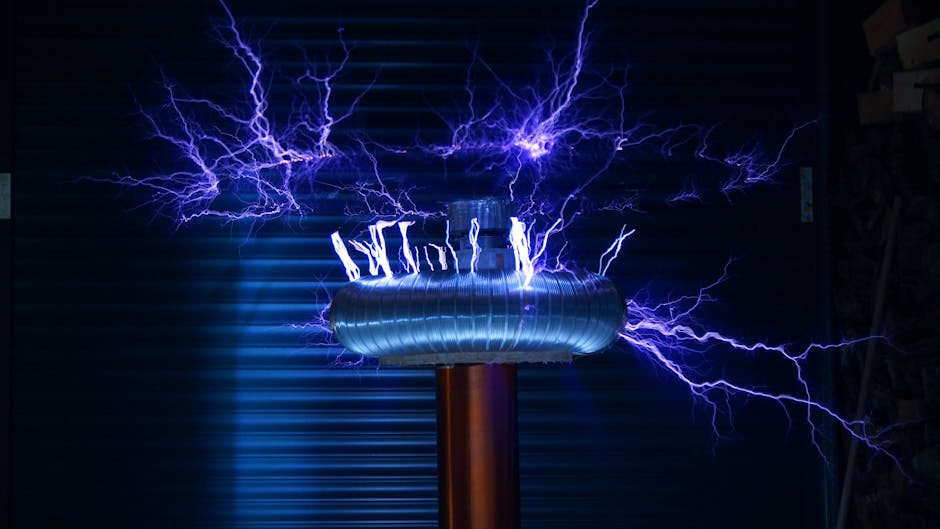
Photo by Killian Eon on Pexels
When charges move in a specific direction, that's an electric current.
- Current (I) is the rate of flow of charge. It's measured in Amperes (A), which is Coulombs per second (C/s).
- Voltage (V), also called potential difference, is the "push" or energy per unit charge that drives current. It's measured in Volts (V), which is Joules per Coulomb (J/C). Think of it like pressure in a water pipe.
- Resistance (R) is the opposition to current flow. It's measured in Ohms (Ω). Good conductors have low resistance, insulators have high resistance.
These three are linked by Ohm's Law: V = I * R.
Magnetism and Magnetic Fields

Photo by Nicola Narracci on Pexels
Magnetism arises from the movement of electric charges.
- A magnetic field is a region around a moving electric charge or a magnetic material (like a magnet) where another magnetic material or moving charge would experience a force.
- Magnetic fields have poles: North (N) and South (S).
- Like poles repel (N repels N, S repels S).
- Opposite poles attract (N attracts S).
- Magnetic field lines come out of the North pole and enter the South pole.
The Connection: Electromagnetism

Photo by Atlantic Ambience on Pexels
The really cool part is how they're connected:
1. Moving electric charges (currents) produce magnetic fields. This is why an electromagnet works: wrap a wire around an iron core, run current through it, and you get a temporary magnet.
2. Changing magnetic fields can produce electric currents. This is called electromagnetic induction and is how generators produce electricity.
Here's a simplified view of the relationship:
graph TD
    A["Stationary Electric Charge"] --> B["Creates Electric Field"];
    C["Moving Electric Charge (Current)"] --> D["Creates Magnetic Field"];
    C --> B;
    B --> E["Exerts Force on Other Charges"];
    D --> F["Exerts Force on Other Moving Charges/Magnets"];
    G["Changing Magnetic Field"] --> H["Induces Electric Current/Voltage"];
3. Worked Example
Let's say you have a simple circuit with a 12-Volt battery and a light bulb that has a resistance of 4 Ohms. We want to find out how much current flows through the bulb.
Using Ohm's Law:
V = I * R
You know:
V = 12 Volts
R = 4 Ohms
You want to find I. So, rearrange the formula:
I = V / R
Plug in the numbers:
I = 12 Volts / 4 Ohms
I = 3 Amperes
So, 3 Amperes of current flow through the light bulb. This current creates a magnetic field around the wires, and that's how the electricity is actually delivered to the bulb.
4. Key Takeaways
- Electric charge is a fundamental property of matter, dictating attraction and repulsion.
- Electric fields surround charges, exerting forces on other charges.
- Electric current is the flow of charge, driven by voltage, and hindered by resistance.
- Magnetic fields are created by moving charges (currents) and exert forces on other moving charges or magnetic materials.
- Ohm's Law (V = I * R) describes the relationship between voltage, current, and resistance in a circuit.
- Electricity and magnetism are two aspects of electromagnetism, where changes in one can induce the other.
- The unit for charge is the Coulomb (C), current is the Ampere (A), voltage is the Volt (V), and resistance is the Ohm (Ω).
Common mistakes to avoid:
- Confusing voltage with current; voltage is the "push," current is the "flow."
- Thinking magnetism is completely separate from electricity; they are intrinsically linked.
- Assuming magnetic fields exist only around permanent magnets; moving charges also create them.
- Forgetting that an electric field exists even around a stationary charge, while a magnetic field requires movement.
5. Now Try It
Imagine you have a coil of wire connected to a sensitive voltmeter. If you quickly move a strong bar magnet into and then out of the center of the coil, what would you observe on the voltmeter? What if you just held the magnet stationary inside the coil? Think about the core principle of electromagnetic induction.
Success looks like: explaining that the voltmeter would show a temporary reading when the magnet is moving, but nothing when it's stationary, and linking this to the concept of changing magnetic fields inducing current.
Try it yourself: Electric and magnetic field lines in 3D
Frequently asked about Electricity and Magnetism: Basic Concepts
Study this next
Get the full physics curriculum
Clone the complete plan to your dashboard for unlimited AI-generated notes, practice quizzes, and a personalised revision schedule.
Save this course free