Half-Life and Radioactive Decay Kinetics
From the Physics Atomic structure and Radioactive decay curriculum
TL;DR
Half-life is the time it takes for half of a radioactive sample to decay, which is a constant value for any given isotope. Radioactive decay follows first-order kinetics, meaning the rate of decay is proportional to the amount of radioactive material present. Understanding half-life lets you predict how much radioactive substance remains over time.
1. The Mental Model
Imagine you have a big pile of popcorn kernels, and every minute, half of the kernels that haven't popped yet will suddenly pop. Half-life works similarly for radioactive atoms: a set amount of time passes, and half of the remaining unstable atoms will have changed into something else.
2. The Core Material
Radioactive decay is a random process at the atomic level, meaning you can't predict exactly when a single atom will decay. However, when you have a vast number of atoms, the decay follows predictable statistical rules. This is where half-life comes in.
The half-life ($t_{1/2}$) of a radioactive isotope is the time required for half of the initial quantity of that isotope to decay. It's a fundamental characteristic of a specific radioisotope and doesn't change with temperature, pressure, or chemical environment.
Understanding Decay Kinetics
Radioactive decay follows first-order kinetics. This means the rate of decay depends only on the concentration of the radioactive substance. The more radioactive atoms you have, the more will decay per unit time. As atoms decay, their number decreases, and so the decay rate slows down.
We can describe this mathematically with the decay constant ($\lambda$). The decay constant is the probability per unit time that a nucleus will decay. It's inversely related to the half-life:
$\lambda = \frac{\ln(2)}{t_{1/2}}$
The relationship between the initial number of radioactive nuclei ($N_0$) and the number remaining ($N_t$) after a time ($t$) is given by:
$N_t = N_0 e^{-\lambda t}$
You can also write this in terms of half-lives passed. If $n$ is the number of half-lives that have passed, then:
$N_t = N_0 \left(\frac{1}{2}\right)^n$
Where $n = \frac{t}{t_{1/2}}$.
Visualising Decay

Photo by Google DeepMind on Pexels
It's helpful to see how the amount of radioactive material decreases over time.
graph LR
    A["Initial Sample (N₀)"] --> B{"After 1st Half-Life (t₁/₂) = N₀/2"}
    B --> C{"After 2nd Half-Life (2t₁/₂) = N₀/4"}
    C --> D{"After 3rd Half-Life (3t₁/₂) = N₀/8"}
    D --> E{"After 4th Half-Life (4t₁/₂) = N₀/16"}
Each step reduces the remaining amount by half. It never truly reaches zero, but the amount becomes infinitesimally small.
Measuring Activity
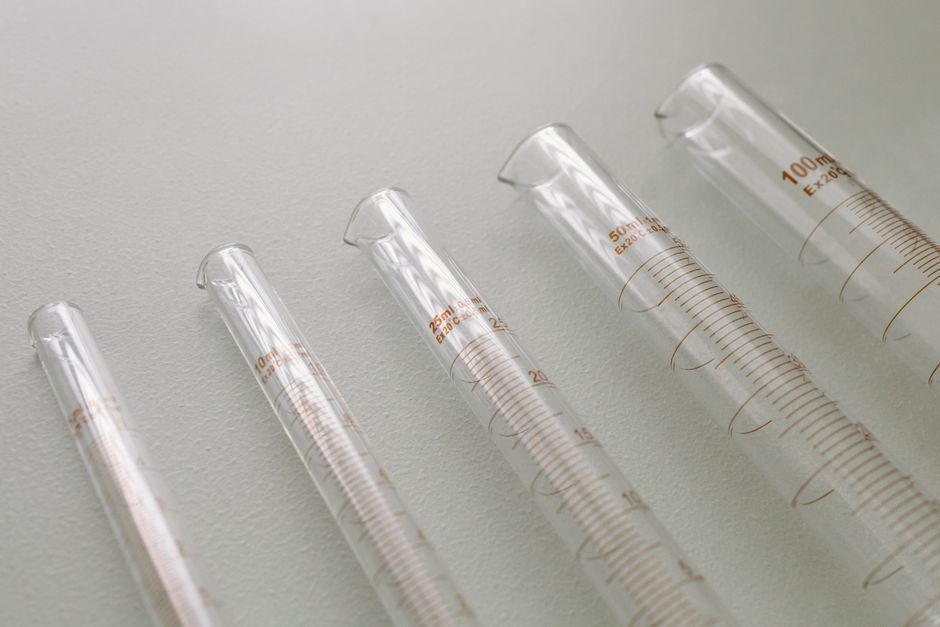
Photo by Tara Winstead on Pexels
Instead of counting individual atoms, we often measure the activity ($A$) of a sample. Activity is the rate of decay, usually measured in becquerels (Bq), where 1 Bq means one decay per second, or curies (Ci), where 1 Ci = $3.7 \times 10^{10}$ Bq.
The activity also follows the same decay pattern:
$A_t = A_0 e^{-\lambda t}$
Or, using half-lives:
$A_t = A_0 \left(\frac{1}{2}\right)^n$
Where $A_0$ is the initial activity and $A_t$ is the activity after time $t$.
3. Worked Example
Let's say you have a 100g sample of Iodine-131 ($^{131}$I), which has a half-life of 8 days. How much $^{131}$I will remain after 24 days?
-
Identify the knowns:
- Initial mass ($N_0$) = 100 g
- Half-life ($t_{1/2}$) = 8 days
- Total time elapsed ($t$) = 24 days
-
Calculate the number of half-lives ($n$):
$n = \frac{t}{t_{1/2}} = \frac{24 \text{ days}}{8 \text{ days}} = 3$ half-lives -
Use the half-life formula:
$N_t = N_0 \left(\frac{1}{2}\right)^n$
$N_t = 100 \text{ g} \times \left(\frac{1}{2}\right)^3$
$N_t = 100 \text{ g} \times \left(\frac{1}{8}\right)$
$N_t = 12.5 \text{ g}$
After 24 days, 12.5 grams of Iodine-131 will remain.
4. Key Takeaways
- Half-life is the constant time period for half of a radioactive sample to decay, unique to each isotope.
- Radioactive decay follows first-order kinetics, meaning the rate of decay is directly proportional to the amount of radioactive substance present.
- The amount of radioactive material remaining decreases exponentially, never truly reaching zero.
- You can calculate the remaining amount or activity using the number of half-lives that have passed.
- The decay constant ($\lambda$) is a measure of the decay rate and is inversely related to half-life.
- Activity is the rate of decay and follows the same exponential decay as the number of nuclei.
Common Mistakes to Avoid:
- Don't assume the substance completely disappears after a few half-lives; it just gets very small.
- Don't confuse half-life with mean lifetime; they are related but distinct concepts.
- Don't think that if half decays in $t_{1/2}$, then all decays in $2t_{1/2}$.
- Remember that the decay constant $\lambda$ is usually given in units of inverse time (e.g., $s^{-1}$, $day^{-1}$).
5. Now Try It
A sample of Carbon-14 ($^{14}$C), used for dating ancient artifacts, has a half-life of 5730 years. If an old bone originally contained 80 Bq of $^{14}$C and now measures 10 Bq, how old is the bone? Think about how many half-lives must have passed to reduce the activity from 80 Bq to 10 Bq, and then calculate the total time. You should be able to determine the age of the bone in years.
Try it yourself: Radioactive decay and half-life calculator
Frequently asked about Half-Life and Radioactive Decay Kinetics
Study this next
Get the full Physics Atomic structure and Radioactive decay curriculum
Clone the complete plan to your dashboard for unlimited AI-generated notes, practice quizzes, and a personalised revision schedule.
Save this course free