The Nucleus and Nuclear Stability
From the Physics Atomic structure and Radioactive decay curriculum
TL;DR
The nucleus is the dense, positively charged center of an atom, made of protons and neutrons. Its stability depends on the balance between the strong nuclear force pulling nucleons together and the electromagnetic repulsion pushing protons apart. Unstable nuclei undergo radioactive decay to achieve a more stable configuration.
1. The Mental Model
Think of the nucleus as a tiny, tightly packed ball of marbles (protons and neutrons). These marbles want to fly apart due to electrical repulsion, but a super-strong "glue" (the strong nuclear force) holds them together. The balance of these forces determines if the ball of marbles is stable or will eventually break apart.
2. The Core Material
The nucleus is where most of an atom's mass is concentrated. It's composed of two types of particles, collectively called nucleons:
* Protons (p): Positively charged particles. The number of protons determines the element (atomic number, Z).
* Neutrons (n): Neutrally charged particles.
The total number of protons and neutrons is the mass number (A). Isotopes of an element have the same number of protons but different numbers of neutrons.
Forces within the Nucleus
Two primary forces compete within the nucleus:
1. Strong Nuclear Force (or Strong Interaction): This is an attractive force that acts between all nucleons (proton-proton, neutron-neutron, proton-neutron). It's incredibly strong, much stronger than electromagnetic repulsion, but it only acts over very short distances (about 10^-15 meters). This is the "glue" that holds the nucleus together.
2. Electromagnetic Force: This is a repulsive force that acts between positively charged protons, trying to push them apart. Its strength decreases with distance, but it has an infinite range.
Nuclear Stability
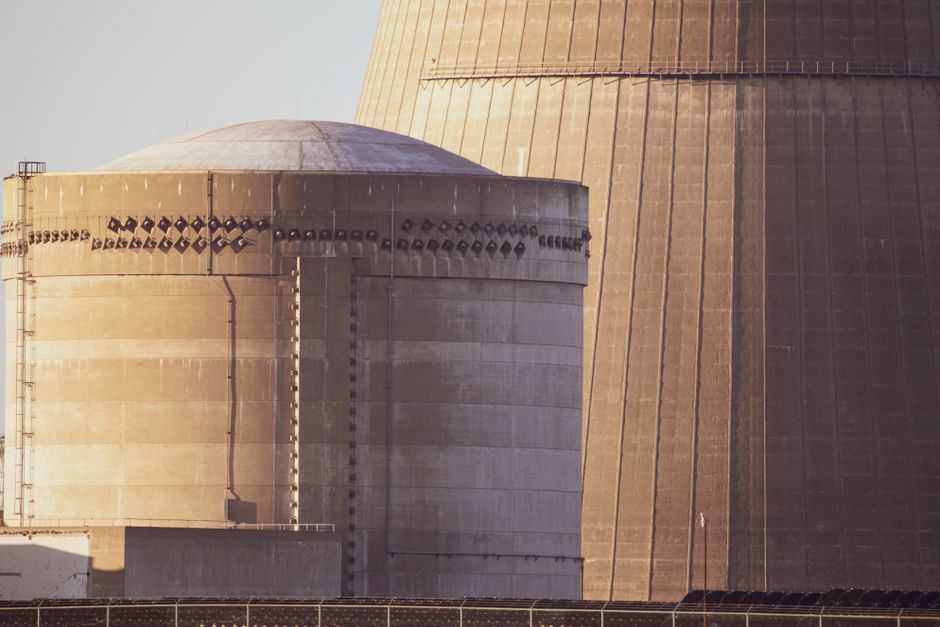
Photo by Sean P. Twomey on Pexels
Nuclear stability is a delicate balance. For a nucleus to be stable, the strong nuclear force must be strong enough to overcome the electromagnetic repulsion between protons.
- Small nuclei (Z < 20): Generally stable when the number of protons (Z) is roughly equal to the number of neutrons (N). The N/Z ratio is close to 1.
- Large nuclei (Z > 20): As the number of protons increases, the electromagnetic repulsion grows significantly because each proton repels every other proton. To counteract this, more neutrons are needed to provide additional strong nuclear force without adding more repulsive charge. So, for heavier stable nuclei, N > Z, and the N/Z ratio increases, typically up to about 1.5 for the largest stable nuclei.
The relationship between the number of protons and neutrons for stable nuclei can be visualized on a belt of stability chart. Nuclei that fall within this "belt" are stable. Those outside it are unstable and undergo radioactive decay.
graph TD
    A["Number of Protons (Z)"] --> B["Nuclear Stability"]
    C["Number of Neutrons (N)"] --> B
    D["Strong Nuclear Force"] --> B
    E["Electromagnetic Repulsion"] --> B

    subgraph Factors Affecting Stability
        D -. "Attracts Nucleons" .-> F[Holds Nucleus Together]
        E -. "Repels Protons" .-> G[Tries to Break Nucleus Apart]
        F --> B
        G --> B
    end

    H["N/Z Ratio"] --> I["For small Z: N ≈ Z"]
    J["N/Z Ratio"] --> K["For large Z: N > Z (more neutrons needed)"]

    I --> B
    K --> B

    B --> L{Stable Nucleus?}
    L -- Yes --> M[Within 'Belt of Stability']
    L -- No --> N[Undergoes Radioactive Decay]
Binding Energy

Photo by Atlantic Ambience on Pexels
The stability of a nucleus can also be quantified by its binding energy. When protons and neutrons come together to form a nucleus, a small amount of their mass is converted into energy – this is the mass defect. This energy is the binding energy, which is released during the formation of the nucleus and must be supplied to break it apart. A higher binding energy per nucleon indicates a more stable nucleus. Iron-56 (Fe-56) has the highest binding energy per nucleon, making it one of the most stable nuclei.
3. Worked Example
Let's consider two isotopes of Neon: Neon-20 ($^{20}_{10}\text{Ne}$) and Neon-24 ($^{24}_{10}\text{Ne}$).
Neon-20:
* Atomic number (Z) = 10 (10 protons)
* Mass number (A) = 20
* Number of neutrons (N) = A - Z = 20 - 10 = 10
* N/Z ratio = 10/10 = 1.0
This nucleus has an N/Z ratio of 1.0, which is typical for a stable light nucleus. Indeed, $^{20}_{10}\text{Ne}$ is a stable isotope.
Neon-24:
* Atomic number (Z) = 10 (10 protons)
* Mass number (A) = 24
* Number of neutrons (N) = A - Z = 24 - 10 = 14
* N/Z ratio = 14/10 = 1.4
This nucleus has a significantly higher number of neutrons compared to protons (14 neutrons for 10 protons). While some heavier stable nuclei have N > Z, for a light element like Neon (Z=10), this N/Z ratio of 1.4 makes it unstable. To become more stable, $^{24}_{10}\text{Ne}$ undergoes beta-minus ($\beta^-$) decay, where a neutron converts into a proton, increasing the N/Z ratio.
4. Key Takeaways
- The nucleus consists of protons (positive) and neutrons (neutral), collectively called nucleons.
- The strong nuclear force holds nucleons together over short distances, overcoming electromagnetic repulsion between protons.
- Nuclear stability is a balance between these two forces, influenced by the proton-to-neutron ratio (N/Z).
- For light stable nuclei, the N/Z ratio is approximately 1; for heavier stable nuclei, N/Z is greater than 1.
- Nuclei outside the "belt of stability" are unstable and undergo radioactive decay to achieve stability.
- Binding energy per nucleon indicates how tightly nucleons are bound; higher binding energy per nucleon means greater stability.
Common Mistakes to Avoid:
- Don't confuse the strong nuclear force with the electromagnetic force; they act differently and have different ranges.
- Don't assume all nuclei with N > Z are unstable; it's the ratio and the size of the nucleus that matters.
- Don't forget that neutrons are crucial for stability in heavier nuclei, as they add strong force attraction without increasing charge repulsion.
- Don't think that binding energy is energy added to the nucleus; it's the energy released when the nucleus forms.
5. Now Try It
Imagine you have two unknown isotopes: one has 6 protons and 6 neutrons, and the other has 6 protons and 9 neutrons. For each isotope, calculate its N/Z ratio. Then, based on what you've learned about nuclear stability for light nuclei, predict which one is more likely to be stable and briefly explain why. Success looks like correctly identifying the N/Z ratio for both and giving a valid reason for your stability prediction based on the principles discussed.
Frequently asked about The Nucleus and Nuclear Stability
Study this next
Get the full Physics Atomic structure and Radioactive decay curriculum
Clone the complete plan to your dashboard for unlimited AI-generated notes, practice quizzes, and a personalised revision schedule.
Save this course free