Buffer Solutions and Solubility Equilibrium
From the chemistry curriculum
TL;DR
Buffer solutions resist changes in pH when small amounts of acid or base are added, relying on a weak acid-conjugate base pair. Solubility equilibrium describes how sparingly soluble ionic compounds dissolve and precipitate, defined by the solubility product constant ($K_{sp}$). Understanding both helps predict chemical behavior in various systems, from biological processes to environmental chemistry.
1. The Mental Model
Imagine a balanced seesaw. A buffer is like that seesaw with small weights on either side, making it stable. When you add a tiny bit more weight to one side (acid or base), the existing weights shift slightly to keep it mostly level (pH stable). Solubility equilibrium is like a busy train station: trains arrive (dissolve) and depart (precipitate) at the same rate, so the number of trains in the station looks constant.
2. The Core Material
Buffer Solutions: The pH Guardians
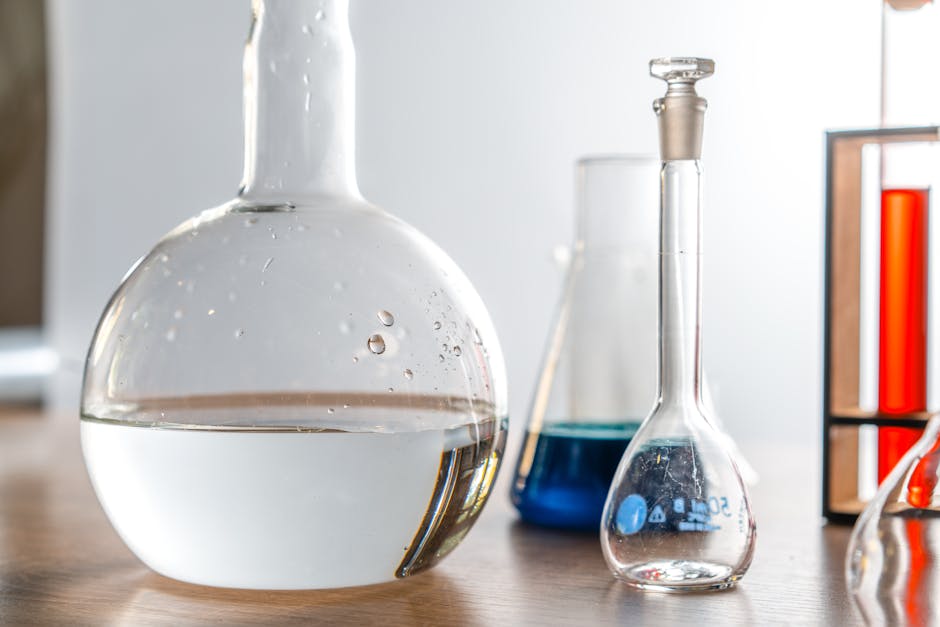
Photo by Ivan S on Pexels
A buffer solution contains a weak acid and its conjugate base, or a weak base and its conjugate acid. This pair works together to "soak up" added H$^+$ or OH$^-$ ions, preventing large changes in pH.
Let's say you have a buffer made from acetic acid (CH$_3$COOH, a weak acid) and sodium acetate (CH$_3$COO$^-$, its conjugate base).
-
When you add a strong acid (H$^+$): The conjugate base (CH$_3$COO$^-$) reacts with the added H$^+$ to form more weak acid (CH$_3$COOH).
CH$_3$COO$^-(aq)$ + H$^+ (aq)$ $\rightleftharpoons$ CH$_3$COOH$(aq)$
This uses up the added H$^+$, so the pH doesn't drop significantly. -
When you add a strong base (OH$^-$): The weak acid (CH$_3$COOH) reacts with the added OH$^-$ to form water and its conjugate base (CH$_3$COO$^-$).
CH$_3$COOH$(aq)$ + OH$^-(aq)$ $\rightleftharpoons$ CH$_3$COO$^-(aq)$ + H$_2$O$(l)$
This uses up the added OH$^-$, so the pH doesn't rise significantly.
The Henderson-Hasselbalch equation is super useful for calculating the pH of a buffer solution:
pH = pK$_a$ + log $\frac{[\text{conjugate base}]}{[\text{weak acid}]}$
Where pK$_a$ = -log($K_a$), and $K_a$ is the acid dissociation constant of the weak acid. The concentrations are usually molarities after any reactions with added strong acid/base have occurred.
Solubility Equilibrium: When Things Don't All Dissolve
Solubility equilibrium applies to sparingly soluble ionic compounds, meaning they don't dissolve much in water. Even for these, a tiny amount does dissolve, forming ions. Eventually, the rate at which the solid dissolves equals the rate at which the ions re-form the solid (precipitate). This is equilibrium.
Consider silver chloride, AgCl, which is sparingly soluble:
AgCl$(s)$ $\rightleftharpoons$ Ag$^+(aq)$ + Cl$^-(aq)$
The solubility product constant, $K_{sp}$, expresses this equilibrium. It's the product of the concentrations of the ions in a saturated solution, each raised to the power of their stoichiometric coefficient.
For AgCl: $K_{sp}$ = [Ag$^+$][Cl$^-$]
For a general sparingly soluble salt M$_x$A$_y$:
M$_x$A$_y(s)$ $\rightleftharpoons$ $x$M$^{y+}(aq)$ + $y$A$^{x-}(aq)$
$K_{sp}$ = [M$^{y+}$]$^x$[A$^{x-}$]$^y$
- If the ion product (Q) < $K_{sp}$: The solution is unsaturated; more solid can dissolve.
- If Q = $K_{sp}$: The solution is saturated; equilibrium exists.
- If Q > $K_{sp}$: The solution is supersaturated; precipitation will occur until Q = $K_{sp}$.
The common ion effect is important here: if you add a common ion (an ion already present in the equilibrium) to a saturated solution, it will shift the equilibrium to the left, causing more solid to precipitate and decreasing the solubility of the salt.
Here's how solubility equilibrium and the common ion effect work:
graph TD
    A["Sparingly Soluble Salt (e.g., AgCl)"] --> B["Dissolves into Ions (Ag+, Cl-)"]
    B --> C["Saturated Solution Reached"]
    C --> D{"Equilibrium Established:
    Dissolution Rate = Precipitation Rate"}
    D --> E["K_sp = [Ag+][Cl-]"]
    D --> F{"Add Common Ion? (e.g., more Cl-)"}
    F -- Yes --> G["Equilibrium Shifts Left (Le Châtelier)"]
    G --> H["More Solid Precipitates"]
    H --> I["Solubility Decreases"]
    F -- No --> D
3. Worked Example
Let's calculate the pH of a buffer solution.
Problem: You have a buffer solution containing 0.10 M acetic acid (CH$_3$COOH) and 0.10 M sodium acetate (CH$_3$COONa). The $K_a$ for acetic acid is $1.8 \times 10^{-5}$. What is the pH of this buffer?
Solution:
-
Identify the weak acid and its conjugate base:
Weak acid: CH$_3$COOH
Conjugate base: CH$_3$COO$^-$ (from CH$_3$COONa) -
Determine the concentrations:
[CH$_3$COOH] = 0.10 M
[CH$_3$COO$^-$] = 0.10 M -
Calculate pK$_a$:
pK$_a$ = -log($K_a$) = -log($1.8 \times 10^{-5}$) $\approx$ 4.74 -
Use the Henderson-Hasselbalch equation:
pH = pK$_a$ + log $\frac{[\text{conjugate base}]}{[\text{weak acid}]}$
pH = 4.74 + log $\frac{[0.10]}{[0.10]}$
pH = 4.74 + log(1)
pH = 4.74 + 0
pH = 4.74
So, the pH of this buffer solution is 4.74. This makes sense because when the concentrations of the weak acid and conjugate base are equal, pH = pK$_a$.
4. Key Takeaways
- Buffer solutions resist pH changes due to the presence of a weak acid/conjugate base pair that consumes added H$^+$ or OH$^-$.
- The Henderson-Hasselbalch equation is a convenient way to calculate the pH of a buffer.
- Solubility equilibrium describes the balance between a sparingly soluble ionic solid and its dissolved ions in a saturated solution.
- The solubility product constant ($K_{sp}$) quantifies the extent of solubility for these compounds.
- The common ion effect reduces the solubility of a sparingly soluble salt when a common ion is added to the solution.
- A buffer's capacity depends on the concentrations of its components; higher concentrations mean more buffer capacity.
- The pH of a buffer is most effective near its pK$_a$ value.
Common Mistakes to Avoid:
- Forgetting to convert $K_a$ to pK$_a$ when using the Henderson-Hasselbalch equation.
- Mixing up weak acid/base and conjugate base/acid in the Henderson-Hasselbalch equation's ratio.
- Ignoring stoichiometry when setting up $K_{sp}$ expressions (e.g., forgetting to square concentrations for ions with coefficients of 2).
- Confusing molar solubility with $K_{sp}$: Molar solubility is the concentration of the dissolved salt; $K_{sp}$ is a constant based on ion concentrations at equilibrium.
5. Now Try It
You have a solution of lead(II) chloride, PbCl$_2$, which has a $K_{sp}$ of $1.7 \times 10^{-5}$.
1. Write the dissolution equilibrium expression for PbCl$_2$.
2. Write the $K_{sp}$ expression for PbCl$_2$.
3. Calculate the molar solubility of PbCl$_2$ in pure water. (Hint: Let 's' be the molar solubility of PbCl$_2$. Then [Pb$^{2+}$] = s and [Cl$^-$] = 2s.)
Success looks like: You correctly write the equilibrium and $K_{sp}$ expression, and calculate 's' with the correct numerical value and units.
Try it yourself: The Haber process simulator
Frequently asked about Buffer Solutions and Solubility Equilibrium
More from chemistry
Get the full chemistry curriculum
Clone the complete plan to your dashboard for unlimited AI-generated notes, practice quizzes, and a personalised revision schedule.
Save this course free