Molecular Orbital (MO) Model
From the organic chemistry curriculum
TL;DR
The MO model describes electrons in molecules as occupying orbitals that span the entire molecule, formed by combining atomic orbitals. These molecular orbitals can be bonding, anti-bonding, or non-bonding, affecting molecular stability and properties. It's a powerful way to understand why molecules form and how they behave, especially for conjugated systems.
1. The Mental Model
Think of molecular orbitals as shared "electron homes" that aren't just around one atom but spread over several atoms in a molecule. These homes are built by blending the atomic orbitals (the electron homes around individual atoms) together.
2. The Core Material
The Molecular Orbital (MO) theory describes how atomic orbitals (AOs) combine to form new molecular orbitals (MOs). Unlike Valence Bond Theory, which focuses on localized bonds, MO theory considers electrons to be delocalized over the entire molecule.
2.1 Forming Molecular Orbitals
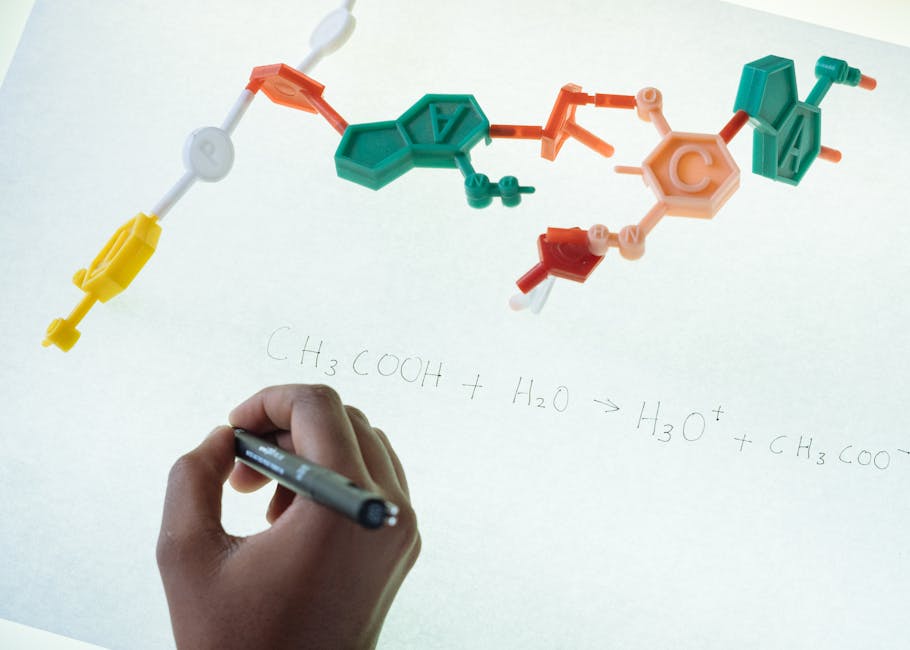
Photo by RF._.studio _ on Pexels
When two atomic orbitals combine, they can do so in two main ways:
1. Constructive interference: This is like waves adding up. The AOs combine "in-phase," leading to a bonding molecular orbital ($\sigma$ or $\pi$). Electrons in bonding MOs stabilize the molecule because they spend more time between the nuclei. These MOs are lower in energy than the original AOs.
2. Destructive interference: This is like waves cancelling out. The AOs combine "out-of-phase," leading to an anti-bonding molecular orbital ($\sigma^*$ or $\pi^*$). Electrons in anti-bonding MOs destabilize the molecule because there's a node (a region of zero electron density) between the nuclei. These MOs are higher in energy than the original AOs.
You can also have non-bonding molecular orbitals if an atomic orbital doesn't interact effectively with other AOs. These have roughly the same energy as the original AO.
2.2 Energy Level Diagrams
We represent MOs using energy level diagrams. You'll place the atomic orbitals of the individual atoms on the sides, and the resulting molecular orbitals in the middle, ordered by energy. Electrons then fill these MOs from lowest energy upwards, following Hund's rule and the Pauli exclusion principle (just like with atomic orbitals).
2.3 Bond Order
A key output of MO theory is bond order, which helps predict the number of bonds between atoms.
$$ \text{Bond Order} = \frac{1}{2} (\text{Number of electrons in bonding MOs} - \text{Number of electrons in anti-bonding MOs}) $$
A higher bond order usually means a stronger, shorter bond.
2.4 $\sigma$ and $\pi$ Orbitals
Remember $\sigma$ and $\pi$ bonds from VSEPR theory? They show up in MO theory too:
* $\sigma$ MOs: Formed from head-on overlap of AOs (like two s orbitals, or an s and a p, or two p's end-to-end). Electron density is concentrated along the internuclear axis.
* $\pi$ MOs: Formed from side-by-side overlap of p orbitals. Electron density is above and below the internuclear axis. These are crucial for understanding conjugated systems.
Here's how MOs form from AOs:
graph TD
    AO1["Atomic Orbital 1 (e.g., 1s)"]
    AO2["Atomic Orbital 2 (e.g., 1s)"]

    AO1 -- "Constructive Overlap" --> BMO["Bonding MO (e.g., $\sigma$)""]
    AO1 -- "Destructive Overlap" --> AMO["Anti-bonding MO (e.g., $\sigma^*$)""]
    AO2 -- "Constructive Overlap" --> BMO
    AO2 -- "Destructive Overlap" --> AMO

    subgraph Energy Level
        AMO -- "Higher Energy" --> BMO
    end
3. Worked Example
Let's look at the simple hydrogen molecule, H$_2$.
Each hydrogen atom has one 1s atomic orbital, containing one electron.
- Combine AOs: The two 1s AOs from each H atom combine to form two molecular orbitals: a $\sigma_{1s}$ (bonding) and a $\sigma^*_{1s}$ (anti-bonding).
- Energy Ordering: The $\sigma_{1s}$ MO is lower in energy than the original 1s AOs, and the $\sigma^*_{1s}$ MO is higher in energy.
-
Fill Electrons: There are a total of two electrons (one from each H atom). Both electrons go into the lowest energy MO, which is the $\sigma_{1s}$ bonding orbital. The $\sigma^*_{1s}$ anti-bonding orbital remains empty.
- Energy Diagram Sketch:
----- $\sigma^*_{1s}$ (empty)
        /
    1s ---      --- 1s
      \     /
         --- $\sigma_{1s}$ ($\uparrow\downarrow$)
4. Calculate Bond Order: - Electrons in bonding MOs = 2 ($\sigma_{1s}$)
- Electrons in anti-bonding MOs = 0 ($\sigma^*_{1s}$)
- Bond Order = $\frac{1}{2} (2 - 0) = 1$
This tells us that H$_2$ has a single bond, which matches what we already know! The fact that the bond order is greater than zero also explains why H$_2$ forms at all.
- Energy Diagram Sketch:
4. Key Takeaways
- MO theory views electrons as delocalized across the entire molecule, not just localized between two atoms.
- Molecular orbitals are formed by combining atomic orbitals; the number of MOs equals the number of AOs combined.
- MOs can be bonding (lower energy, stabilize), anti-bonding (higher energy, destabilize), or non-bonding.
- Electrons fill MOs from lowest to highest energy, following Pauli's exclusion principle and Hund's rule.
- Bond order, calculated from bonding and anti-bonding electrons, predicts bond strength and existence.
Common mistakes to avoid:
- Confusing the number of atomic orbitals with the number of molecular orbitals (they must be equal).
- Forgetting to apply Hund's rule or Pauli's exclusion principle when filling MOs.
- Incorrectly counting electrons in bonding vs. anti-bonding orbitals when calculating bond order.
- Assuming MO theory only applies to simple diatomic molecules; it's very powerful for larger, especially conjugated, systems.
5. Now Try It
Sketch the MO energy level diagram for the He$_2$ molecule (helium dimer). Determine its bond order and predict if it's a stable molecule. What would success look like? You'd have a diagram showing the combined 1s atomic orbitals forming $\sigma_{1s}$ and $\sigma^*_{1s}$ molecular orbitals, correctly filled with the total number of electrons for He$_2$, and a calculated bond order that explains its observed instability.
Frequently asked about Molecular Orbital (MO) Model
More from organic chemistry
Get the full organic chemistry curriculum
Clone the complete plan to your dashboard for unlimited AI-generated notes, practice quizzes, and a personalised revision schedule.
Save this course free