Models in Science and Organic Chemistry
From the organic chemistry curriculum
TL;DR
Models simplify complex systems to help us understand and predict behavior, and in organic chemistry, they're essential for visualizing molecules and reactions. We use various models, from simple drawings to sophisticated computer simulations, each with its own strengths and limitations. Understanding these models helps you interpret molecular structures and predict chemical outcomes more effectively.
1. The Mental Model
Think of a model as a simplified representation of something real. Just like a map is a model of a city, a molecular model is a simplified way to represent a molecule. It helps you see what's usually invisible and understand how things work.
2. The Core Material
In organic chemistry, we deal with incredibly small molecules that we can't directly see. Models allow us to visualize their structure, shape, and how they interact.
2.1 Why We Use Models
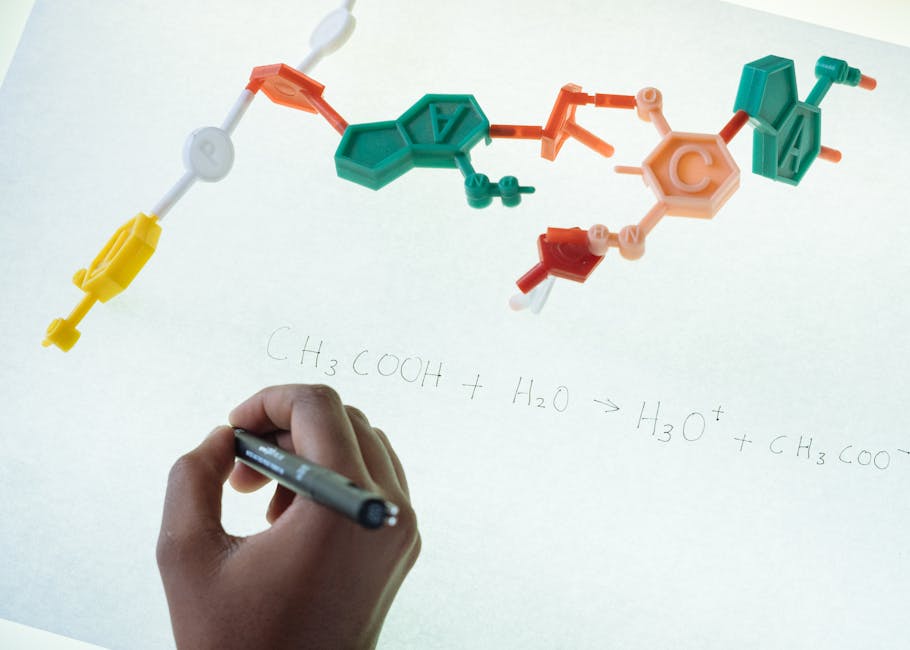
Photo by RF._.studio _ on Pexels
- Visualization: They make abstract concepts like molecular structure tangible.
- Prediction: They help predict properties (like boiling point) and reactivity (how a molecule will react).
- Communication: They provide a common language for chemists to discuss molecules.
- Simplification: They strip away complexity to focus on key features.
2.2 Types of Models in Organic Chemistry

Photo by Tara Winstead on Pexels
We use a range of models, each offering a different perspective:
- Lewis Structures: These show valence electrons as dots and bonds as lines. They're great for understanding bonding patterns and electron distribution, but they don't show 3D shape.
- Kekulé Structures (Line-Angle Formulas): A simplified way to draw molecules where carbons are at vertices and ends of lines, and hydrogens attached to carbon are often implied. They quickly convey connectivity.
- Wedge-and-Dash Projections: These add a 3D perspective to 2D drawings. A solid wedge means a bond is coming out of the page towards you, and a dashed wedge means it's going into** the page away from you.
- Fischer Projections: Primarily used for carbohydrates and amino acids, these show chiral centers with horizontal lines coming out and vertical lines going in. They're a specific 2D representation for 3D arrangements.
- Newman Projections: Used to view molecules down a specific carbon-carbon bond, showing the relative positions of groups on adjacent carbons. Excellent for analyzing conformational isomers.
- Ball-and-Stick Models: Physical or digital models where atoms are represented by spheres (balls) and bonds by sticks. They clearly show connectivity and bond angles.
- Space-Filling Models (CPK Models): These show atoms as spheres proportional to their van der Waals radii, emphasizing the actual "space" a molecule occupies. They're great for understanding steric hindrance.
- Electrostatic Potential Maps: Computer-generated models that color-code the surface of a molecule based on electron density. Red indicates electron-rich areas (partially negative), and blue indicates electron-poor areas (partially positive). Useful for predicting reactivity.
2.3 Limitations of Models
No model is perfect; they're all simplifications.
- Simplification: By necessity, models omit some details. A ball-and-stick model doesn't show the continuous electron cloud, for instance.
- Scale: Models don't represent actual size differences perfectly.
- Dynamic Nature: Molecules are constantly vibrating and rotating, but most models show a static snapshot.
- Over-interpretation: It's easy to assume a model is the exact reality rather than just a useful representation.
Here's how different models build on each other, moving from connectivity to 3D shape:
graph TD
    A["Lewis Structure (Connectivity & Electrons)"] --> B["Kekulé Structure (Skeletal Connectivity)"]
    B --> C["Wedge-and-Dash (Basic 3D)"]
    C --> D["Ball-and-Stick Model (Physical 3D)"]
    C --> E["Newman Projection (Conformational)"]
    C --> F["Fischer Projection (Specific Chiral 3D)"]
    D --> G["Space-Filling Model (Volume & Sterics)"]
    G --> H["Electrostatic Potential Map (Reactivity Potential)"]
3. Worked Example
Let's consider the molecule ethanol, CH$_3$CH$_2$OH.
-
Lewis Structure: Shows all valence electrons.
H   H
        |   |
      H-C-C-O-H
        |   |
        H   H
(with lone pairs on Oxygen) -
Kekulé (Line-Angle) Structure: Simpler, showing carbon backbone.
OH
      /
    —
(where the dash represents the CH3, the vertex the CH2, and the attached line the OH) -
Wedge-and-Dash (for the CH2-OH part to show its 3D nature):
Imagine viewing down the C-C bond, where the CH$_3$ group is behind the first C. For the CH$_2$ group, one H might be "in" and one "out".
OH
          |
        C (front carbon)
       / \
      H   H
     /     \
    C (back carbon)
    /|\
   H H H
To be more precise for a chiral center (ethanol isn't chiral, but we can illustrate a single carbon's geometry):
H
          |
        H-C - CH3
          / \
        OH   H (dashed wedge)
(This is an oversimplification for illustration, as ethanol has free rotation. The dashes and wedges help represent the tetrahedral geometry around each carbon.) -
Ball-and-Stick Model: You'd see two black carbon spheres, six white hydrogen spheres, and one red oxygen sphere. The carbons would be connected, and the oxygen would be connected to one carbon, with all hydrogens connected as shown in the Lewis structure. This model clearly shows the approximate 109.5° bond angles around the carbons and the bent geometry around the oxygen.
4. Key Takeaways
- Models simplify reality to help us understand complex molecular structures and reactions.
- Different models (Lewis, Kekulé, wedge-and-dash, ball-and-stick, space-filling, etc.) emphasize different aspects of a molecule.
- Lewis structures show bonding and lone pairs; line-angle formulas simplify the carbon skeleton.
- Wedge-and-dash, Newman, and Fischer projections specifically communicate 3D molecular geometry.
- Ball-and-stick and space-filling models provide physical representations of molecular shape and volume.
- All models have limitations; they are tools, not perfect replicas of reality.
Common Mistakes to Avoid:
- Confusing 2D representations with 3D reality: A Lewis structure is flat, but the molecule it represents is three-dimensional.
- Assuming one model is "best": The best model depends on what information you're trying to convey or understand.
- Ignoring a model's limitations: Remember that models are simplifications and don't capture every nuance (like electron clouds or molecular vibrations).
- Misinterpreting wedge-and-dash: Always remember what solid and dashed wedges represent in terms of position relative to the viewer.
5. Now Try It
Draw the Lewis structure, Kekulé (line-angle) structure, and a simple wedge-and-dash representation for propan-2-ol (isopropyl alcohol), CH$_3$CH(OH)CH$_3$. For the wedge-and-dash, focus on the central carbon atom and its four attached groups (two CH$_3$, one H, one OH) to illustrate its tetrahedral geometry. What success looks like: You'll have three distinct drawings, with the wedge-and-dash showing one group coming out towards you and one going away from you from the central carbon.
Frequently asked about Models in Science and Organic Chemistry
More from organic chemistry
Get the full organic chemistry curriculum
Clone the complete plan to your dashboard for unlimited AI-generated notes, practice quizzes, and a personalised revision schedule.
Save this course free