Introduction to Organic Chemistry and Reaction Concepts
From the organic chemistry curriculum
TL;DR
Organic chemistry is the study of carbon-containing compounds, which form the basis of most known life and materials. Understanding their structures and how they react is key to predicting their behavior. Reactions involve breaking and forming bonds, often driven by the movement of electrons.
1. The Mental Model
Think of organic molecules as LEGO sets. Carbon atoms are the central connector bricks, capable of forming four bonds. Other atoms (like hydrogen, oxygen, nitrogen) are specialized bricks. Organic chemistry is about building these sets, taking them apart, and reassembling them to create new structures.
2. The Core Material
Organic chemistry primarily deals with compounds containing carbon-hydrogen bonds and often other elements like oxygen, nitrogen, sulfur, and halogens. Carbon's ability to form four stable bonds (tetravalency) and link with itself in long chains or rings makes it incredibly versatile.
What Makes Organic Molecules Unique?

Photo by Steve A Johnson on Pexels
- Carbon's Versatility: Carbon can form single, double, or triple bonds. It can also bond with itself to form long chains, branched structures, and rings, leading to an immense diversity of compounds.
- Functional Groups: These are specific groups of atoms within a molecule that are responsible for its characteristic chemical reactions. They are the "action centers" of organic molecules. For example, an alcohol has an -OH group, and a carboxylic acid has a -COOH group.
- Isomerism: Molecules with the same molecular formula but different arrangements of atoms are called isomers. They can have vastly different properties. For instance, ethanol (drinking alcohol) and dimethyl ether (a gas) both have the formula C2H6O.
Understanding Organic Reactions

Photo by Mikhail Nilov on Pexels
Organic reactions involve the transformation of reactants into products. This always means breaking existing chemical bonds and forming new ones.
Electron Movement is Key
Chemical reactions happen because electrons move. These movements can be visualized using curved arrows:
- A single-headed arrow (fishhook arrow) shows the movement of one electron. This is common in radical reactions.
- A double-headed arrow shows the movement of a pair of electrons. This is much more common in ionic reactions, which you'll encounter frequently.
Electrons typically flow from areas of high electron density (like lone pairs or pi bonds) to areas of low electron density (like partially positive atoms or empty orbitals).
Types of Reagents
- Nucleophiles ("nucleus-loving"): Electron-rich species that donate electrons to form a new bond. They often have lone pairs or pi bonds and are negatively charged or neutral with a high electron density. Examples: OH-, NH3, alkenes.
- Electrophiles ("electron-loving"): Electron-deficient species that accept electrons to form a new bond. They are often positively charged or have partial positive charges and empty orbitals. Examples: H+, C=O (carbonyl carbon), carbocations.
Think of it like dating: Nucleophiles are the "givers" (electron donors), and electrophiles are the "takers" (electron acceptors). A reaction typically occurs when a nucleophile attacks an electrophile.
graph TD
    A["Nucleophile (Electron-Rich)"] --> B["Attacks"];
    B --> C["Electrophile (Electron-Deficient)"];
    C --> D["New Bond Forms"];
    D --> E["Old Bond Breaks (Often)"];
    E --> F["Products Formed"];
Reaction Mechanisms
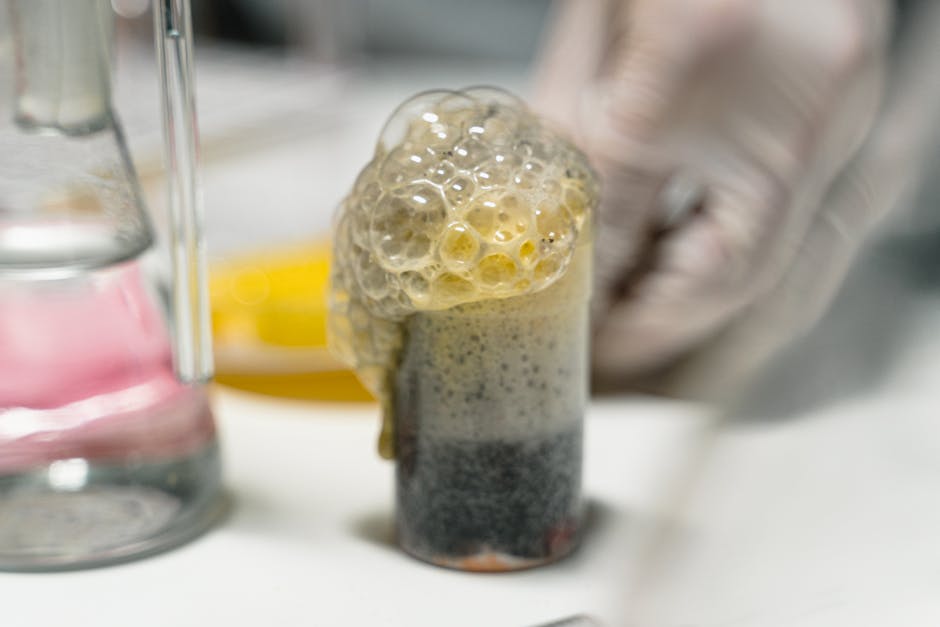
Photo by MART PRODUCTION on Pexels
A reaction mechanism describes the step-by-step sequence of elementary reactions by which overall chemical change occurs. It shows which bonds break, which bonds form, and the flow of electrons using curved arrows. Understanding mechanisms allows you to predict product outcomes and reaction rates.
3. Worked Example
Let's look at a simple acid-base reaction, specifically the protonation of water by HCl. This is a common nucleophile-electrophile interaction.
Reaction: HCl + H2O → H3O+ + Cl-
Mechanism:
-
Identify Nucleophile and Electrophile:
- Water (H2O): Oxygen has two lone pairs of electrons, making it electron-rich and a nucleophile.
- Hydrogen Chloride (HCl): The hydrogen atom is bonded to a very electronegative chlorine, giving it a partial positive charge (δ+) and making it an electrophilic site.
-
Electron Flow (Curved Arrows):
- A lone pair of electrons from the oxygen atom of water attacks the hydrogen atom of HCl.
- Simultaneously, the H-Cl bond breaks, and the bonding electrons move to the more electronegative chlorine atom, forming a chloride ion (Cl-).
    H     ..       H
    |    :O:  +  H-Cl   -->    H-O:+  +  :Cl:-
    |     ¨        |           |
    H              Cl           H
(Imagine an arrow from oxygen's lone pair to H of HCl, and an arrow from H-Cl bond to Cl.)
This results in the formation of a hydronium ion (H3O+) and a chloride ion (Cl-).
4. Key Takeaways
- Organic chemistry is the study of carbon compounds, characterized by carbon's ability to form four bonds and diverse structures.
- Functional groups dictate the chemical reactivity of organic molecules.
- Organic reactions involve breaking and forming bonds, driven by the movement of electrons.
- Curved arrows track electron movement, usually from electron-rich nucleophiles to electron-deficient electrophiles.
- Nucleophiles are electron donors (often with lone pairs or pi bonds), and electrophiles are electron acceptors (often with partial positive charges).
- A reaction mechanism shows the detailed, step-by-step pathway of electron flow during a reaction.
- Isomers have the same molecular formula but different atomic arrangements and properties.
Common Mistakes to Avoid:
* Confusing single-headed and double-headed arrows for electron movement.
* Not identifying the nucleophilic and electrophilic centers correctly in a reaction.
* Forgetting that every arrow represents the movement of electrons, not atoms.
* Ignoring formal charges, which are crucial for tracking electron changes.
5. Now Try It
Take the reaction of ammonia (NH3) with a generic proton (H+). Draw the Lewis structures of the reactants and products. Then, use curved arrows to show the movement of electrons that leads to the formation of the ammonium ion (NH4+). What is the nucleophile, and what is the electrophile in this specific reaction? Think about where the electrons start and where they want to go. Success looks like correctly identifying the electron flow and the resulting charges.
Frequently asked about Introduction to Organic Chemistry and Reaction Concepts
More from organic chemistry
Get the full organic chemistry curriculum
Clone the complete plan to your dashboard for unlimited AI-generated notes, practice quizzes, and a personalised revision schedule.
Save this course free