Introduction to Differentiation and Power Rule
From the calculus curriculum
TL;DR
Differentiation helps us find the instantaneous rate of change or the slope of a curve at any point. The Power Rule is a fundamental shortcut for differentiating polynomial terms, making it much quicker than using the limit definition. By applying the Power Rule, you can find the derivative of many common functions efficiently.
1. The Mental Model
Imagine you're walking on a hilly path. Differentiation helps you figure out exactly how steep the path is at your exact location, not just the average steepness over a long stretch. It's all about finding the instantaneous rate of change.
2. The Core Material
Differentiation is a core concept in calculus that lets us find the derivative of a function. The derivative tells us the slope of the tangent line to the function's graph at any given point. Think of the tangent line as a line that just touches the curve at one point, matching its direction exactly there.
Traditionally, finding the derivative involves using the limit definition, which looks like this:
$$f'(x) = \lim_{h \to 0} \frac{f(x+h) - f(x)}{h}$$
While this formula is fundamental to understanding what a derivative is, it's quite involved for many functions. Luckily, for many common functions, we have shortcuts called differentiation rules. The most important one for beginners is the Power Rule.
The Power Rule

Photo by Alari Tammsalu on Pexels
The Power Rule is a straightforward way to differentiate terms of the form $x^n$.
If your function is $f(x) = x^n$, where $n$ is any real number, then its derivative, denoted $f'(x)$ (read as "f prime of x"), is:
$$f'(x) = n \cdot x^{n-1}$$
Let's break down what's happening:
1. You take the exponent ($n$) and bring it down to the front, multiplying it by the term.
2. You then reduce the original exponent by 1 ($n-1$).
It's that simple!
Differentiation Rules in Action
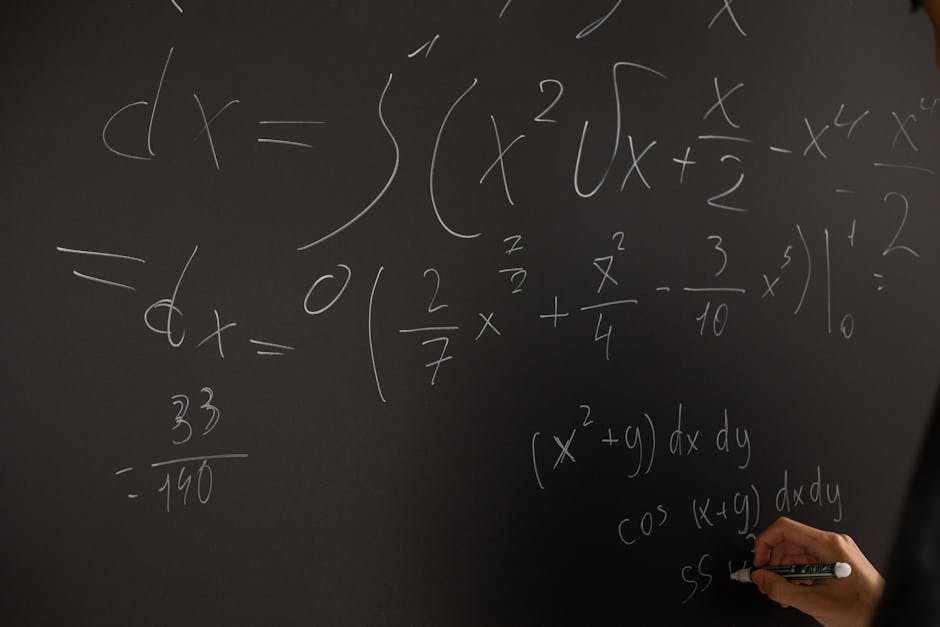
Photo by Monstera Production on Pexels
Let's look at some examples to clarify:
-
Example 1: $f(x) = x^3$
Here, $n=3$.
Apply the Power Rule: $f'(x) = 3 \cdot x^{3-1} = 3x^2$. -
Example 2: $f(x) = x^5$
Here, $n=5$.
Apply the Power Rule: $f'(x) = 5 \cdot x^{5-1} = 5x^4$. -
What about constants?
If you have a constant multiplied by a term, like $g(x) = c \cdot f(x)$, then its derivative is $g'(x) = c \cdot f'(x)$. You just keep the constant multiplier.
For example, if $f(x) = 4x^3$:
$f'(x) = 4 \cdot (3x^{3-1}) = 4 \cdot 3x^2 = 12x^2$. -
What about terms without an exponent?
Consider $f(x) = x$. This is the same as $x^1$.
Using the Power Rule: $f'(x) = 1 \cdot x^{1-1} = 1 \cdot x^0 = 1 \cdot 1 = 1$.
So, the derivative of $x$ is 1. This makes sense: the line $y=x$ has a constant slope of 1. -
What about constants alone?
Consider $f(x) = 7$. You can think of this as $7x^0$.
Using the Power Rule (and constant rule): $f'(x) = 7 \cdot (0 \cdot x^{0-1}) = 7 \cdot 0 = 0$.
The derivative of any constant is 0. This also makes sense: a horizontal line ($y=7$) has no slope.
Sum and Difference Rule

Photo by Gratisography on Pexels
If you have a function that's a sum or difference of several terms, you can differentiate each term separately.
If $f(x) = g(x) \pm h(x)$, then $f'(x) = g'(x) \pm h'(x)$.
For example, if $f(x) = 3x^4 - 2x^2 + 5x - 8$:
* Derivative of $3x^4$ is $3 \cdot 4x^{4-1} = 12x^3$.
* Derivative of $-2x^2$ is $-2 \cdot 2x^{2-1} = -4x^1 = -4x$.
* Derivative of $5x$ is $5 \cdot 1x^{1-1} = 5 \cdot x^0 = 5 \cdot 1 = 5$.
* Derivative of $-8$ (a constant) is $0$.
So, $f'(x) = 12x^3 - 4x + 5$.
Here's a flowchart to visualize the process for a polynomial term:
graph TD
    A["Start with a term (e.g., ax^n)"] --> B{Is it a constant 'c'?};
    B -- Yes --> C["Derivative is 0"];
    B -- No --> D{Is 'n' an exponent?};
    D -- Yes --> E["Bring exponent 'n' down"];
    E --> F["Multiply by current coefficient 'a' (now 'an')"];
    F --> G["Reduce exponent by 1 (n-1)"];
    G --> H["Result: an*x^(n-1)"];
    D -- No (e.g., ax) --> I["Exponent is 1"];
    I --> J["Bring down 1, reduce by 1"];
    J --> K["Result: a (coefficient only)"];
3. Worked Example
Let's differentiate the function $f(x) = 5x^3 - 7x^2 + x - 10$.
-
Break it down: We'll differentiate each term separately using the Sum/Difference Rule.
-
Differentiate $5x^3$:
- Coefficient $a=5$, exponent $n=3$.
- Bring down the exponent: $3 \cdot 5 = 15$.
- Reduce the exponent by 1: $3-1=2$.
- Result: $15x^2$.
-
Differentiate $-7x^2$:
- Coefficient $a=-7$, exponent $n=2$.
- Bring down the exponent: $2 \cdot (-7) = -14$.
- Reduce the exponent by 1: $2-1=1$.
- Result: $-14x^1 = -14x$.
-
Differentiate $x$:
- This is $1x^1$. Coefficient $a=1$, exponent $n=1$.
- Bring down the exponent: $1 \cdot 1 = 1$.
- Reduce the exponent by 1: $1-1=0$.
- Result: $1x^0 = 1 \cdot 1 = 1$.
-
Differentiate $-10$:
- This is a constant.
- Result: $0$.
-
Combine the results:
$f'(x) = 15x^2 - 14x + 1 - 0$
$f'(x) = 15x^2 - 14x + 1$
4. Key Takeaways
- The derivative tells you the instantaneous rate of change or the slope of a curve at a specific point.
- The Power Rule is a shortcut for differentiating terms like $x^n$: you multiply by the old exponent and then subtract 1 from the exponent.
- For terms like $ax^n$, the derivative is $anx^{n-1}$.
- The derivative of $x$ (or $x^1$) is $1$.
- The derivative of any constant (like 5, -10, or $\pi$) is always $0$.
- When a function is a sum or difference of terms, differentiate each term separately.
Common Mistakes to Avoid:
- Forgetting to reduce the exponent by 1 after bringing it down.
- Confusing a constant term (like 5) with a constant multiplier (like $5x^2$).
- Forgetting that the derivative of $x$ is $1$, not $0$ or $x$.
- Accidentally applying the Power Rule to non-polynomial terms (e.g., $e^x$ or $\ln x$ – those have their own rules!).
5. Now Try It
Take 15 minutes to differentiate the following function: $g(x) = 7x^4 - 3x^3 + 2x^2 - 6x + 12$. Write down each step clearly, similar to the worked example.
What success looks like: You should be able to confidently find the derivative of each term and combine them to get the final derivative $g'(x)$. Your final answer should be a new polynomial expression.
Frequently asked about Introduction to Differentiation and Power Rule
Study this next
Get the full calculus curriculum
Clone the complete plan to your dashboard for unlimited AI-generated notes, practice quizzes, and a personalised revision schedule.
Save this course free