Kingdom Protista
From the biological classification curriculum
TL;DR
Protista is a diverse kingdom of mostly single-celled eukaryotic organisms that don't fit neatly into other kingdoms. They're often called the "catch-all" or "junk drawer" kingdom due to their wide variety in structure, nutrition, and reproduction. You'll find everything from animal-like protozoans to plant-like algae and fungus-like slime molds here.
1. The Mental Model
Think of Protista as the "miscellaneous" category for eukaryotes. If an organism has a nucleus but isn't a plant, animal, or fungus, it likely belongs to the Protista kingdom. This means you'll see a lot of variation in how they live and what they look like.
2. The Core Material
The Kingdom Protista is incredibly diverse, making it one of the hardest to define precisely. What unites them is primarily what they aren't: they're not animals, plants, or fungi, but they are eukaryotes (meaning their cells have a nucleus and other membrane-bound organelles). Most protists are unicellular, but some are multicellular, lacking specialized tissues.
We generally categorize protists into three main groups based on how they obtain nutrients and their similarities to other kingdoms:
2.1. Animal-like Protists (Protozoans)
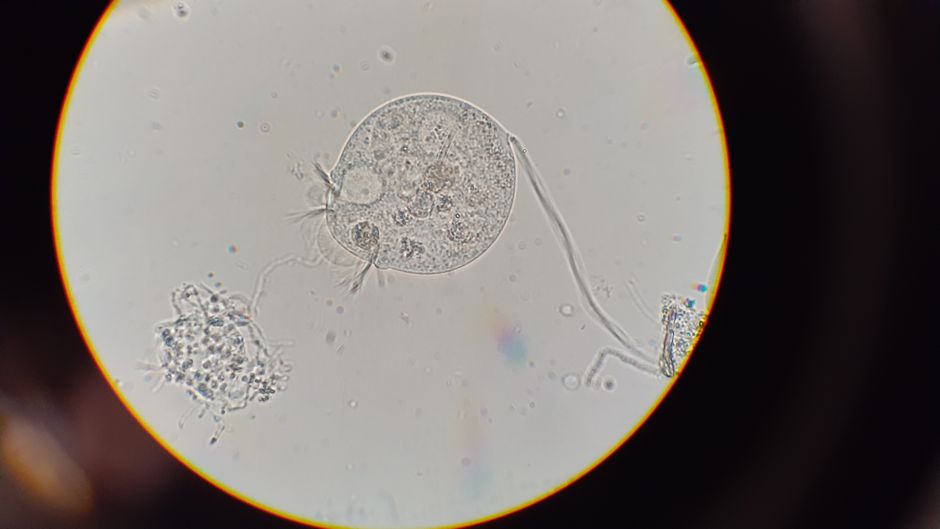
Photo by Coy on Pexels
These protists are heterotrophic, meaning they consume other organisms for food, much like animals. They are typically motile (can move) and lack a cell wall. You can further classify them by how they move:
* Amoeboids: Move using pseudopods (temporary cytoplasmic extensions, "false feet"). Example: Amoeba.
* Ciliates: Move and feed using cilia (short, hair-like structures). Example: Paramecium.
* Flagellates: Move using flagella (long, whip-like tails). Example: Euglena (though Euglena can also photosynthesize).
* Sporozoans: Non-motile parasites that form spores. Example: Plasmodium (causes malaria).
2.2. Plant-like Protists (Algae)

Photo by Kaedy B on Pexels
These protists are autotrophic, meaning they produce their own food through photosynthesis, like plants. They contain chlorophyll and can be unicellular or multicellular. They're vital producers in aquatic ecosystems.
* Dinoflagellates: Have two flagella and often cause "red tides."
* Diatoms: Have intricate glass-like cell walls (silica) and are major components of phytoplankton.
* Euglenoids: Like Euglena, they have flagella and can photosynthesize, but can also consume food if light isn't available (mixotrophic).
* Green Algae, Red Algae, Brown Algae: These are larger, often multicellular forms. They're thought to be ancestors of plants.
2.3. Fungus-like Protists

Photo by Ravi Kant on Pexels
These protists are heterotrophic decomposers, absorbing nutrients from dead organic matter, similar to fungi. Unlike true fungi, they lack chitin in their cell walls (if they have one).
* Slime Molds: Can exist as individual amoeboid cells or aggregate into a single multinucleate mass that moves and feeds.
* Water Molds: Grow as filaments and can be parasitic or decomposers. They caused the Great Irish Potato Famine.
Here's a diagram to help visualize the major categories within Kingdom Protista:
graph TD
    A["Kingdom Protista"] --> B["Animal-like Protists (Protozoans)"]
    A --> C["Plant-like Protists (Algae)"]
    A --> D["Fungus-like Protists"]

    B --> B1["Amoeboids (e.g., Amoeba)"]
    B --> B2["Ciliates (e.g., Paramecium)"]
    B --> B3["Flagellates (e.g., Trypanosoma)"]
    B --> B4["Sporozoans (e.g., Plasmodium)"]

    C --> C1["Dinoflagellates (e.g., Noctiluca)"]
    C --> C2["Diatoms (e.g., Pinnularia)"]
    C --> C3["Euglenoids (e.g., Euglena)"]
    C --> C4["Green Algae (e.g., Chlamydomonas)"]
    C --> C5["Brown Algae (e.g., Kelp)"]
    C --> C6["Red Algae (e.g., Porphyra)"]

    D --> D1["Slime Molds (e.g., Physarum)"]
    D --> D2["Water Molds (e.g., Phytophthora)"]
3. Worked Example
Let's consider Euglena. When you observe Euglena under a microscope, you'd see a single-celled organism with a distinct flagellum allowing it to swim. You'd also notice chloroplasts inside its cell, indicating it can perform photosynthesis. However, if you keep it in the dark, it can still survive by consuming organic matter from its environment. This dual nature (photosynthesis and heterotrophic feeding) means Euglena is classified as a protist, specifically a flagellate within the plant-like protists (Euglenoids), demonstrating the "mixotrophic" characteristic often found in this kingdom.
4. Key Takeaways
- Protista is a very diverse kingdom for eukaryotic organisms that aren't plants, animals, or fungi.
- Most protists are unicellular, but some are multicellular without specialized tissues.
- They are broadly categorized into animal-like (protozoans), plant-like (algae), and fungus-like groups based on nutrition.
- Animal-like protists are heterotrophic and move using pseudopods, cilia, or flagella, or are non-motile parasites.
- Plant-like protists are autotrophic (photosynthetic) and include diatoms, dinoflagellates, and various forms of algae.
- Fungus-like protists are heterotrophic decomposers, like slime molds and water molds.
- Protists play crucial roles as producers, consumers, and decomposers in many ecosystems.
Common Mistakes to Avoid

Photo by KATRIN BOLOVTSOVA on Pexels
- Don't think all protists are microscopic; some algae, like kelp, are very large.
- Don't assume all protists are single-celled; there are multicellular protists.
- Don't confuse protists with true fungi, plants, or animals; remember they lack the defining characteristics (e.g., chitin cell walls in fungi, specialized tissues in plants/animals).
- Avoid thinking of "Protista" as a unified, closely related group; it's a collection of diverse organisms.
5. Now Try It
Imagine you've collected a pond water sample. Describe what you'd look for to identify an "animal-like" protist versus a "plant-like" protist. Specifically, think about how they might move, what visible structures they might have (or lack), and what that tells you about how they get food. What would success look like? You'd be able to list at least three distinct characteristics for each type that you'd observe under a microscope, linking each characteristic to its function or classification.
Frequently asked about Kingdom Protista
Study this next
Get the full biological classification curriculum
Clone the complete plan to your dashboard for unlimited AI-generated notes, practice quizzes, and a personalised revision schedule.
Save this course free