Unit 2: Organic Chemistry Fundamentals
From the QCE, Chemistry Unit 1 and 2 exam revision curriculum
TL;DR
Organic chemistry is all about carbon-containing compounds, which form the basis of most life on Earth. You'll learn how to name these molecules, understand their unique structures, and predict how they behave in reactions. Mastering the basics of functional groups and isomerism is key to unlocking this fascinating field.
1. The Mental Model
Think of organic chemistry as building with LEGOs, but your LEGO bricks are atoms, and carbon is the special multi-connector piece. You're learning the rules for how these pieces fit together, what shapes they make, and how different arrangements change the final "toy's" properties.
2. The Core Material
Organic chemistry focuses on compounds containing carbon, usually bonded to hydrogen, oxygen, nitrogen, and other elements. Carbon's ability to form four stable bonds and link with itself in chains and rings creates an incredible diversity of molecules.
Hydrocarbons: The Foundation
Photo by Nothing Ahead on Pexels
These are the simplest organic compounds, made only of carbon and hydrogen.
- Alkanes: Contain only carbon-carbon single bonds. They're "saturated" because they have the maximum number of hydrogen atoms possible.
- General formula: C$_{n}$H$_{2n+2}$
- Suffix:
-ane - Examples: Methane (CH₄), Ethane (C₂H₆), Propane (C₃H₈)
- Alkenes: Contain at least one carbon-carbon double bond. They're "unsaturated."
- General formula: C$_{n}$H$_{2n}$
- Suffix:
-ene - Examples: Ethene (C₂H₄), Propene (C₃H₆)
- Alkynes: Contain at least one carbon-carbon triple bond. Also "unsaturated."
- General formula: C$_{n}$H$_{2n-2}$
- Suffix:
-yne - Examples: Ethyne (C₂H₂), Propyne (C₃H₄)
Functional Groups: The Reactivity Hubs
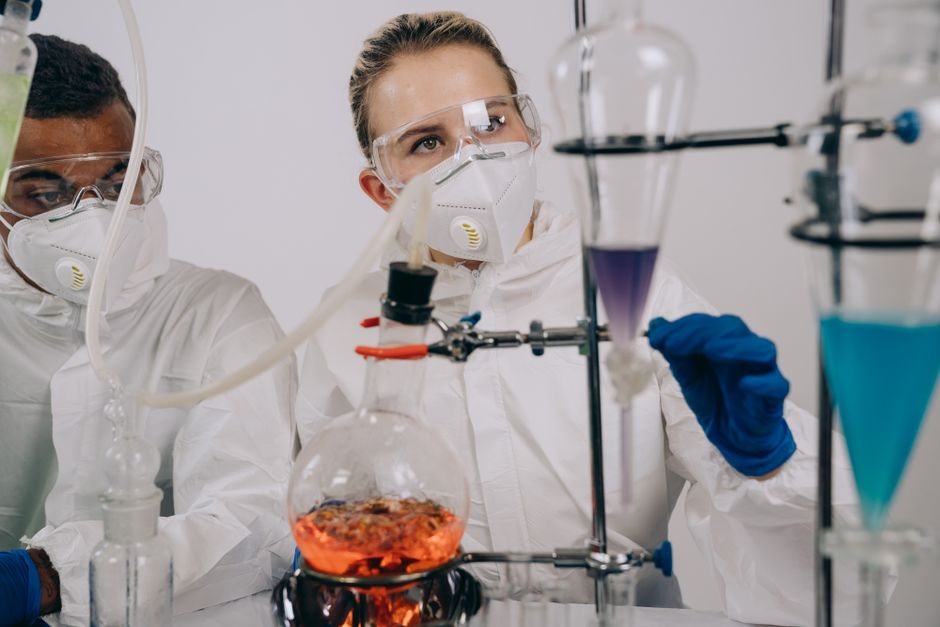
Photo by Mikhail Nilov on Pexels
Functional groups are specific arrangements of atoms within a molecule that are responsible for its characteristic chemical reactions. They often contain heteroatoms (atoms other than C or H) like oxygen, nitrogen, or halogens.
Here's a breakdown of some common functional groups:
| Functional Group | Structure | Suffix/Prefix (example) | Class Name |
|---|---|---|---|
| Hydroxyl | -OH | -ol (ethanol) | Alcohol |
| Carboxyl | -COOH (or O=C-OH) | -oic acid (ethanoic acid) | Carboxylic acid |
| Carbonyl (ketone) | C=O (where C is bonded to two other C atoms) | -one (propanone) | Ketone |
| Carbonyl (aldehyde) | R-CHO (where C is bonded to at least one H) | -al (ethanal) | Aldehyde |
| Amino | -NH₂ | amino- (ethylamine) | Amine |
| Haloalkane | -X (X = F, Cl, Br, I) | fluoro-, chloro-, bromo-, iodo- | Haloalkane |
Naming Organic Compounds (Nomenclature)
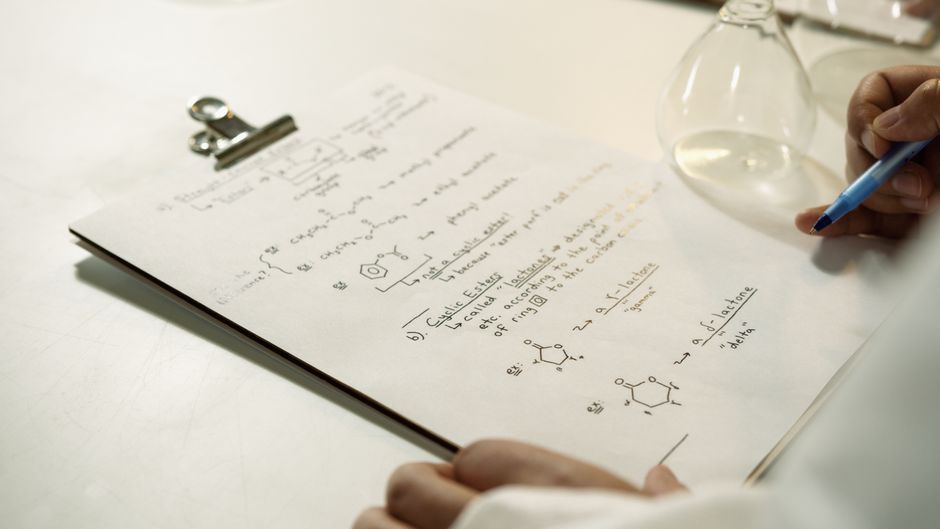
Photo by Artem Podrez on Pexels
You'll use the IUPAC (International Union of Pure and Applied Chemistry) system to name compounds. It follows a systematic approach:
- Identify the longest carbon chain (parent chain).
- Number the parent chain to give the lowest possible numbers to functional groups or substituents.
- Identify and name substituents (branches, other functional groups).
- Methyl (-CH₃), Ethyl (-CH₂CH₃), Propyl (-CH₂CH₂CH₃)
- Assemble the name:
- Substituents (with position numbers) in alphabetical order
- Parent chain name (meth-, eth-, prop-, but-, pent-, hex-...)
- Suffix indicating the primary functional group (e.g., -ane, -ene, -yne, -ol, -oic acid)
Isomerism: Different Structures, Same Formula
Photo by Artem Podrez on Pexels
Isomers are compounds that have the same molecular formula but different structural arrangements of atoms. This leads to different physical and chemical properties.
- Structural Isomers (Constitutional Isomers): Atoms are connected in a different order.
- Chain Isomers: Different arrangements of the carbon skeleton (e.g., butane vs. 2-methylpropane).
- Positional Isomers: Same carbon skeleton and functional group, but the functional group is at a different position (e.g., propan-1-ol vs. propan-2-ol).
- Functional Group Isomers: Same molecular formula, but different functional groups (e.g., ethanol vs. dimethylether).
- Stereoisomers: Atoms are connected in the same order but differ in their spatial arrangement.
- Geometric Isomers (cis-trans isomers): Occur in molecules with restricted rotation, typically around a C=C double bond. If similar groups are on the same side of the double bond, it's cis; if on opposite sides, it's trans.
- Optical Isomers (Enantiomers): Non-superimposable mirror images. They contain a chiral centre (a carbon atom bonded to four different groups).
graph TD
    A["Organic Compounds"] --> B["Hydrocarbons (C & H only)"]
    A --> C["Compounds with Functional Groups"]

    B --> B1["Alkanes (single bonds)"]
    B --> B2["Alkenes (double bonds)"]
    B --> B3["Alkynes (triple bonds)"]

    C --> C1["Alcohols (-OH)"]
    C --> C2["Carboxylic Acids (-COOH)"]
    C --> C3["Ketones (C=O, internal)"]
    C --> C4["Aldehydes (C=O, terminal)"]
    C --> C5["Amines (-NH2)"]
    C --> C6["Haloalkanes (-X)"]

    A --> D["Isomers (Same Formula, Different Structure)"]
    D --> D1["Structural Isomers"]
    D --> D2["Stereoisomers"]

    D1 --> D1a["Chain Isomers"]
    D1 --> D1b["Positional Isomers"]
    D1 --> D1c["Functional Group Isomers"]

    D2 --> D2a["Geometric (cis-trans) Isomers"]
    D2 --> D2b["Optical Isomers (Enantiomers)"]
3. Worked Example
Problem: Draw the condensed structural formula and name all possible structural isomers for a compound with the molecular formula C₄H₁₀O. Identify the functional groups present in each.
Solution:
-
Determine saturation: Compare C₄H₁₀O to C$_{n}$H$_{2n+2}$O. For n=4, 2n+2 = 10. So C₄H₁₀O is saturated, meaning it can contain alcohols (-OH) or ethers (C-O-C), but not double bonds.
-
Explore Alcohol Isomers:
- Butan-1-ol:
CH₃-CH₂-CH₂-CH₂-OH
(Longest chain: 4 carbons, -OH on C1)
Functional group: Alcohol - Butan-2-ol:
CH₃-CH₂-CH(OH)-CH₃
(Longest chain: 4 carbons, -OH on C2)
Functional group: Alcohol - 2-Methylpropan-1-ol:
CH₃-CH(CH₃)-CH₂-OH
(Longest chain: 3 carbons (propane), methyl branch on C2, -OH on C1)
Functional group: Alcohol - 2-Methylpropan-2-ol:
CH₃-C(CH₃)(OH)-CH₃
(Longest chain: 3 carbons (propane), methyl branch on C2, -OH on C2)
Functional group: Alcohol
- Butan-1-ol:
-
Explore Ether Isomers:
- Methoxypropane:
CH₃-O-CH₂-CH₂-CH₃
(Methyl group on one side of oxygen, propyl on the other)
Functional group: Ether - Ethoxyethane:
CH₃-CH₂-O-CH₂-CH₃
(Ethyl group on both sides of oxygen)
Functional group: Ether - 1-Methoxyethane (or Isopropyl methyl ether):
CH₃-O-CH(CH₃)-CH₃
(Methyl group on one side of oxygen, isopropyl on the other)
Functional group: Ether
- Methoxypropane:
So there are 7 structural isomers for C₄H₁₀O (4 alcohols and 3 ethers).
4. Key Takeaways
- Carbon's ability to form four bonds and catenate (bond to itself) underpins the vast diversity of organic compounds.
- Hydrocarbons (alkanes, alkenes, alkynes) are fundamental building blocks, differing by their carbon-carbon bond types.
- Functional groups dictate a molecule's chemical reactivity and classification. Memorise the common ones and their suffixes/prefixes.
- IUPAC nomenclature provides a systematic way to name organic compounds based on their structure.
- Isomers have the same molecular formula but different arrangements of atoms, leading to distinct properties.
- Understand the difference between structural isomers (different connectivity) and stereoisomers (different spatial arrangement).
Common Mistakes to Avoid:
* Not numbering the longest chain correctly: Always find the absolute longest continuous carbon chain.
* Incorrectly locating functional groups or substituents: Ensure you number the chain to give them the lowest possible numbers.
* Confusing structural and stereoisomers: Remember, structural isomers have different bonding patterns, while stereoisomers have the same bonding but different 3D shapes.
* Forgetting to draw all possible isomers: Systematically explore different chain lengths, functional group positions, and branching patterns.
* Ignoring valency rules: Always ensure carbon has 4 bonds, hydrogen 1, oxygen 2, and nitrogen 3 (in neutral compounds).
5. Now Try It
Sketch condensed structural formulas for all possible geometric (cis-trans) isomers of C₅H₁₀ that contain one double bond. For each, clearly indicate if it's cis or trans and provide its IUPAC name. You should find three possibilities. Success means you've correctly drawn the 3 isomers and named them with their stereochemical descriptors.
Frequently asked about Unit 2: Organic Chemistry Fundamentals
Study this next
Get the full QCE, Chemistry Unit 1 and 2 exam revision curriculum
Clone the complete plan to your dashboard for unlimited AI-generated notes, practice quizzes, and a personalised revision schedule.
Save this course free