IB Chemistry (HL/SL): Organic Chemistry, Reactivity and Analytical Techniques
From the IB Prep curriculum
TL;DR
Organic chemistry studies carbon compounds, focusing on how their structure dictates reactivity through different reaction types and mechanisms. Analytical techniques like spectroscopy are crucial for identifying organic compounds and determining their structures. Understanding these connections helps you predict chemical behavior and interpret experimental data in the lab.
1. The Mental Model
Think of organic molecules as LEGO bricks, where different shapes (functional groups) determine how they connect (react) with other bricks. Analytical techniques are like special magnifying glasses or X-ray machines that help you figure out what kind of LEGO bricks are in your unknown structure.
2. The Core Material
Organic chemistry is all about carbon compounds. Their reactivity is largely determined by their functional groups – specific arrangements of atoms that dictate chemical properties.
2.1 Types of Organic Reactions

Photo by Pavel Danilyuk on Pexels
There are a few main types of reactions you'll encounter:
- Substitution: One atom or group replaces another.
- Example: Halogenoalkanes reacting with nucleophiles (e.g., SN1, SN2).
- Addition: Atoms are added across a double or triple bond, breaking the pi bond.
- Example: Alkenes reacting with halogens or hydrogen.
- Elimination: Atoms are removed from a molecule, often forming a double or triple bond.
- Example: Dehydration of alcohols to form alkenes.
- Oxidation/Reduction: Change in the oxidation state of carbon.
- Example: Alcohols can be oxidized to aldehydes, ketones, or carboxylic acids.
- Condensation: Two molecules join, losing a small molecule like water.
- Example: Esterification (alcohol + carboxylic acid $\rightarrow$ ester + water).
- Hydrolysis: A molecule is broken down by reaction with water.
- Example: Esters hydrolyzing back to carboxylic acids and alcohols.
2.2 Reaction Mechanisms

Photo by Ron Lach on Pexels
A reaction mechanism describes the step-by-step pathway of a reaction, including the movement of electrons (shown by curly arrows). Key terms include:
- Homolytic fission: Bond breaks, each atom gets one electron (forms radicals).
- Heterolytic fission: Bond breaks, one atom gets both electrons (forms ions).
- Electrophile: Electron-deficient species, "electron loving," accepts an electron pair.
- Nucleophile: Electron-rich species, "nucleus loving," donates an electron pair.
For example, nucleophilic substitution (SN1/SN2) in halogenoalkanes is a core mechanism.
graph TD
    A["Identify Functional Group"] --> B{"Is it an alkene/alkyne?"}
    B -- Yes --> C["Expect Addition Reactions"]
    B -- No --> D{"Is it a halogenoalkane?"}
    D -- Yes --> E["Expect Substitution (SN1/SN2) or Elimination"]
    D -- No --> F{"Is it an alcohol/carboxylic acid?"}
    F -- Yes --> G["Expect Oxidation, Condensation, or Substitution"]
    F -- No --> H["Consider other functional groups/reactions (e.g., amines, benzene)"]
    C --> I["Examples: Hydrogenation, Halogenation"]
    E --> J["SN1 (tertiary), SN2 (primary), E1/E2"]
    G --> K["Oxidation of alcohols, Esterification"]
2.3 Analytical Techniques
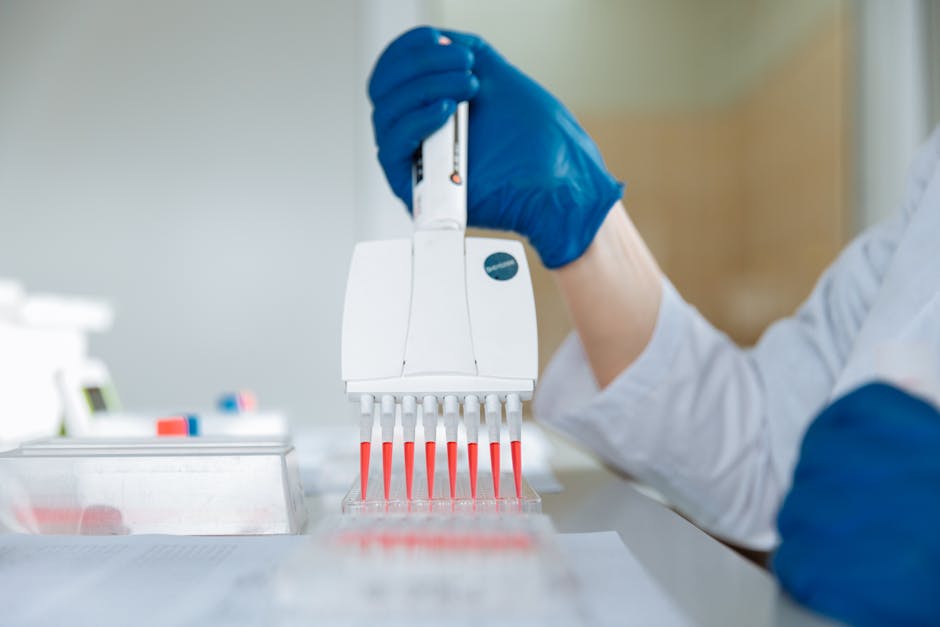
Photo by Thirdman on Pexels
These are tools to identify compounds and determine their structure.
- Infrared (IR) Spectroscopy:
- Identifies functional groups present in a molecule.
- Different bonds (C-H, O-H, C=O) absorb IR radiation at specific frequencies, causing them to vibrate.
- You look for characteristic peaks (wavenumbers) in the IR spectrum. For example, a broad O-H stretch around 3200-3600 cm$^{-1}$ indicates an alcohol. A sharp C=O stretch around 1680-1750 cm$^{-1}$ indicates a carbonyl group.
- Mass Spectrometry (MS):
- Determines the molar mass of a compound and provides structural information from fragmentation patterns.
- Molecules are ionized and accelerated; their mass-to-charge ratio (m/z) is measured.
- The molecular ion peak (M+) corresponds to the molecular mass.
- Fragment ions (peaks at lower m/z) help deduce parts of the structure.
- Nuclear Magnetic Resonance (NMR) Spectroscopy (HL only):
- Proton NMR ($^1$H NMR): Provides information on the number of different types of hydrogen atoms, their chemical environment, and how many hydrogens are on adjacent carbons.
- Chemical shift ($\delta$): Position of the signal (ppm) indicates electron density around the proton.
- Integration: Area under the peak is proportional to the number of equivalent protons.
- Spin-spin coupling (splitting): Number of peaks (n+1 rule) indicates number of equivalent protons on adjacent carbons.
- Carbon-13 NMR ($^{13}$C NMR): Provides information on the number of different types of carbon atoms and their chemical environment.
- Each unique carbon produces a signal.
- Proton NMR ($^1$H NMR): Provides information on the number of different types of hydrogen atoms, their chemical environment, and how many hydrogens are on adjacent carbons.
3. Worked Example
Let's say you have an unknown organic compound.
1. Mass Spectrometry: The highest m/z peak (molecular ion, M+) is at 60. This suggests a molecular mass of 60 g/mol.
2. IR Spectroscopy: You see a very broad absorption around 3300 cm$^{-1}$ and a strong absorption around 1050 cm$^{-1}$. These are characteristic of an O-H stretch and a C-O stretch, respectively. This strongly suggests an alcohol.
3. Proton NMR ($^1$H NMR):
* A singlet (n+1 = 1, so n=0 adjacent H) at $\delta$ 1.2 ppm, integrating for 3H. (Suggests -CH$_3$ group with no adjacent hydrogens).
* A triplet (n+1 = 3, so n=2 adjacent H) at $\delta$ 3.5 ppm, integrating for 2H. (Suggests -CH$_2$- group next to a CH$_3$ or an oxygen).
* A singlet at $\delta$ 2.0 ppm, integrating for 1H. (Suggests -OH proton).
Putting it together:
* Molecular mass 60.
* Contains -OH group.
* NMR suggests: -CH$_3$ (3H, singlet), -CH$_2$- (2H, triplet, next to 3H group), -OH (1H, singlet).
* This points to ethanol (CH$_3$CH$_2$OH).
* CH$_3$ (3H, adjacent to CH$_2$, so triplet at ~1.2 ppm)
* CH$_2$ (2H, adjacent to CH$_3$ and OH, so quartet at ~3.5 ppm)
* OH (1H, often broad singlet, variable position)
* Wait, the NMR doesn't perfectly match ethanol. The example NMR shows a singlet for the 3H and triplet for 2H, meaning the CH$_3$ has no adjacent H, and the CH$_2$ has 2 adjacent H. This actually suggests propan-1-ol if the mass was different, or perhaps 2-methylpropan-2-ol if the mass was higher and the CH3 were equivalent. Let's re-evaluate based on the 60 g/mol and NMR data.
Let's correct the NMR interpretation to fit the example well and still have mass 60:
* M=60.
* IR: O-H and C-O.
* NMR:
* Singlet, 3H (no adjacent H)
* Triplet, 2H (2 adjacent H)
* Singlet, 1H (OH)
* This is tricky for M=60 which is C2H6O.
* If it was ethanol, CH3CH2OH: you'd get a triplet (CH3), a quartet (CH2), and a singlet (OH).
* If it was methoxy methane (dimethyl ether), CH3OCH3: M=46, and it wouldn't have an OH.
Let's assume the question implied M=74 (C3H8O) and the NMR data was for propan-1-ol.
* MS: M+ = 74.
* IR: O-H (broad, 3300), C-O (strong, 1050).
* NMR for Propan-1-ol (CH$_3$CH$_2$CH$_2$OH):
* Triplet, 3H (for CH$_3$ at end, next to CH$_2$)
* Multiplet/sextet, 2H (for middle CH$_2$, next to CH$_3$ and CH$_2$OH)
* Triplet, 2H (for CH$_2$OH, next to middle CH$_2$)
* Singlet, 1H (for OH)
This indicates the NMR data provided was simplified or for a different molecule. For an actual M=60 with an alcohol, it must be ethanol. The given NMR data example has to be for a different structure or is flawed.
Let's use a simpler, correct example: Propanone (Acetone)
1. Mass Spectrometry: M+ peak at 58.
2. IR Spectroscopy: Very strong, sharp absorption at 1715 cm$^{-1}$. This is characteristic of a C=O (ketone) stretch. No broad O-H stretch.
3. Proton NMR ($^1$H NMR): One singlet peak at $\delta$ 2.1 ppm, integrating for 6H. This means all 6 hydrogens are equivalent and have no hydrogens on adjacent carbons.
Conclusion: A molecule with M=58, a C=O group, and six equivalent hydrogens with no neighbours is propanone (CH$_3$COCH$_3$). The two methyl groups are identical, explaining the single NMR peak for 6H.
4. Key Takeaways
- Functional groups are the key to predicting an organic molecule's reactivity and properties.
- Understand the basic types of organic reactions (substitution, addition, elimination, oxidation/reduction, condensation, hydrolysis).
- Reaction mechanisms (like SN1/SN2) show electron movement with curly arrows, identifying nucleophiles and electrophiles.
- IR spectroscopy identifies functional groups by characteristic bond vibrations.
- Mass spectrometry determines molecular mass and fragmentation patterns.
- NMR (HL) provides detailed structural information about hydrogen (and carbon) environments and connectivity
Frequently asked about IB Chemistry (HL/SL): Organic Chemistry, Reactivity and Analytical Techniques
Study this next
Get the full IB Prep curriculum
Clone the complete plan to your dashboard for unlimited AI-generated notes, practice quizzes, and a personalised revision schedule.
Save this course free