Chemical Calculations: Stoichiometry and Concentration
TL;DR
Stoichiometry is all about using balanced chemical equations to figure out the amounts of reactants and products involved in a reaction. Concentration tells you how much solute is dissolved in a given amount of solvent or solution. Mastering these helps you predict reaction outcomes and prepare solutions accurately.
1. The Mental Model
Imagine a recipe for baking. Stoichiometry is like knowing exactly how many eggs you need for a certain amount of flour, and how many cookies you'll get. Concentration is like knowing how much sugar is dissolved in your lemonade to get it just right.
2. The Core Material
Stoichiometry: Balancing the Chemical Books
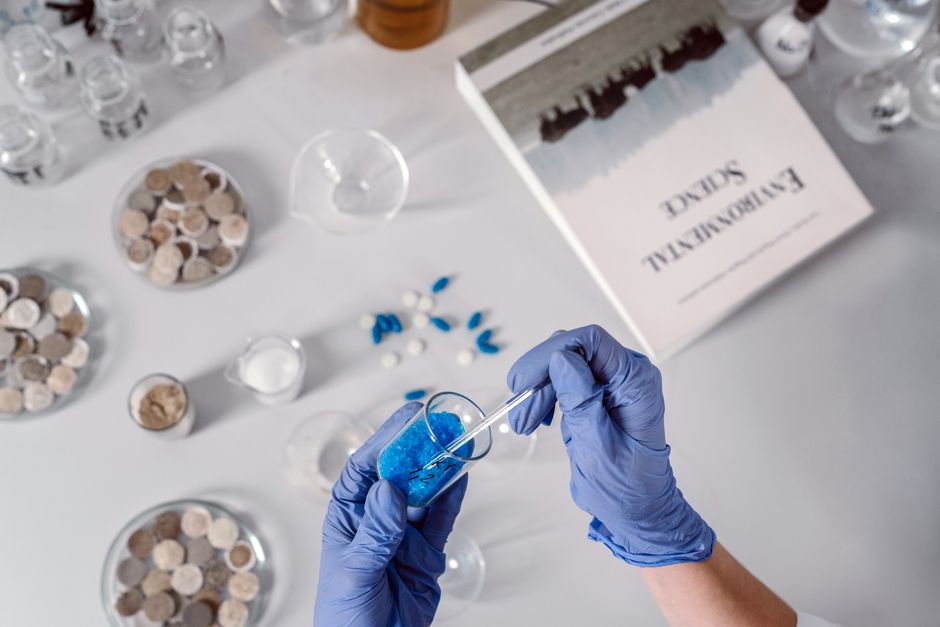
Photo by Mikhail Nilov on Pexels
Stoichiometry uses the mole concept and balanced chemical equations to relate quantities of substances. The coefficients in a balanced equation represent the mole ratio of reactants and products.
Here's the general process:
graph TD
    A["Balanced Chemical Equation"] --> B["Identify Known & Unknown Substances"];
    B --> C["Convert Known Mass/Volume to Moles"];
    C --> D["Use Mole Ratio from Equation"];
    D --> E["Calculate Moles of Unknown Substance"];
    E --> F["Convert Moles of Unknown to Desired Units (Mass/Volume/Concentration)"];
-
Mole Concept: A mole is a unit that represents 6.022 x 10^23 particles (atoms, molecules, ions). The molar mass (in g/mol) of a substance is numerically equal to its relative formula mass (Mr).
- Moles = Mass (g) / Molar Mass (g/mol)
- Moles = Volume (dm³) x Concentration (mol/dm³) (for solutions)
- Moles = Volume (dm³) / 24 dm³/mol (for gases at room temperature and pressure, RTP)
-
Mole Ratios: The big numbers (coefficients) in front of chemical formulas in a balanced equation tell you the ratio in which substances react and are formed. For example, in 2H₂ + O₂ → 2H₂O, 2 moles of H₂ react with 1 mole of O₂ to produce 2 moles of H₂O.
Concentration: How Much Stuff is There?

Photo by Ann H on Pexels
Concentration expresses the amount of solute in a given amount of solvent or solution. The most common unit is moles per cubic decimetre (mol/dm³), also known as molarity (M).
- Concentration (mol/dm³) = Moles of Solute (mol) / Volume of Solution (dm³)
Remember:
* 1 dm³ = 1000 cm³
* To convert cm³ to dm³, divide by 1000.
You can also have concentration in g/dm³:
* Concentration (g/dm³) = Mass of Solute (g) / Volume of Solution (dm³)
And you can convert between mol/dm³ and g/dm³ using molar mass:
* Concentration (g/dm³) = Concentration (mol/dm³) x Molar Mass (g/mol)
3. Worked Example
Let's say you react 10.0 g of calcium carbonate (CaCO₃) with hydrochloric acid (HCl) according to the equation:
CaCO₃(s) + 2HCl(aq) → CaCl₂(aq) + H₂O(l) + CO₂(g)
What volume of carbon dioxide gas (CO₂) is produced at RTP (room temperature and pressure)?
(Molar mass of CaCO₃ = 100.1 g/mol; Molar volume of gas at RTP = 24 dm³/mol)
- Identify Known & Unknown:
- Known: Mass of CaCO₃ = 10.0 g
- Unknown: Volume of CO₂ gas
- Convert Known Mass to Moles:
- Moles of CaCO₃ = Mass / Molar Mass = 10.0 g / 100.1 g/mol = 0.0999 mol
- Use Mole Ratio:
- From the balanced equation, 1 mole of CaCO₃ produces 1 mole of CO₂.
- So, Moles of CO₂ = Moles of CaCO₃ = 0.0999 mol
- Convert Moles of Unknown to Desired Units:
- Volume of CO₂ = Moles x Molar Volume (at RTP)
- Volume of CO₂ = 0.0999 mol x 24 dm³/mol = 2.40 dm³ (to 3 sig figs)
Therefore, 2.40 dm³ of carbon dioxide gas is produced.
4. Key Takeaways
- Stoichiometry uses balanced equations to calculate amounts of substances in reactions.
- The mole is the central unit connecting mass, volume, and number of particles.
- Molar mass is crucial for converting between mass and moles.
- Mole ratios from balanced equations are essential for relating different substances.
- Concentration quantifies the amount of solute in a solution, usually in mol/dm³.
- Always check your units (g, mol, dm³, cm³) and convert them correctly.
Common Mistakes to Avoid:
- Not balancing the chemical equation before doing any calculations.
- Incorrectly calculating molar masses.
- Mixing up mole ratios or using them in the wrong direction.
- Forgetting to convert volumes to dm³ when calculating concentration or using molar volume.
5. Now Try It
You have a 0.50 mol/dm³ solution of sodium hydroxide (NaOH). What mass of NaOH was dissolved to make 250 cm³ of this solution?
(Molar mass of NaOH = 40.0 g/mol)
Success looks like: Finding the correct mass in grams, showing your steps clearly for converting volume, calculating moles, and then mass.
Frequently asked about Chemical Calculations: Stoichiometry and Concentration
Study this next
Get the full 1. Particle theory/atoms/mixtures 2. Periodic table: group properties and trends 3. Rates of reactions 4. Chemical energetics 5. Calculations 6. Electrolysis: molten compounds, aqueous solutions and applications curriculum
Clone the complete plan to your dashboard for unlimited AI-generated notes, practice quizzes, and a personalised revision schedule.
Save this course free