Foundations of Matter: Particle Theory, Atoms, and Mixtures
TL;DR
Everything is made of tiny particles, and how they behave explains different states of matter. Atoms are the basic building blocks, and how they combine or mix creates various substances. Understanding these basics is crucial for all chemistry topics.
1. The Mental Model
Imagine everything around you, from the air you breathe to the desk you're sitting at, is made of invisible, constantly moving LEGO bricks. The way these bricks are packed and their energy determines if something is solid, liquid, or gas.
2. The Core Material
Particle Theory
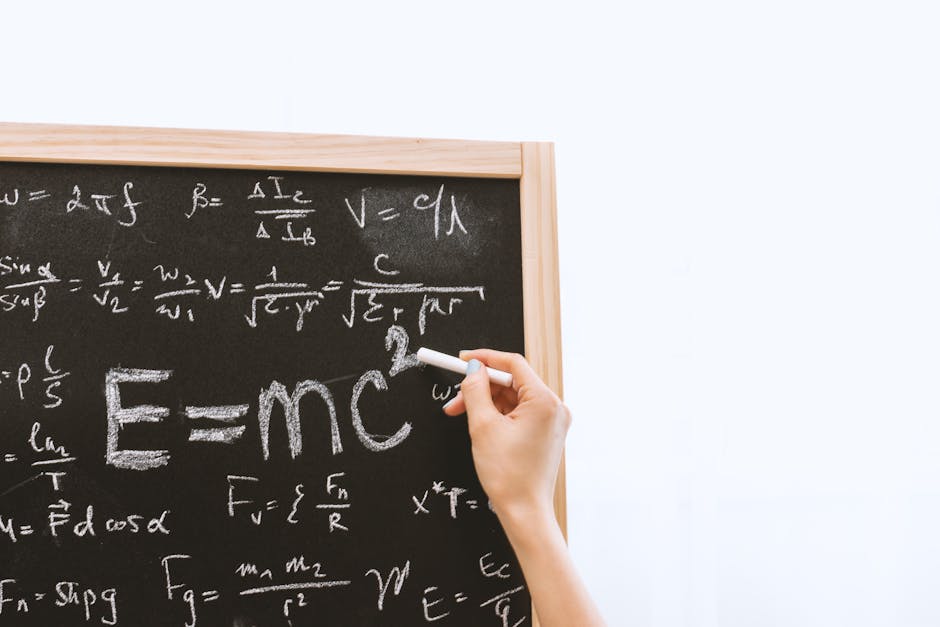
Photo by JESHOOTS.com on Pexels
Particle theory says that all matter is made up of tiny, discrete particles (atoms, ions, or molecules) that are constantly moving. The energy of these particles and how close they are together determines the state of matter:
- Solids: Particles are packed tightly in a fixed arrangement, vibrating in place. They have strong forces between them.
- Liquids: Particles are close together but can move past each other, like marbles in a bag. Forces are weaker than in solids.
- Gases: Particles are far apart and move randomly and rapidly. Forces between them are very weak or negligible.
Changing states involves adding or removing energy, which affects particle movement and arrangement.
graph TD
    A["Solid (fixed positions, vibrate)"] --> B["Liquid (close, slide past)"]
    B --> C["Gas (far apart, random motion)"]
    C --> B
    B --> A
    A --"Melting/Fusion (energy added)"--> B
    B --"Boiling/Evaporation (energy added)"--> C
    C --"Condensation (energy removed)"--> B
    B --"Freezing/Solidification (energy removed)"--> A
    A --"Sublimation (energy added)"--> C
    C --"Deposition (energy removed)"--> A
Atoms: The Building Blocks
Photo by Markus Winkler on Pexels
An atom is the smallest unit of an element that retains the chemical identity of that element. It's made of a central nucleus (containing positively charged protons and neutral neutrons) surrounded by negatively charged electrons orbiting in shells.
- Protons: Positive charge (+1), mass of 1 atomic mass unit (amu). Define the element (atomic number).
- Neutrons: No charge (0), mass of 1 amu. Contribute to mass, isotopes vary in neutron number.
- Electrons: Negative charge (-1), negligible mass (about 1/1836 amu). Determine chemical reactivity and bonding.
In a neutral atom, the number of protons equals the number of electrons.
Mixtures
A mixture contains two or more substances that are not chemically bonded together. Each substance retains its individual properties.
- Homogeneous mixtures: Have a uniform composition throughout. You can't easily see the different parts. Examples: saltwater, air.
- Heterogeneous mixtures: Have a non-uniform composition. You can see the different parts. Examples: sand and water, salad.
Mixtures can be separated by physical means (like filtration, distillation, magnetism), unlike compounds which require chemical reactions.
3. Worked Example
Let's say you have a glass of sugar dissolved in water.
- Particle Theory: In the liquid state, the water particles are close but can move around. The sugar particles (molecules) are also present, moving freely among the water particles.
- Atoms: Both sugar (C, H, O atoms) and water (H, O atoms) are made of different types of atoms chemically bonded together to form molecules.
- Mixture: Since the sugar and water are not chemically bonded to each other and you can't see separate sugar crystals, this is a homogeneous mixture (specifically, a solution). You could separate the sugar from the water by evaporation (a physical method).
4. Key Takeaways
- All matter is made of tiny, constantly moving particles.
- The arrangement and energy of particles determine if a substance is a solid, liquid, or gas.
- Atoms are the fundamental units of elements, composed of protons, neutrons, and electrons.
- Protons define the element; electrons determine chemical behavior.
- Mixtures are combinations of substances that aren't chemically bonded and can be physically separated.
- Homogeneous mixtures are uniform, while heterogeneous mixtures are not.
Common Mistakes to Avoid:
- Confusing atoms with molecules (molecules are groups of atoms).
- Thinking particles stop moving in a solid (they still vibrate).
- Believing mixtures are formed by chemical reactions (they are physical combinations).
- Mixing up the charges/masses of subatomic particles.
5. Now Try It
Imagine you have a container of iron filings mixed with sulfur powder. Describe this mixture in terms of particle theory and atoms, classify it, and suggest a simple physical method to separate the two components. What would happen if you heated the mixture strongly? (Hint: think about what would form if atoms bonded chemically).
Frequently asked about Foundations of Matter: Particle Theory, Atoms, and Mixtures
Study this next
Get the full 1. Particle theory/atoms/mixtures 2. Periodic table: group properties and trends 3. Rates of reactions 4. Chemical energetics 5. Calculations 6. Electrolysis: molten compounds, aqueous solutions and applications curriculum
Clone the complete plan to your dashboard for unlimited AI-generated notes, practice quizzes, and a personalised revision schedule.
Save this course free