Rates of Reactions and Equilibrium
TL;DR
Reaction rates tell us how fast reactants turn into products. Chemical equilibrium is reached when the forward and reverse reaction rates are equal, meaning concentrations stay constant. Factors like concentration, temperature, pressure, surface area, and catalysts affect reaction rates and equilibrium position.
1. The Mental Model
Imagine a busy road. The "rate" is how many cars pass a point per minute. "Equilibrium" is like a steady flow of cars into and out of a busy junction, where the number of cars entering equals the number leaving, so the total number of cars at the junction stays constant.
2. The Core Material
Understanding Reaction Rates
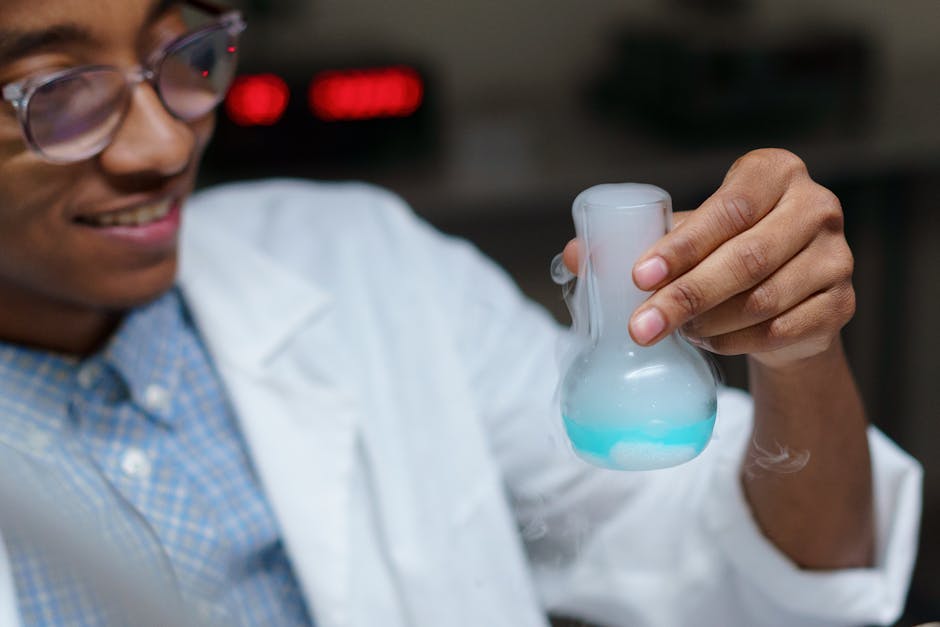
Photo by cottonbro studio on Pexels
The rate of reaction is a measure of how quickly reactants are used up or products are formed. It's often expressed as change in concentration over time (e.g., mol/dm³s). For a reaction to occur, reactant particles must collide with sufficient energy (activation energy) and in the correct orientation. This is called collision theory.
Factors affecting reaction rate:
- Concentration: Increasing reactant concentration means more particles per unit volume, leading to more frequent successful collisions.
- Temperature: Higher temperature gives particles more kinetic energy, increasing both the frequency and energy of collisions, thus more successful collisions.
- Pressure (for gases): Increasing pressure means gas particles are closer together, leading to more frequent collisions.
- Surface Area (for solids): Breaking a solid into smaller pieces increases its surface area, exposing more particles to react and increasing collision frequency.
- Catalysts: A catalyst speeds up a reaction by providing an alternative reaction pathway with a lower activation energy, without being used up itself.
Chemical Equilibrium

Photo by Jonathan Borba on Pexels
Many reactions are reversible, meaning products can react to reform reactants. When a reversible reaction occurs in a closed system, it eventually reaches equilibrium. At equilibrium:
- The rate of the forward reaction equals the rate of the reverse reaction.
- The concentrations of reactants and products remain constant (they don't have to be equal).
- The reaction is still ongoing, it's a dynamic equilibrium.
Le Chatelier's Principle

Photo by AMOL NAKVE on Pexels
This principle helps predict how a system at equilibrium will respond to changes. It states: If a change of condition is applied to a system in equilibrium, the system will shift in a direction that relieves the stress.
Here's how different changes affect equilibrium:
graph TD
    A["Change Applied to Equilibrium"] --> B{System Response};

    B --> C{"Increase Reactant Conc."};
    C --> C1["Shift right (to products)"]

    B --> D{"Increase Product Conc."};
    D --> D1["Shift left (to reactants)"]

    B --> E{"Increase Temperature"};
    E --> E1["Shift in endothermic direction"]

    B --> F{"Decrease Temperature"};
    F --> F1["Shift in exothermic direction"]

    B --> G{"Increase Pressure (gases)"};
    G --> G1["Shift to side with fewer moles of gas"]

    B --> H{"Decrease Pressure (gases)"};
    H --> H1["Shift to side with more moles of gas"]

    B --> I{"Add Catalyst"};
    I --> I1["No change to equilibrium position, only speeds up reaching it"]
Understanding the shifts:
- Concentration: Adding reactants pushes the reaction forward to use them up. Removing products pulls the reaction forward to replace them.
- Temperature: If you add heat (increase temperature), the system shifts to absorb that heat (endothermic direction). If you remove heat (decrease temperature), it shifts to release heat (exothermic direction). You need to know if the forward reaction is endo- or exothermic.
- Pressure: This only affects reactions involving gases. The system shifts to reduce the stress of increased pressure by favoring the side with fewer gas molecules. Decreased pressure favors the side with more gas molecules.
- Catalyst: A catalyst speeds up both the forward and reverse reactions equally. It helps the system reach equilibrium faster but doesn't change the final equilibrium concentrations.
3. Worked Example
Consider the Haber process for ammonia synthesis:
N₂(g) + 3H₂(g) ⇌ 2NH₃(g) ΔH = -92 kJ/mol (exothermic in forward direction)
Let's apply Le Chatelier's Principle:
- Increase in N₂ concentration: The system will shift right (towards products) to consume the added N₂, increasing NH₃ yield.
- Decrease in temperature: Since the forward reaction is exothermic (releases heat), decreasing temperature will make the system shift right to produce more heat, increasing NH₃ yield.
- Increase in pressure: There are 4 moles of gas on the reactant side (1 N₂ + 3 H₂) and 2 moles of gas on the product side (2 NH₃). Increasing pressure will shift the equilibrium right to the side with fewer moles of gas, increasing NH₃ yield.
4. Key Takeaways
- Reaction rates are influenced by how often and effectively particles collide.
- Increase temperature, concentration, surface area, or use a catalyst to speed up reactions.
- Equilibrium is a dynamic state where forward and reverse reaction rates are equal, and concentrations remain constant.
- Le Chatelier's Principle predicts how equilibrium shifts in response to changes in conditions.
- Increasing reactant concentration or removing products shifts equilibrium towards products.
- For exothermic reactions, lowering temperature shifts equilibrium to products; for endothermic, increasing temperature shifts to products.
- For gases, increasing pressure shifts equilibrium to the side with fewer moles of gas.
- Catalysts speed up the rate at which equilibrium is reached but don't change its position.
Common Mistakes to Avoid

Photo by KATRIN BOLOVTSOVA on Pexels
- Don't confuse "equilibrium" with "equal concentrations" – they're not the same.
- Remember pressure only affects reactions involving gases.
- Don't assume a catalyst changes the equilibrium position; it only changes the rate to equilibrium.
- Incorrectly applying exothermic/endothermic principles for temperature changes – always check the ΔH sign.
5. Now Try It
Consider the reaction: 2SO₂(g) + O₂(g) ⇌ 2SO₃(g) ΔH = -197 kJ/mol. What happens to the equilibrium concentration of SO₃ if you:
a) Increase the temperature?
b) Increase the pressure?
c) Remove some O₂?
d) Add a catalyst?
Success looks like correctly stating the shift direction (left/right) for each change and explaining why based on Le Chatelier's Principle and the given reaction details.
Frequently asked about Rates of Reactions and Equilibrium
Study this next
Get the full 1. Particle theory/atoms/mixtures 2. Periodic table: group properties and trends 3. Rates of reactions 4. Chemical energetics 5. Calculations 6. Electrolysis: molten compounds, aqueous solutions and applications curriculum
Clone the complete plan to your dashboard for unlimited AI-generated notes, practice quizzes, and a personalised revision schedule.
Save this course free