Derivation and Components of Terzaghi's Bearing Capacity Equation
From the Terzaghi's equation - foundation engineering curriculum
TL;DR
Terzaghi's bearing capacity equation estimates the ultimate load a shallow foundation can support before shear failure. It considers three main failure zones beneath the foundation: a triangular wedge, radial shear zones, and passive Rankine zones. The equation combines terms for cohesion, surcharge, and the unit weight of the soil, each with a corresponding bearing capacity factor.
1. The Mental Model
Imagine pushing a block into sand. The sand directly under the block is compressed, pushing soil outwards and upwards in a specific pattern. Terzaghi simplified this complex soil behavior into distinct zones, allowing us to calculate how much force the block can withstand before the sand fails.
2. The Core Material
Terzaghi's bearing capacity equation is a fundamental tool for shallow foundation design. It predicts the ultimate bearing capacity ($q_u$), which is the maximum pressure a foundation can exert on the soil without causing shear failure. This equation is based on a simplified model of soil failure, assuming a general shear failure mechanism.
The equation is given by:
$q_u = c N_c + q N_q + 0.5 \gamma B N_\gamma$
Let's break down each component:
a. Failure Zones
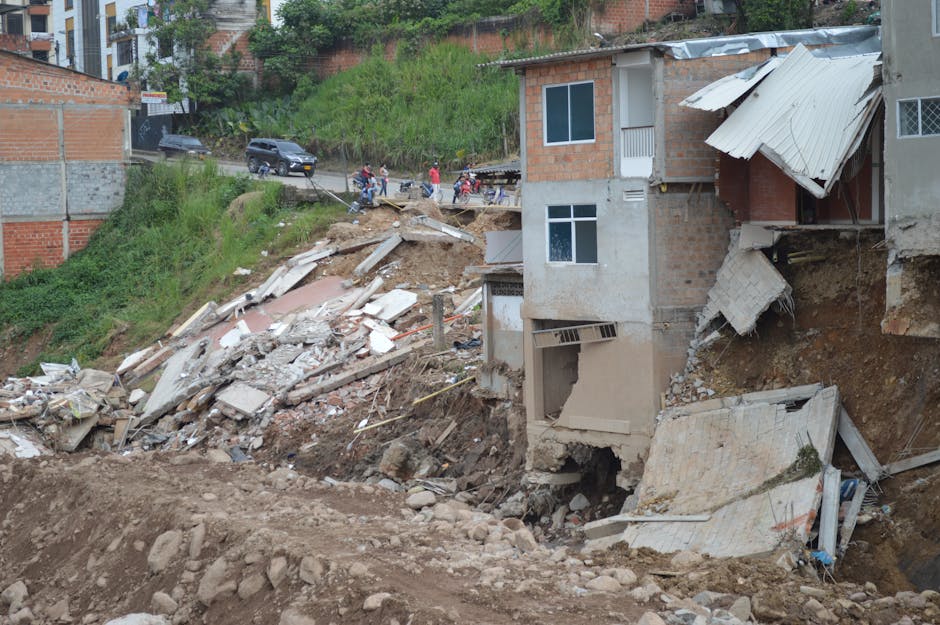
Photo by Franklin Peña Gutierrez on Pexels
Terzaghi visualized the soil failure beneath a strip footing (a long, narrow foundation) as a composite of three zones:
1. Zone I: Elastic Wedge (Active Rankine Zone): This is a triangular wedge of soil directly beneath the foundation, which moves down with the foundation as a rigid mass. The angle of this wedge with the horizontal is approximately $\phi$ (the angle of internal friction of the soil).
2. Zone II: Radial Shear Zones: These zones extend outwards from the elastic wedge. The soil in these zones undergoes significant shear deformation along curved slip surfaces, resembling logarithmic spirals.
3. Zone III: Passive Rankine Zones: These zones are at the outer edges of the radial shear zones. The soil here is pushed upwards and outwards, reaching a state of plastic equilibrium, similar to a passive earth pressure condition.
graph TD
    A["Foundation Pressure (q_u)"] --> B["Elastic Wedge (Zone I)"]
    B --> C1["Radial Shear Zone (Zone II - Left)"]
    B --> C2["Radial Shear Zone (Zone II - Right)"]
    C1 --> D1["Passive Rankine Zone (Zone III - Left)"]
    C2 --> D2["Passive Rankine Zone (Zone III - Right)"]
    D1 & D2 --> E["Soil Heave/Failure"]
b. Equation Components

Photo by Vitaly Gariev on Pexels
Each term in the equation accounts for a different contribution to the soil's resistance to failure:
-
$c N_c$ (Cohesion Term):
- $c$: This is the cohesion of the soil. Cohesion is the internal bonding strength of the soil particles, especially significant in cohesive soils like clay. It represents the soil's inherent ability to resist shear.
- $N_c$: This is the bearing capacity factor for cohesion. It's dimensionless and depends only on the angle of internal friction ($\phi$) of the soil. As $\phi$ increases, $N_c$ generally increases, meaning cohesive soils with higher friction angles can support more load from their cohesive strength.
-
$q N_q$ (Surcharge Term):
- $q$: This represents the effective overburden pressure (surcharge) at the foundation level. It's the pressure exerted by the soil above the foundation base. It essentially provides confining pressure, which increases the soil's shear strength.
- $N_q$: This is the bearing capacity factor for surcharge. Like $N_c$, it's dimensionless and depends only on $\phi$. A higher $\phi$ leads to a higher $N_q$, indicating that greater confining pressure contributes more significantly to bearing capacity in soils with higher friction.
-
$0.5 \gamma B N_\gamma$ (Unit Weight/Weight of Shear Zone Term):
- $\gamma$: This is the effective unit weight of the soil below the foundation level. It accounts for the weight of the soil within the failure zones themselves.
- $B$: This is the width of the foundation. For a strip footing, it's the width; for other shapes, modified effective widths are used.
- $N_\gamma$: This is the bearing capacity factor for unit weight. It's also dimensionless and depends solely on $\phi$. This term captures the contribution of the soil's own weight within the failure zone to resisting the applied load.
c. Shape Factors
Photo by Steve A Johnson on Pexels
Terzaghi's original equation was derived for a continuous (strip) footing. For other foundation shapes (square, circular, rectangular), shape factors are applied to the $N_c$, $N_q$, and $N_\gamma$ terms to adjust the equation:
- For square foundations: $q_u = 1.3 c N_c + q N_q + 0.4 \gamma B N_\gamma$
- For circular foundations: $q_u = 1.3 c N_c + q N_q + 0.3 \gamma B N_\gamma$
These factors reflect how the different geometries influence the soil's ability to resist failure, primarily by altering the effective volume of the shear zones.
3. Worked Example
Let's calculate the ultimate bearing capacity for a square foundation on a cohesive granular soil.
Given:
* Foundation width, $B = 2$ m
* Depth of foundation, $D_f = 1$ m
* Soil cohesion, $c = 20 \text{ kPa}$
* Soil angle of internal friction, $\phi = 25^\circ$
* Unit weight of soil, $\gamma = 18 \text{ kN/m}^3$
Step 1: Determine bearing capacity factors for $\phi = 25^\circ$.
(You'd typically use a table or chart for these values, based on Terzaghi's factors).
For $\phi = 25^\circ$:
* $N_c \approx 25.1$
* $N_q \approx 12.7$
* $N_\gamma \approx 9.7$
Step 2: Calculate the surcharge, $q$.
$q = \gamma \times D_f = 18 \text{ kN/m}^3 \times 1 \text{ m} = 18 \text{ kPa}$
Step 3: Apply the Terzaghi's equation for a square foundation.
$q_u = 1.3 c N_c + q N_q + 0.4 \gamma B N_\gamma$
$q_u = (1.3 \times 20 \text{ kPa} \times 25.1) + (18 \text{ kPa} \times 12.7) + (0.4 \times 18 \text{ kN/m}^3 \times 2 \text{ m} \times 9.7)$
$q_u = (652.6) + (228.6) + (139.68)$
$q_u = 1020.88 \text{ kPa}$
So, the ultimate bearing capacity for this square foundation is approximately 1021 kPa.
4. Key Takeaways
- Terzaghi's equation calculates the ultimate load a shallow foundation can withstand before shear failure.
- The equation consists of three terms: cohesion, surcharge (overburden), and the unit weight of the soil below the foundation.
- Each term is multiplied by a specific bearing capacity factor ($N_c, N_q, N_\gamma$) which depends solely on the soil's angle of internal friction ($\phi$).
- The soil failure mechanism is simplified into an elastic wedge, radial shear zones, and passive Rankine zones.
- Shape factors are applied to the original strip footing equation to account for different foundation geometries (square, circular, rectangular).
- The "surcharge" term represents the confining pressure provided by the soil above the foundation base.
- Terzaghi's equation provides a conservative estimate, making it suitable for initial design.
Common Mistakes to Avoid:
- Using the wrong bearing capacity factors for the given $\phi$ or using factors from a different theory (e.g., Meyerhof, Vesic).
- Forgetting to apply shape factors when the foundation isn't a strip footing.
- Incorrectly calculating the surcharge ($q$) or the effective unit weight ($\gamma$), especially with groundwater present.
- Not understanding that $q_u$ is the ultimate bearing capacity; actual design uses a safe bearing capacity with a factor of safety.
5. Now Try It
You're designing a continuous strip footing that is 1.5 m wide and founded at 1.0 m depth in a soil with $\phi = 30^\circ$, $c = 15 \text{ kPa}$, and $\gamma = 19 \text{ kN/m}^3$. Using Terzaghi's bearing capacity factors for $\phi = 30^\circ$: $N_c = 37.2$, $N_q = 22.5$, $N_\gamma = 19.7$. Calculate the ultimate bearing capacity ($q_u$).
Success looks like: Arriving at a $q_u$ value in kPa, clearly showing your steps for calculating $q$, and each of the three terms in the equation.
Frequently asked about Derivation and Components of Terzaghi's Bearing Capacity Equation
Study this next
Get the full Terzaghi's equation - foundation engineering curriculum
Clone the complete plan to your dashboard for unlimited AI-generated notes, practice quizzes, and a personalised revision schedule.
Save this course free