Fundamentals of Soil Mechanics and Bearing Capacity
From the Terzaghi's equation - foundation engineering curriculum
TL;DR
Soil mechanics is about understanding how soil behaves under stress, which is crucial for designing stable foundations. Bearing capacity refers to the maximum load a soil can support before it fails, and Terzaghi's equation is a key tool for calculating this for shallow foundations. We'll break down the factors influencing bearing capacity and how to apply them.
1. The Mental Model
Think of soil as a collection of tiny particles that can resist compression and shear. When you place a foundation on top, it pushes down, and the soil pushes back. Bearing capacity is simply how much "pushing back" the soil can do before it gives way.
2. The Core Material
When designing foundations, one of your primary goals is to ensure the soil beneath can safely support the building's weight without excessive settlement or outright failure. This is where bearing capacity comes in. It's the maximum average contact pressure between the foundation and the soil that doesn't produce shear failure in the soil.
2.1 Soil Properties
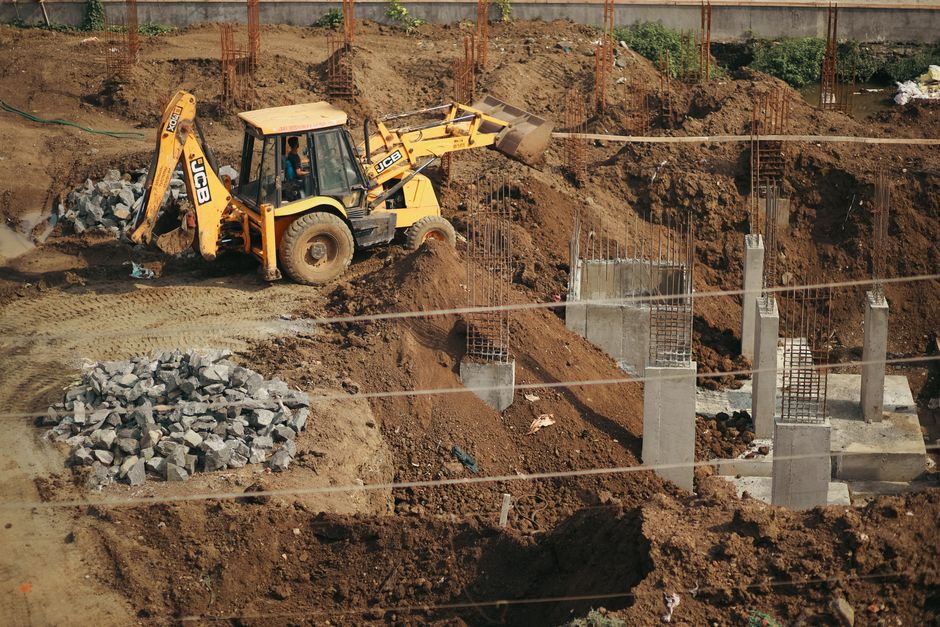
Photo by Ag photography on Pexels
Understanding the basic properties of soil is fundamental:
- Cohesion (c): This is the "stickiness" of the soil, its ability to resist being pulled apart. Think of clay; it has high cohesion.
- Angle of Internal Friction ($\phi$): This represents the friction between soil particles. Sandy soils have a high angle of internal friction because their particles rub against each other.
- Unit Weight ($\gamma$): This is the weight of a unit volume of soil. It's important for calculating the overburden pressure.
2.2 Types of Failure

Photo by Markus Winkler on Pexels
When soil fails under a foundation, it typically does so in one of three ways:
- General Shear Failure: This is the most common and occurs in dense or stiff soils. A well-defined failure surface extends to the ground surface.
- Local Shear Failure: Happens in medium-dense soils. The failure surface isn't fully developed and doesn't reach the ground surface.
- Punching Shear Failure: Occurs in loose or soft soils. The foundation simply "punches" into the soil without a clear failure surface.
2.3 Terzaghi's Bearing Capacity Equation
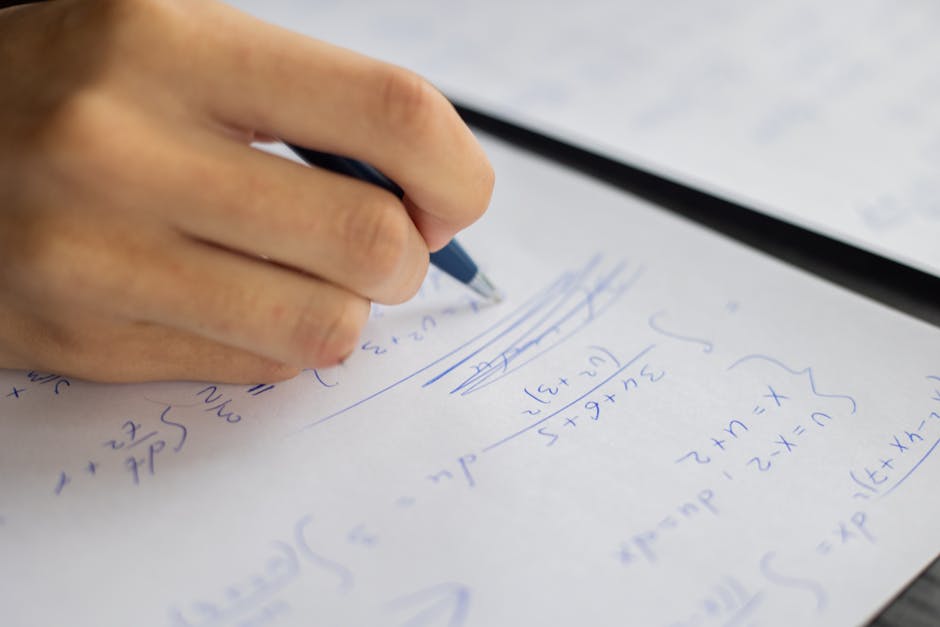
Photo by Monstera Production on Pexels
Terzaghi's equation is a classic formula for estimating the ultimate bearing capacity ($q_u$) of shallow foundations. It considers the soil properties, foundation geometry, and depth.
For a strip footing (infinitely long, narrow foundation), the equation is:
$q_u = c N_c + q N_q + 0.5 \gamma B N_\gamma$
Where:
* $q_u$: Ultimate bearing capacity (pressure)
* $c$: Cohesion of the soil
* $q$: Overburden pressure at the foundation level ($\gamma D_f$, where $D_f$ is the depth of the foundation)
* $\gamma$: Unit weight of the soil
* $B$: Width of the footing
* $N_c, N_q, N_\gamma$: Terzaghi's bearing capacity factors, which depend on the angle of internal friction ($\phi$) of the soil. These factors are typically found in tables or charts.
For square and circular footings, there are shape factors applied to this equation. For example, for a square footing:
$q_u = 1.3 c N_c + q N_q + 0.4 \gamma B N_\gamma$
The net ultimate bearing capacity ($q_{nu}$) is $q_u - q$. This is the additional pressure the soil can carry above the existing overburden pressure.
Finally, the allowable bearing capacity ($q_{all}$) is found by dividing the net ultimate bearing capacity by a factor of safety (FS), typically between 2.5 and 3.0:
$q_{all} = q_{nu} / FS$
This $q_{all}$ is the maximum pressure you can safely apply to the soil.
graph TD
    A["Foundation Design Input"] --> B{Soil Investigation};
    B --> C["Determine Soil Properties (c, φ, γ)"];
    C --> D{Choose Foundation Type};
    D --> E["Calculate Overburden Pressure (q = γ * Df)"];
    E --> F{"Select Bearing Capacity Factors (Nc, Nq, Nγ) based on φ"};
    F --> G["Calculate Ultimate Bearing Capacity (qu)"];
    G --> H["Calculate Net Ultimate Bearing Capacity (qnu = qu - q)"];
    H --> I["Apply Factor of Safety (FS)"];
    I --> J["Calculate Allowable Bearing Capacity (qall = qnu / FS)"];
    J --> K["Compare qall with Actual Foundation Pressure"];
    K --> L{Is qall >= Actual Pressure?};
    L -- Yes --> M["Foundation Design is Safe"];
    L -- No --> N["Revise Foundation Design or Improve Soil"];
3. Worked Example
Let's calculate the allowable bearing capacity for a square footing.
Given:
* Footing width ($B$) = 2 m
* Depth of foundation ($D_f$) = 1.5 m
* Soil cohesion ($c$) = 10 kPa
* Angle of internal friction ($\phi$) = 25 degrees
* Unit weight of soil ($\gamma$) = 18 kN/m³
* Factor of Safety (FS) = 3.0
Steps:
-
Find bearing capacity factors ($N_c, N_q, N_\gamma$) for $\phi = 25^\circ$ (from tables):
- $N_c \approx 20.72$
- $N_q \approx 10.66$
- $N_\gamma \approx 10.88$
-
Calculate overburden pressure ($q$):
- $q = \gamma \times D_f = 18 \text{ kN/m}^3 \times 1.5 \text{ m} = 27 \text{ kPa}$
-
Calculate ultimate bearing capacity ($q_u$) for a square footing:
- $q_u = 1.3 c N_c + q N_q + 0.4 \gamma B N_\gamma$
- $q_u = (1.3 \times 10 \times 20.72) + (27 \times 10.66) + (0.4 \times 18 \times 2 \times 10.88)$
- $q_u = 269.36 + 287.82 + 156.67$
- $q_u = 713.85 \text{ kPa}$
-
Calculate net ultimate bearing capacity ($q_{nu}$):
- $q_{nu} = q_u - q = 713.85 - 27 = 686.85 \text{ kPa}$
-
Calculate allowable bearing capacity ($q_{all}$):
- $q_{all} = q_{nu} / FS = 686.85 / 3.0 = 228.95 \text{ kPa}$
So, this soil can safely support a maximum pressure of approximately 229 kPa from the square footing.
4. Key Takeaways
- Soil mechanics studies how soil behaves under load, which is critical for foundation design.
- Bearing capacity is the maximum load soil can support without failing.
- Terzaghi's equation uses soil properties (cohesion, friction angle, unit weight) and foundation dimensions to calculate ultimate bearing capacity.
- Bearing capacity factors ($N_c, N_q, N_\gamma$) are crucial and depend on the soil's angle of internal friction.
- The factor of safety ensures that the applied load is significantly less than the soil's failure capacity.
- Shallow foundations primarily fail in general, local, or punching shear, depending on soil density.
Common Mistakes to Avoid:
* Forgetting the overburden pressure ($q$): This term is often overlooked but significantly impacts the calculation.
* Using the wrong shape factors: Make sure you use the correct multipliers (e.g., 1.3 for $c N_c$ for square footings) for your foundation shape.
* Incorrectly reading bearing capacity factors: Always double-check the tables or charts for $N_c, N_q, N_\gamma$ based on the correct $\phi$.
* Not applying a factor of safety: Design must always incorporate a safety margin.
5. Now Try It
Calculate the allowable bearing capacity for a strip footing with the following parameters:
* Footing width ($B$) = 1.8 m
* Depth of foundation ($D_f$) = 1.2 m
* Soil cohesion ($c$) = 5 kPa
* Angle of internal friction ($\phi$) = 30 degrees
* Unit weight of soil ($\gamma$) = 19 kN/m³
* Factor of Safety (FS) = 2.5
(You'll need to find $N_c, N_q, N_\gamma$ for $\phi = 30^\circ$ from a bearing capacity factor table.)
What success looks like: You should arrive at an allowable bearing capacity ($q_{all}$) value in kPa that is reasonable for typical soil conditions.
Frequently asked about Fundamentals of Soil Mechanics and Bearing Capacity
Study this next
Get the full Terzaghi's equation - foundation engineering curriculum
Clone the complete plan to your dashboard for unlimited AI-generated notes, practice quizzes, and a personalised revision schedule.
Save this course free