Length and Distance Measurements
From the English measurements curriculum
TL;DR
English measurements for length and distance use units like inches, feet, yards, and miles. You'll often need to convert between these units using specific conversion factors. Understanding these basic relationships is key to accurately measuring and calculating distances in the English system.
1. The Mental Model
Think of measuring length like stacking building blocks of different sizes. You have tiny blocks (inches), medium blocks (feet), bigger blocks (yards), and huge blocks (miles). To measure something, you pick the most appropriate block size or combine them.
2. The Core Material
The English system, also known as the Imperial system, uses several common units for measuring length and distance. It's important to memorize the conversion factors between these units.
Here are the primary units you'll encounter and their relationships:
- Inch (in): This is the smallest common unit, often used for smaller objects like paper or a book.
- Foot (ft): A foot is made up of 12 inches. This is a very common unit for everyday measurements like height or room dimensions.
- Yard (yd): A yard is equal to 3 feet. It's often used for fabric, sports fields, or shorter outdoor distances.
- Mile (mi): A mile is the largest common unit, used for long distances like travel between cities. A mile is significantly larger than a yard.
Here's how these units relate to each other:
- 1 foot = 12 inches
- 1 yard = 3 feet
- 1 mile = 1,760 yards (or 5,280 feet)
When you need to convert between units, you'll either multiply or divide by these conversion factors.
- To convert a larger unit to a smaller unit (e.g., feet to inches), you multiply.
- To convert a smaller unit to a larger unit (e.g., inches to feet), you divide.
Let's visualize the hierarchy of these units and how to move between them:
graph TD
    A["Inches"] -->|Divide by 12| B["Feet"]
    B -->|Divide by 3| C["Yards"]
    C -->|Divide by 1760| D["Miles"]
    D -->|Multiply by 1760| C
    C -->|Multiply by 3| B
    B -->|Multiply by 12| A
Understanding this flow helps you remember whether to multiply or divide. If you're going "down" the chart (miles to inches), you multiply. If you're going "up" (inches to miles), you divide.
Common Abbreviations
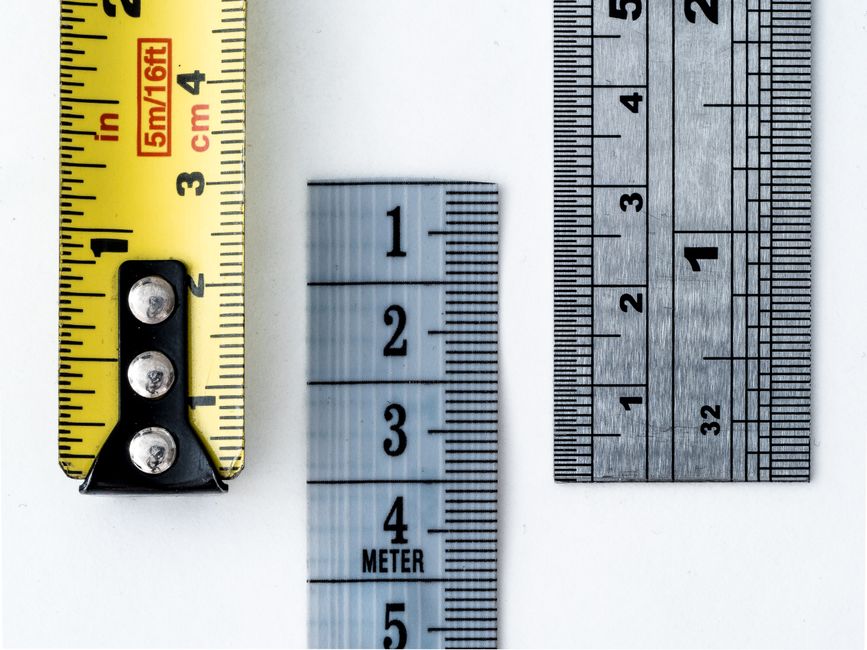
Photo by William Warby on Pexels
You'll often see these units abbreviated:
* Inch: in. or " (e.g., 6")
* Foot: ft. or ' (e.g., 5')
* Yard: yd.
* Mile: mi.
3. Worked Example
Let's say you need to find out how many inches are in 2.5 yards.
- Identify your starting unit and target unit: You're starting with yards and want to end up with inches.
- Break it down: You know 1 yard = 3 feet, and 1 foot = 12 inches.
- Convert yards to feet first:
2.5 yards * 3 feet/yard = 7.5 feet - Then convert feet to inches:
7.5 feet * 12 inches/foot = 90 inches
So, 2.5 yards is equal to 90 inches.
4. Key Takeaways
- The fundamental units for length in the English system are inches, feet, yards, and miles.
- Memorize the core conversion factors: 1 ft = 12 in, 1 yd = 3 ft, 1 mi = 1760 yd.
- To convert from a larger unit to a smaller unit, you multiply by the conversion factor.
- To convert from a smaller unit to a larger unit, you divide by the conversion factor.
- You might need multiple steps for conversions, like yards to inches (yards → feet → inches).
- Always include the unit in your answer to avoid confusion.
Common Mistakes to Avoid

Photo by KATRIN BOLOVTSOVA on Pexels
- Forgetting whether to multiply or divide during conversion – use the "bigger to smaller, multiply" rule.
- Mixing up the conversion factors, especially between yards and feet, or feet and inches.
- Not writing down intermediate steps for multi-step conversions, which can lead to errors.
- Omitting the units in your final answer, making it unclear what quantity you're describing.
5. Now Try It
You're helping a friend build a fence that is 45 feet long. The store sells fence panels that are 5 yards long. How many fence panels do you need to buy? What success looks like: Your answer should be a whole number, representing the minimum number of panels required, along with a brief explanation of how you got there.
Frequently asked about Length and Distance Measurements
Study this next
Get the full English measurements curriculum
Clone the complete plan to your dashboard for unlimited AI-generated notes, practice quizzes, and a personalised revision schedule.
Save this course free