Advanced Functions and Systems
From the Honors Algebra 2 curriculum
TL;DR
You'll explore different types of functions beyond linear and quadratic, learning to analyze their behavior and properties. You'll also learn to solve systems involving these advanced functions using various algebraic and graphical techniques. Understanding these concepts will deepen your insight into real-world mathematical modeling.
1. The Mental Model
Think of advanced functions as more sophisticated tools in your mathematical toolbox, each designed for specific kinds of relationships. Systems of these functions are like puzzles where you're looking for points where multiple relationships intersect or agree.
2. The Core Material
In Honors Algebra 2, "Advanced Functions" typically refers to polynomial functions of higher degrees, rational functions, radical functions, exponential functions, and logarithmic functions. "Systems" then involves finding solutions that satisfy two or more of these functions simultaneously.
Polynomial Functions (Degree > 2)

Photo by Vitaly Gariev on Pexels
These are functions like $f(x) = ax^3 + bx^2 + cx + d$ or $f(x) = ax^4 + ...$. The degree (highest exponent) tells you the maximum number of roots (x-intercepts) and turning points the function can have.
* Roots: Can be found using factoring, synthetic division with the Rational Root Theorem, or numerical methods.
* End Behavior: Determined by the leading term's coefficient and the degree. For example, an odd-degree polynomial with a positive leading coefficient will go from bottom-left to top-right.
Rational Functions
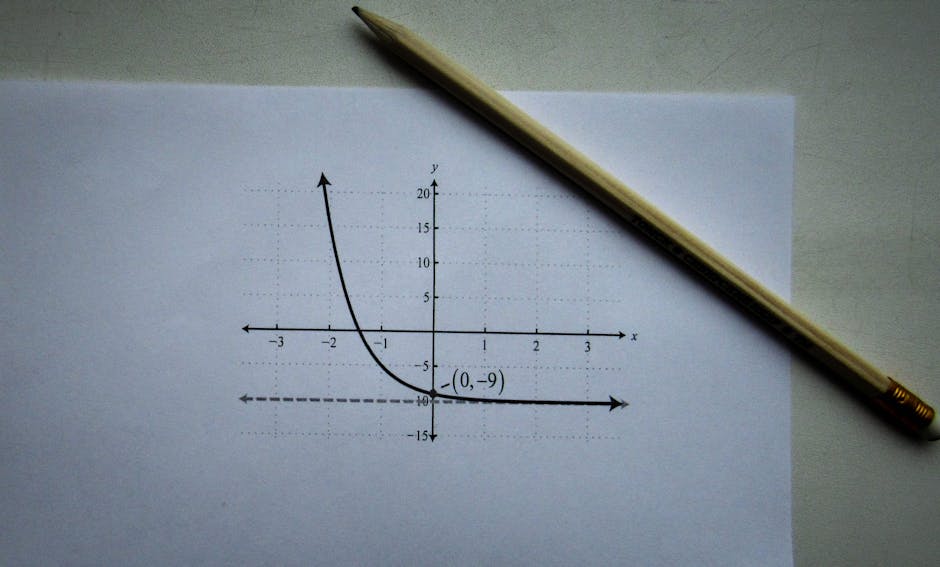
Photo by Sergey Meshkov on Pexels
A rational function is a ratio of two polynomials, $f(x) = \frac{P(x)}{Q(x)}$, where $Q(x) \neq 0$.
* Vertical Asymptotes: Occur where the denominator $Q(x)=0$ and the numerator $P(x) \neq 0$.
* Horizontal Asymptotes: Determined by comparing the degrees of $P(x)$ and $Q(x)$.
* Degree of $P(x) < $ Degree of $Q(x) \implies y=0$.
* Degree of $P(x) = $ Degree of $Q(x) \implies y=\frac{\text{leading coefficient of } P(x)}{\text{leading coefficient of } Q(x)}$.
* Degree of $P(x) > $ Degree of $Q(x) \implies$ no horizontal asymptote, possibly a slant (oblique) asymptote.
* Holes: Occur if a factor cancels out from both the numerator and denominator.
Radical Functions
Photo by Shubham Dhage on Pexels
These involve roots, like $f(x) = \sqrt{x}$ or $f(x) = \sqrt[3]{x-2}$.
* Domain: For even roots (square root, fourth root), the radicand (expression under the root) must be non-negative. For odd roots, the domain is all real numbers.
* Solving Radical Equations: Isolate the radical, then raise both sides to the power of the index to eliminate the radical. Always check for extraneous solutions!
Exponential and Logarithmic Functions
Photo by Nothing Ahead on Pexels
- Exponential: $f(x) = a \cdot b^x$, where $b>0, b \neq 1$. Used for growth/decay.
- Has a horizontal asymptote.
- Logarithmic: $f(x) = \log_b x$, the inverse of $f(x) = b^x$.
- Has a vertical asymptote.
- Key properties: $\log_b (xy) = \log_b x + \log_b y$, $\log_b (x/y) = \log_b x - \log_b y$, $\log_b x^p = p \log_b x$.
Systems of Advanced Functions
Solving systems means finding the points $(x,y)$ where the graphs of the functions intersect.
graph TD
    Start["Begin with the system"]
    IdentifyFunctionTypes["Identify the types of functions involved"]
    ChooseMethod["Choose an appropriate solution method"]
    Substitution["Substitution Method (Isolate one variable, substitute into other equation)"]
    Elimination["Elimination Method (For linear or certain polynomial systems)"]
    Graphical["Graphical Method (Plot functions, find intersections)"]
    AlgebraicSolve["Algebraically solve the resulting equation"]
    CheckSolutions["Check solutions in all original equations (especially for radicals/rationals)"]
    Solution["State the solution set (x,y points)"]

    Start --> IdentifyFunctionTypes
    IdentifyFunctionTypes --> ChooseMethod
    ChooseMethod --> Substitution
    ChooseMethod --> Elimination
    ChooseMethod --> Graphical

    Substitution --> AlgebraicSolve
    Elimination --> AlgebraicSolve
    Graphical --> CheckSolutions
    AlgebraicSolve --> CheckSolutions
    CheckSolutions --> Solution
- Substitution: Often the most versatile for non-linear systems. Solve one equation for one variable and substitute that expression into the other equation.
- Graphical: Graph both functions on the same coordinate plane and identify their intersection points. This is great for visualizing, but algebraic methods are needed for exact solutions.
- Elimination: Sometimes possible if you can manipulate equations to eliminate a variable, especially if they share common terms.
3. Worked Example
Let's solve the system:
1. $y = x^2 - 4$ (a parabola)
2. $y = 2x - 1$ (a line)
Since both equations are already solved for $y$, we can set them equal to each other:
$x^2 - 4 = 2x - 1$
Now, rearrange into a standard quadratic form:
$x^2 - 2x - 4 + 1 = 0$
$x^2 - 2x - 3 = 0$
Factor the quadratic equation:
$(x-3)(x+1) = 0$
This gives us two possible $x$-values for the intersections:
$x - 3 = 0 \implies x = 3$
$x + 1 = 0 \implies x = -1$
Now, substitute these $x$-values back into either original equation to find the corresponding $y$-values. Let's use $y = 2x - 1$:
For $x=3$:
$y = 2(3) - 1 = 6 - 1 = 5$
So, one intersection point is $(3, 5)$.
For $x=-1$:
$y = 2(-1) - 1 = -2 - 1 = -3$
So, the other intersection point is $(-1, -3)$.
The solution to the system is the set of points: $\{(3, 5), (-1, -3)\}$.
4. Key Takeaways
- Higher degree polynomials have properties (roots, turning points, end behavior) determined by their degree and leading coefficient.
- Rational functions introduce vertical asymptotes, horizontal asymptotes, and sometimes holes, which are crucial for graphing.
- Radical functions require careful attention to domain restrictions and checking for extraneous solutions after solving.
- Exponential and logarithmic functions are inverses and model growth/decay, with distinct asymptotes.
- Solving systems of advanced functions often involves substitution to reduce to a single, solvable equation.
- Graphing is a great way to visualize solutions for systems, but algebraic methods provide exact answers.
Common Mistakes to Avoid:
- Forgetting to check for extraneous solutions when solving radical or rational equations.
- Incorrectly determining the domain of radical functions, especially even roots.
- Misapplying rules for horizontal asymptotes in rational functions.
- Not identifying all intersection points when solving systems algebraically.
5. Now Try It
Solve the following system algebraically:
1. $y = \sqrt{x+2}$
2. $y = x$
What to do: Set the two expressions for $y$ equal to each other, solve the resulting equation for $x$, and then find the corresponding $y$-values. Remember to check for extraneous solutions.
What success looks like: You should find one valid ordered pair $(x,y)$ that satisfies both equations.
Frequently asked about Advanced Functions and Systems
More from Honors Algebra 2
Get the full Honors Algebra 2 curriculum
Clone the complete plan to your dashboard for unlimited AI-generated notes, practice quizzes, and a personalised revision schedule.
Save this course free