Rational Expressions and Functions
From the Honors Algebra 2 curriculum
TL;DR
Rational expressions are essentially fractions where the numerator and denominator are polynomials; you'll learn to simplify, operate on, and solve equations involving them. Understanding these expressions is crucial for graphing rational functions, which often have interesting features like asymptotes. Mastering the basics here will help you tackle more complex algebraic and calculus concepts later on.
1. The Mental Model
Think of rational expressions as grown-up fractions. Just like you can add, subtract, multiply, and divide regular fractions, you can do the same with these polynomial fractions. The big difference is you'll need to pay close attention to which values make the denominator zero, as those values are not allowed.
2. The Core Material
What is a Rational Expression?

Photo by Ann H on Pexels
A rational expression is a fraction $\frac{P(x)}{Q(x)}$ where $P(x)$ and $Q(x)$ are polynomials, and $Q(x)$ cannot be zero. The most important thing here is remembering that you can never divide by zero. This means you must always identify the excluded values (also called restricted values or non-permissible values) for $x$ that make the denominator zero.
Simplifying Rational Expressions

Photo by Vanessa Garcia on Pexels
To simplify a rational expression, you factor both the numerator and the denominator, and then cancel out any common factors.
Example:
Simplify $\frac{x^2 - 4}{x^2 + 5x + 6}$
- Factor: Numerator: $(x-2)(x+2)$. Denominator: $(x+2)(x+3)$.
- Identify Excluded Values: $x+2 \neq 0 \implies x \neq -2$. $x+3 \neq 0 \implies x \neq -3$.
- Cancel Common Factors: $\frac{(x-2)\cancel{(x+2)}}{\cancel{(x+2)}(x+3)} = \frac{x-2}{x+3}$
Simplified expression: $\frac{x-2}{x+3}$, where $x \neq -2, -3$.
Operations with Rational Expressions
Photo by Vanessa Garcia on Pexels
- Multiplication: Factor all numerators and denominators, then cancel common factors before multiplying.
- Division: "Keep, Change, Flip." Keep the first fraction, change division to multiplication, and flip the second fraction (reciprocal). Then proceed as with multiplication.
- Addition/Subtraction: Just like regular fractions, you need a common denominator. Find the Least Common Denominator (LCD) by factoring all denominators and taking the highest power of each unique factor. Then rewrite each expression with the LCD, and combine the numerators.
Rational Functions
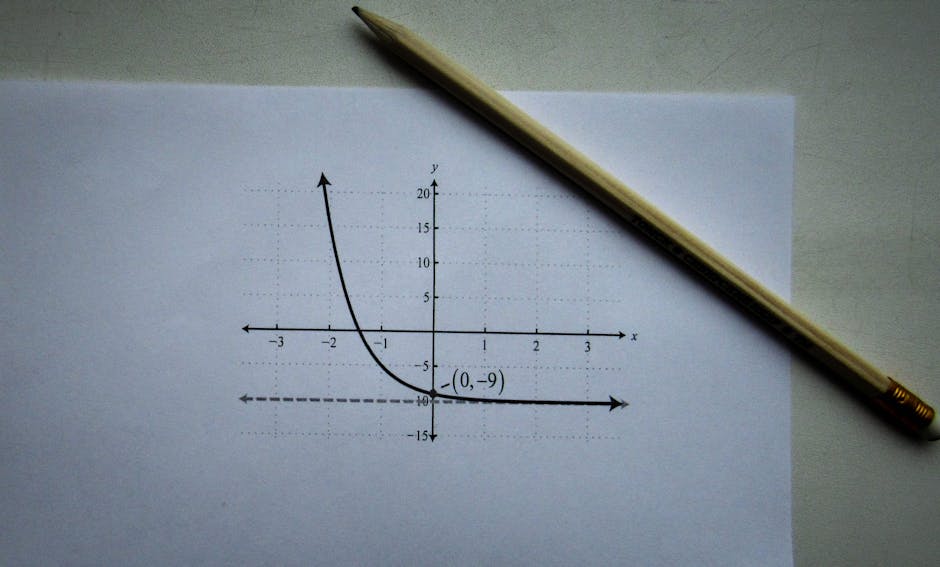
Photo by Sergey Meshkov on Pexels
A rational function is a function $f(x) = \frac{P(x)}{Q(x)}$. Graphing these functions introduces some cool features:
- Vertical Asymptotes: Occur at excluded values (where the denominator is zero) after the expression has been simplified, meaning the factor causing zero isn't cancelled. These are vertical lines the graph approaches but never touches.
- Holes (Removable Discontinuities): Occur at excluded values where the factor causing zero does cancel out during simplification. There's a "hole" in the graph at that x-value.
- Horizontal Asymptotes: Depend on the degrees of the numerator ($n$) and denominator ($m$):
- If $n < m$: Horizontal asymptote at $y=0$.
- If $n = m$: Horizontal asymptote at $y = \frac{\text{leading coefficient of numerator}}{\text{leading coefficient of denominator}}$.
- If $n > m$: No horizontal asymptote, but potentially a slant (oblique) asymptote (if $n = m+1$), found by polynomial long division.
Here's a flowchart to help you identify discontinuities:
graph TD
    A["Start with Rational Function f(x) = P(x)/Q(x)"] --> B["Factor P(x) and Q(x)"]
    B --> C{"Are there factors common to P(x) and Q(x)?"}
    C -- "Yes" --> D["Set common factors to 0"]
    D --> E["Solve for x"]
    E --> F["Result: Hole at x-value (Removable Discontinuity)"]
    C -- "No" --> G{"Are there factors in Q(x) not common to P(x)?"}
    G -- "Yes" --> H["Set unique Q(x) factors to 0"]
    H --> I["Solve for x"]
    I --> J["Result: Vertical Asymptote at x-value (Non-removable Discontinuity)"]
    J --> K["Check degrees of P(x) and Q(x) for Horizontal/Slant Asymptote"]
    F --> K
    K --> L["End"]
3. Worked Example
Let's analyze the rational function $f(x) = \frac{x^2 - 1}{x^2 - 2x - 3}$.
-
Factor:
$f(x) = \frac{(x-1)(x+1)}{(x-3)(x+1)}$ -
Identify Excluded Values (from original denominator):
$(x-3)(x+1) = 0 \implies x=3$ or $x=-1$. These are the values $x$ cannot be. -
Simplify (cancel common factors):
$f(x) = \frac{(x-1)\cancel{(x+1)}}{(x-3)\cancel{(x+1)}} = \frac{x-1}{x-3}$ (for $x \neq -1$) -
Identify Discontinuities:
- Hole: Since $(x+1)$ cancelled, there's a hole at $x=-1$. To find the y-coordinate of the hole, plug $x=-1$ into the simplified expression: $y = \frac{-1-1}{-1-3} = \frac{-2}{-4} = \frac{1}{2}$. So, there's a hole at $(-1, \frac{1}{2})$.
- Vertical Asymptote: The factor $(x-3)$ remains in the denominator after simplification. So, there's a vertical asymptote at $x=3$.
-
Identify Horizontal Asymptote:
The degree of the numerator ($n=2$) is equal to the degree of the denominator ($m=2$). So, the horizontal asymptote is at $y = \frac{\text{leading coefficient of numerator}}{\text{leading coefficient of denominator}} = \frac{1}{1} = 1$. So, $y=1$ is the horizontal asymptote.
4. Key Takeaways
- Always find excluded values by setting the original denominator to zero before simplifying.
- To simplify, factor both numerator and denominator completely and cancel common factors.
- A common factor that cancels out indicates a hole in the graph at that x-value.
- A factor remaining in the denominator after simplification indicates a vertical asymptote at that x-value.
- Horizontal asymptotes depend on comparing the degrees of the numerator and denominator.
- Operations (add, subtract, multiply, divide) follow similar rules to numerical fractions, with extra attention to factoring and common denominators.
Common Mistakes to Avoid:
- Cancelling terms that aren't factors (e.g., cancelling $x$ in $\frac{x+1}{x+2}$). You can only cancel factors.
- Forgetting to state excluded values after simplifying.
- Incorrectly finding a common denominator for addition/subtraction.
- Mixing up when to look for holes vs. vertical asymptotes.
5. Now Try It
Take the function $g(x) = \frac{x^2 + x - 6}{x^2 - 4}$. Find all excluded values, simplify the expression, identify any holes and vertical asymptotes, and determine the horizontal asymptote.
Success looks like: Clearly listing excluded values, providing the correct simplified expression, stating the coordinates of any hole(s), and giving the equations for all asymptotes.
Frequently asked about Rational Expressions and Functions
More from Honors Algebra 2
Get the full Honors Algebra 2 curriculum
Clone the complete plan to your dashboard for unlimited AI-generated notes, practice quizzes, and a personalised revision schedule.
Save this course free