Foundations of Functions and Equations
From the Honors Algebra 2 curriculum
TL;DR
This topic is all about understanding what functions and equations are, how they behave, and the different ways to represent them. We'll cover key concepts like domain and range, how to evaluate functions, and methods for solving various types of equations. Mastering these basics will build a strong foundation for more advanced algebra.
1. The Mental Model
Think of a function as a reliable machine: you put something in (an input), and it always gives you exactly one specific thing out (an output). Equations are like mathematical statements that declare two expressions are equal, and often, your goal is to find the values that make that statement true.
2. The Core Material
What's a Function?

Photo by Efrem Efre on Pexels
A function is a special type of relation where each input has exactly one output. Imagine you have a rule that says "double the number." If you input 3, the output is always 6. It's never 5 or 7.
- Input (Domain): The set of all possible values you can put into the function.
- Output (Range): The set of all possible values you get out of the function.
- Vertical Line Test: If you can draw a vertical line anywhere on a graph and it touches the graph more than once, it's NOT a function. This is because a single x-value (input) would have multiple y-values (outputs).
How to Represent Functions

Photo by Ann H on Pexels
Functions can be shown in several ways:
- Equation: Like $f(x) = 2x + 1$. Here, $f(x)$ means "the function of x" or "the output when the input is x."
- Table of Values: A list of (input, output) pairs.
- Graph: A visual representation on a coordinate plane.
- Mapping Diagram: Shows inputs pointing to their corresponding outputs.
Evaluating Functions
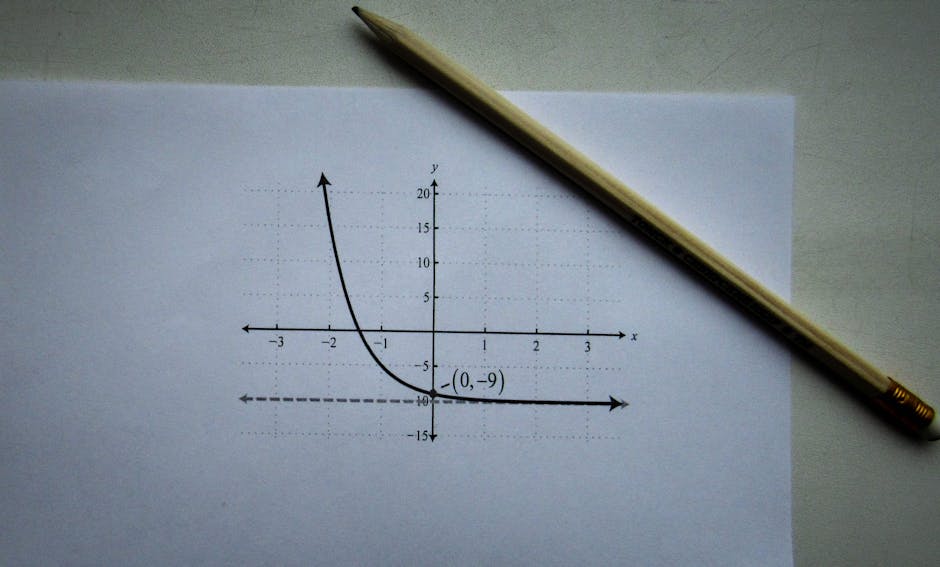
Photo by Sergey Meshkov on Pexels
This just means finding the output of a function for a specific input.
Example: If $f(x) = x^2 - 3x$, find $f(4)$.
* Substitute 4 for every $x$: $f(4) = (4)^2 - 3(4)$
* Calculate: $f(4) = 16 - 12 = 4$. So, when the input is 4, the output is 4.
Understanding Equations

Photo by Vanessa Garcia on Pexels
An equation is a mathematical statement showing that two expressions are equal. For example, $2x + 5 = 11$. The goal is usually to find the value(s) of the variable(s) that make the equation true. These values are called the solution(s).
Types of Equations (and how to approach them)
- Linear Equations: Variables raised to the power of 1 (e.g., $3x + 7 = 16$).
- Strategy: Isolate the variable using inverse operations (addition/subtraction, multiplication/division).
- Quadratic Equations: Variables raised to the power of 2 (e.g., $x^2 - 5x + 6 = 0$).
- Strategy: Factor, use the quadratic formula, or complete the square. You'll often get two solutions.
- Absolute Value Equations: Involve the absolute value of an expression (e.g., $|x - 3| = 5$).
- Strategy: Set the expression inside the absolute value equal to both the positive and negative value of the other side. You'll usually get two solutions.
- Radical Equations: Involve a variable under a radical symbol (e.g., $\sqrt{x + 2} = 4$).
- Strategy: Isolate the radical, then raise both sides to the power of the index (square for square root, cube for cube root, etc.). Always check for extraneous solutions!
- Rational Equations: Involve variables in the denominator of a fraction (e.g., $\frac{2}{x} + \frac{1}{3} = \frac{5}{6}$).
- Strategy: Find a common denominator, multiply to clear the denominators, and solve the resulting equation. Watch out for values that make the denominator zero!
Here's a flowchart to help visualize the steps for solving different equation types:
graph TD
    A["Start: Identify Equation Type"] --> B{Is it Linear?};
    B -- Yes --> C["Isolate Variable (Add/Subtract, Multiply/Divide)"];
    B -- No --> D{Is it Quadratic?};
    D -- Yes --> E["Factor, Quadratic Formula, or Complete the Square"];
    D -- No --> F{Is it Absolute Value?};
    F -- Yes --> G["Set expression equal to +/- value"];
    F -- No --> H{Is it Radical?};
    H -- Yes --> I["Isolate Radical, Square/Cube Both Sides"];
    I --> J["Check for Extraneous Solutions"];
    H -- No --> K{Is it Rational?};
    K -- Yes --> L["Clear Denominators (LCM), Solve"];
    L --> M["Check for Denominator = 0"];
    C --> N["Solution Found"];
    E --> N;
    G --> N;
    J --> N;
    M --> N;
Domain Restrictions
Sometimes, certain inputs just don't make sense for a function or equation. These are called domain restrictions.
- No dividing by zero: If you have a variable in the denominator, set the denominator equal to zero to find the values that are NOT allowed.
- No negative numbers under an even root: If you have a square root (or 4th root, etc.) of an expression, that expression must be greater than or equal to zero.
3. Worked Example
Let's solve a rational equation and check its domain.
Equation: $\frac{3}{x+2} + \frac{1}{x} = \frac{7}{x(x+2)}$
Step 1: Identify Domain Restrictions.
* From $x+2$: $x+2 \neq 0 \implies x \neq -2$.
* From $x$: $x \neq 0$.
* From $x(x+2)$: This covers both $x \neq 0$ and $x \neq -2$.
So, $x$ cannot be $0$ or $-2$.
Step 2: Find a Common Denominator.
The least common multiple (LCM) of the denominators is $x(x+2)$.
Step 3: Multiply each term by the common denominator to clear the fractions.
$x(x+2) \left(\frac{3}{x+2}\right) + x(x+2) \left(\frac{1}{x}\right) = x(x+2) \left(\frac{7}{x(x+2)}\right)$
$3x + (x+2) = 7$
Step 4: Solve the resulting linear equation.
$3x + x + 2 = 7$
$4x + 2 = 7$
$4x = 5$
$x = \frac{5}{4}$
Step 5: Check if the solution is valid (not one of the restricted values).
Our solution $x = \frac{5}{4}$ is not $0$ or $-2$. So, it's a valid solution.
4. Key Takeaways
- A function assigns exactly one output for every input.
- You can represent functions using equations, tables, graphs, or mapping diagrams.
- The domain is all possible inputs, and the range is all possible outputs.
- Evaluating a function means finding its output for a given input.
- Equations are statements of equality, and solving them means finding the values that make the statement true.
- Always be aware of domain restrictions, especially when dealing with variables in denominators or under even roots.
- Use inverse operations to isolate variables when solving linear equations.
- Quadratic equations often have two solutions, found by factoring, using the quadratic formula, or completing the square.
Common Mistakes to Avoid:
- Forgetting to check for extraneous solutions in radical or rational equations.
- Not accounting for both positive and negative cases when solving absolute value equations.
- Confusing the domain with the range or vice-versa.
- Assuming division by zero is allowed – it's a major no-no!
5. Now Try It
Exercise:
Given the function $g(x) = \frac{\sqrt{x-3}}{x-5}$.
1. Find the domain of $g(x)$.
2. Evaluate $g(7)$.
What success looks like:
For part 1, you should identify two types of restrictions and combine them to state the valid interval for $x$. For part 2, you should substitute 7 into the function and simplify to get a single numerical output.
Frequently asked about Foundations of Functions and Equations
More from Honors Algebra 2
Get the full Honors Algebra 2 curriculum
Clone the complete plan to your dashboard for unlimited AI-generated notes, practice quizzes, and a personalised revision schedule.
Save this course free