Introduction to Cell Structure and Function
From the AP Biology curriculum
TL;DR
Cells are the fundamental units of life, categorized as prokaryotic (simpler, no nucleus) or eukaryotic (complex, with a nucleus and organelles). Understanding their basic structures and functions is crucial for grasping all biological processes.
1. The Mental Model
Think of a cell like a tiny, self-contained city: it has a boundary (cell membrane), a control center (nucleus in eukaryotes), power plants (mitochondria), factories (ribosomes), and transport systems, all working together to keep it alive.
2. The Core Material
You're about to dive into the amazing world of cells! Every living thing, from the smallest bacterium to the largest whale, is made of cells. There are two main types you'll need to know: prokaryotic cells and eukaryotic cells.
Prokaryotic Cells

Photo by turek on Pexels
These are the older, simpler cells. They're usually much smaller than eukaryotic cells and lack a true nucleus or other membrane-bound organelles. Think of them as minimalist architects – they have what they need, but nothing fancy.
- Key features:
- No nucleus; genetic material (DNA) floats in a region called the nucleoid.
- No membrane-bound organelles (like mitochondria or ER).
- Have a cell wall (outside the plasma membrane) for protection and shape.
- Have a plasma membrane that controls what goes in and out.
- Contain cytoplasm (the jelly-like substance filling the cell) and ribosomes (for making proteins).
- Examples: Bacteria and Archaea.
Eukaryotic Cells
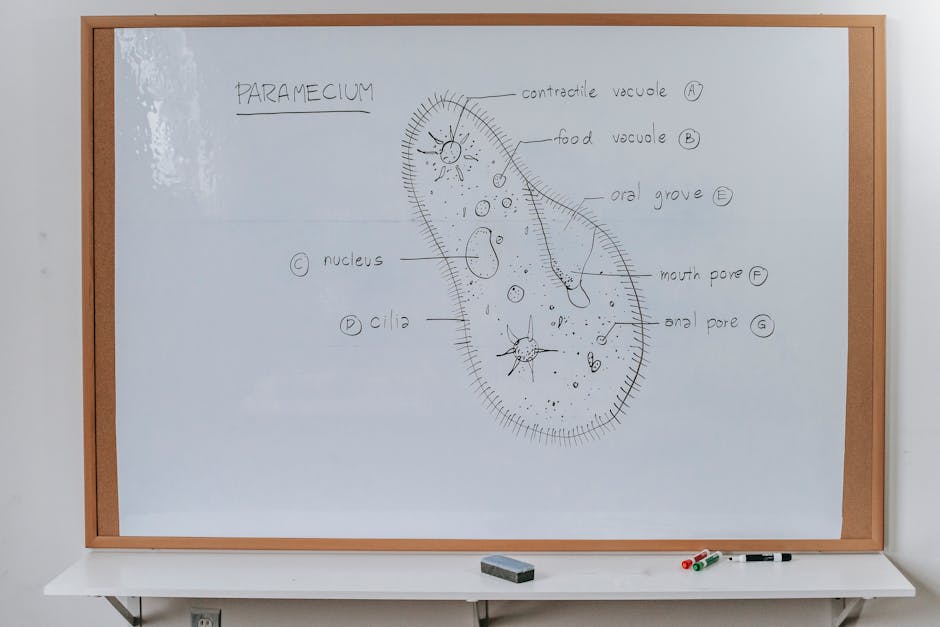
Photo by Katerina Holmes on Pexels
These are the "complex" cells, including all animal, plant, fungal, and protist cells. They're characterized by having a true nucleus and many specialized, membrane-bound organelles.
- Key features:
- Nucleus: Houses the cell's DNA, acting as the control center.
- Plasma membrane: Selectively permeable boundary.
- Cytoplasm/Cytosol: Jelly-like substance filling the cell, where organelles are suspended.
- Mitochondria: The "powerhouses" – produce ATP through cellular respiration.
- Endoplasmic Reticulum (ER): Network of membranes involved in protein and lipid synthesis.
- Rough ER: Has ribosomes; involved in protein synthesis and modification for secretion or insertion into membranes.
- Smooth ER: No ribosomes; involved in lipid synthesis, detoxification, and calcium storage.
- Golgi Apparatus: Modifies, sorts, and packages proteins and lipids from the ER for secretion or delivery to other organelles.
- Lysosomes: (Mainly animal cells) Contain digestive enzymes to break down waste and cellular debris.
- Vacuoles: (Prominent in plant cells) Storage, waste removal, and maintaining turgor pressure.
- Chloroplasts: (Plant cells and some protists) Site of photosynthesis.
- Cell Wall: (Plant cells, fungi, some protists) Provides structural support and protection outside the plasma membrane.
- Ribosomes: (Found in both types, but are not membrane-bound organelles) Site of protein synthesis.
Comparing Prokaryotic and Eukaryotic Cells
Photo by turek on Pexels
Here's a simple diagram to help you visualize the main differences:
graph TD
    A["Cell Types"] --> P["Prokaryotic Cells"]
    A --> E["Eukaryotic Cells"]

    P --> P1["No true nucleus"]
    P --> P2["DNA in nucleoid region"]
    P --> P3["No membrane-bound organelles"]
    P --> P4["Smaller size"]
    P --> P5["Simple internal structure"]
    P --> P6["Examples: Bacteria, Archaea"]

    E --> E1["True nucleus (DNA enclosed)"]
    E --> E2["Membrane-bound organelles"]
    E --> E3["Larger size"]
    E --> E4["Complex internal structure"]
    E --> E5["Examples: Animals, Plants, Fungi, Protists"]

    P1 -- "Both have" --> C1["Plasma membrane"]
    P2 -- "Both have" --> C2["Cytoplasm"]
    P3 -- "Both have" --> C3["Ribosomes"]
3. Worked Example
Imagine you're looking at a microscopic image of a new single-celled organism. It's relatively small, and you can see a cell wall, a plasma membrane, and ribosomes, but no obvious internal compartments or a centralized nucleus. This organism's genetic material seems to be free-floating within the cell.
Based on these observations, you'd conclude it's a prokaryotic cell. The key indicators are its small size, the presence of a cell wall, and, most importantly, the absence of a true nucleus and membrane-bound organelles. If it were eukaryotic, you'd expect to see a clear nucleus and structures like mitochondria or an ER.
4. Key Takeaways
- Cells are the basic structural and functional units of all known organisms.
- Prokaryotic cells are simpler, lack a nucleus, and have no membrane-bound organelles.
- Eukaryotic cells are more complex, possess a true nucleus, and contain various membrane-bound organelles.
- The plasma membrane controls movement of substances in and out of all cells.
- Ribosomes are essential for protein synthesis in both prokaryotic and eukaryotic cells.
- Plant cells have a cell wall and chloroplasts, which are absent in animal cells.
Common mistakes to avoid:
- Don't confuse the nucleoid region in prokaryotes with a true nucleus.
- Remember that ribosomes are not membrane-bound organelles, so they are present in both cell types.
- Don't forget that both prokaryotes and eukaryotes have a plasma membrane, cytoplasm, and genetic material.
- Don't assume all cells with a cell wall are prokaryotes; plant cells and fungi also have cell walls.
5. Now Try It
Take 15 minutes to sketch a simple animal cell and a plant cell. Label at least five major organelles unique to each or prominently different between them. Then, list two functions for each of those labeled organelles. When you're done, check your sketches against a textbook diagram to see how well you did.
Frequently asked about Introduction to Cell Structure and Function
More from AP Biology
Get the full AP Biology curriculum
Clone the complete plan to your dashboard for unlimited AI-generated notes, practice quizzes, and a personalised revision schedule.
Save this course free